
 AU
AU
 CA
CA
 US
US
 NZ
NZ
 IND
IND

 UK
UK

 Share
Share
 X (Formerly Twitter)
 Whatsapp
 Facebook
 LinkedIn
 Telegram
 Email This Article
 Copy Link
 Summarize with AI
 Chat GPT
 Perplexity
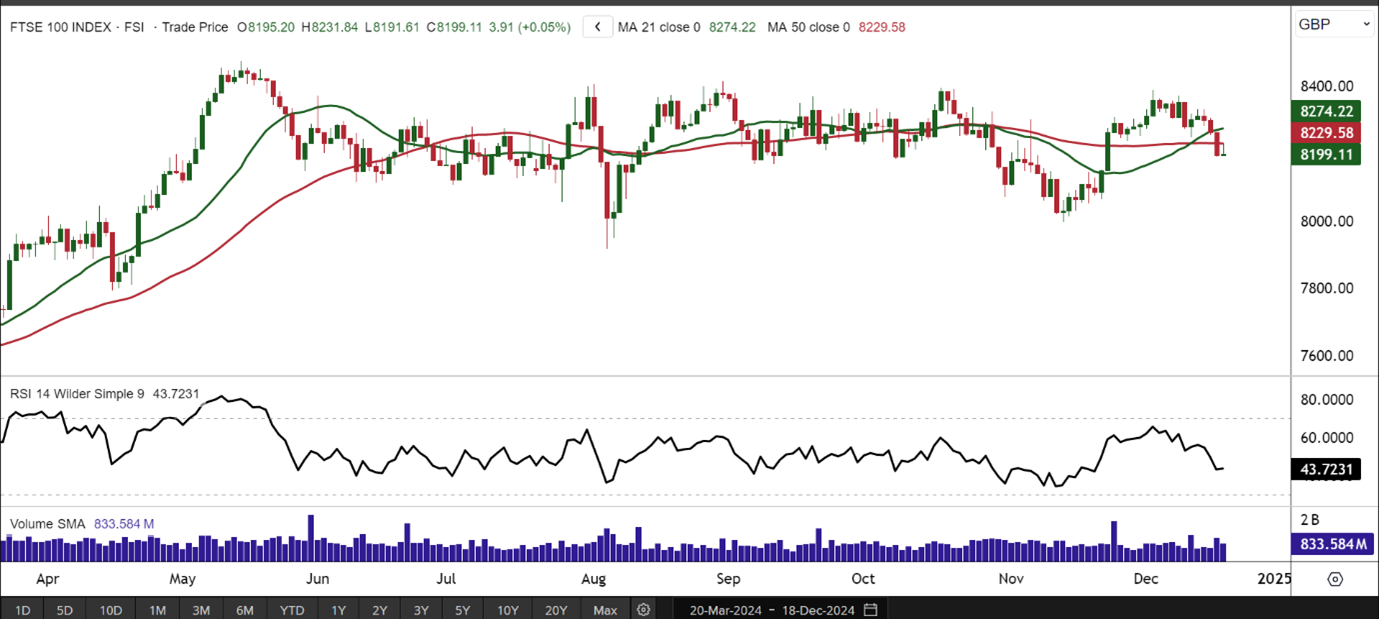
Image Source: Krish Capital Pty Ltd
Index Update: The FTSE 100 index, a key benchmark index for the London stock exchange, went down around 1.38% on 19 December 2024. Energy, Real Estate, & Financials sector faced a significant growth. Moreover, sectors such as Industrials, Real Estate & Basic Materials witnessed a substantial decline.
Macro Update: The Bank of England is set to maintain interest rates at 4.75%, reflecting its cautious approach amid persistent inflation pressures despite signs of an economic slowdown. Economists polled by Reuters unanimously expect rates to remain unchanged for now, with the first quarter-point cut anticipated in February 2025, followed by additional reductions later in the year. Concurrently, Britain's water regulator, Ofwat, approved a 36% increase in water bills over the next five years to support much-needed infrastructure improvements in the struggling water sector. This rise is lower than the 44% requested by companies but higher than the initial 21% proposed by the regulator in July. Sterling showed slight recovery on Thursday after a sharp drop caused by the U.S. Federal Reserve's decision to adjust its rate cut projections, with UK market focus firmly on the Bank of England’s expected decision.
Top Market Movers: Among top gainers on FTSE 100 index, Severn Trent PLC (LSE: SVT) witnessed a rise of 1.57% followed by United Utilities Group PLC (LSE: UU.) which gained around 0.98%.
Commodity Update: The U.S. dollar approached a two-year high after the Federal Reserve signalled a slower pace of rate cuts in 2025, with FED Chairman Jerome Powell emphasizing that future reductions depend on progress in controlling inflation. Policymakers now forecast two 25 basis point cuts next year, down from the previous expectation of four. Meanwhile, the yen weakened to a one-month low ahead of a Bank of Japan policy decision. In commodities, gold fell 1.09% to $2,624.30, silver dropped 2.60% to $29.94, copper declined 1.04% to $8,953.50, and oil prices were stable, with Brent crude at $73.06 per barrel.
Our Stance: The Federal Reserve's recent quarter-point interest rate cut to 4.25%-4.5% was anticipated; however, its indication of a slower pace for future reductions in 2025 has unsettled global markets. Fed Chair Jerome Powell emphasized the need for caution, linking further cuts to tangible progress in reducing inflation. This stance led to significant declines in U.S. stock indices, with the S&P 500 experiencing its largest daily drop in months. The Fed's cautious approach has also influenced other central banks. The Bank of Japan (BOJ) maintained its short-term policy rate at 0.25%, expressing concerns about potential economic uncertainties under the incoming Trump administration. This decision contributed to a depreciation of the yen against the dollar. The Fed's policy shift has broader implications, potentially affecting global economic stability and influencing decisions by other central banks. The cautious stance suggests a focus on controlling inflation, which may impact economic growth and market dynamics worldwide.
FTSE 100
The FTSE 100 closed at 8,199.11, posting a modest gain of 0.05%, despite forming a bullish candlestick pattern. This suggests that while investor sentiment remains cautious following the Federal Reserve’s recent rate decision, attention now turns to the upcoming Bank of England (BoE) rate decision. The index continues to trade below its 50-period Simple Moving Average (SMA), a key resistance level, which signals that downward pressure could persist. The Relative Strength Index (RSI) stands at 43.72, indicating bearish momentum with a slight bias towards continued bearishness. On the weekly chart, the FTSE 100 saw a slight decline of 0.10%, closing at 8,300.33. Despite this, the index remains comfortably above the 50-period SMA at 8,047.08, with additional support found at 7,932. Immediate resistance is at the 8,400 level, and a breakout above this level could suggest a shift toward a more bullish trend. Conversely, a drop below 8,020 could signal further downside risks. Investors should monitor these critical levels closely, as the index remains in a range-bound phase, with the BoE’s decision likely to influence market direction in the near term.


 Jun 05, 2026




 Please wait processing your request...