
 AU
AU
 CA
CA
 US
US
 NZ
NZ
 IND
IND

 UK
UK

 Share
Share
 X (Formerly Twitter)
 Whatsapp
 Facebook
 LinkedIn
 Telegram
 Email This Article
 Copy Link
 Summarize with AI
 Chat GPT
 Perplexity
Index Update: The FTSE 100 index, a key benchmark index for the London stock exchange, went up around 0.29% on 23 December 2024. Sectors such as Real Estate, Technology & Basic Materials witnessed a substantial decline. Moreover, HealthCare, Utilities & Financials sector has faced a significant growth.
Macro Update: The British economy showed no growth in Q3 2024, with GDP estimates revised to 0.0% from 0.1%, while Q2 growth was also downgraded to 0.4% from 0.5%, signaling a slowdown under PM Keir Starmer's government. Bank of England Governor Andrew Bailey is set to accompany finance minister Rachel Reeves to China for the revival of high-level economic talks, frozen since 2019. The UK's FTSE 100 hit a one-month low, dropping 0.7% and logging a 3% weekly decline, with declines in personal goods, banks, and defence sectors, amid global market jitters over U.S. President-elect Trump's tariff comments on the EU. In positive news, Britain ran a smaller-than-expected budget deficit in November, at £11.249 billion compared to a forecast of £13 billion, partly due to lower interest on government bonds, easing some pressure on Reeves amid a challenging fiscal environment and a Bank of England forecast of zero growth for Q4 2024.
Top Market Movers: Among top gainers on FTSE 100 index, Airtel Africa PLC (LSE: AAF) witnessed a rise of 3.89% followed by AstraZeneca PLC (LSE: AZN) which gained around 1.58%.
Commodity Update: The dollar remained steady on Monday following a modest rise in U.S. inflation last month, easing concerns about the speed of upcoming rate cuts. Investor confidence increased after U.S. lawmakers passed a spending bill, avoiding a government shutdown. In the commodities market, gold dipped 0.14% to $2,641.40, while silver surged 0.88% to $30.22. Copper rose 0.40% to $8,991.50, and Brent crude climbed 0.40% to $73.20 per barrel. The positive economic data on inflation sparked hopes of further policy easing next year, boosting global growth prospects and supporting oil demandR.
Our Stance: Recent U.S. developments reflect the complex dynamics of fiscal policy, consumer behavior, and market trends. Congress averted a government shutdown with a stopgap funding bill extending operations through March 2025, while consumer spending rose 0.4% in November, showcasing economic resilience. Inflation eased slightly, with the PCE price index up just 0.1%, though year-over-year rates remain above the Federal Reserve's 2% target. The Fed cut interest rates to 4.25%-4.50% but signaled fewer cuts in 2025, prompting market volatility and casting doubt on a "Santa Claus rally" for December. As the new administration takes office, economic uncertainty persists, demanding cautious navigation of the evolving landscape.
FTSE 100
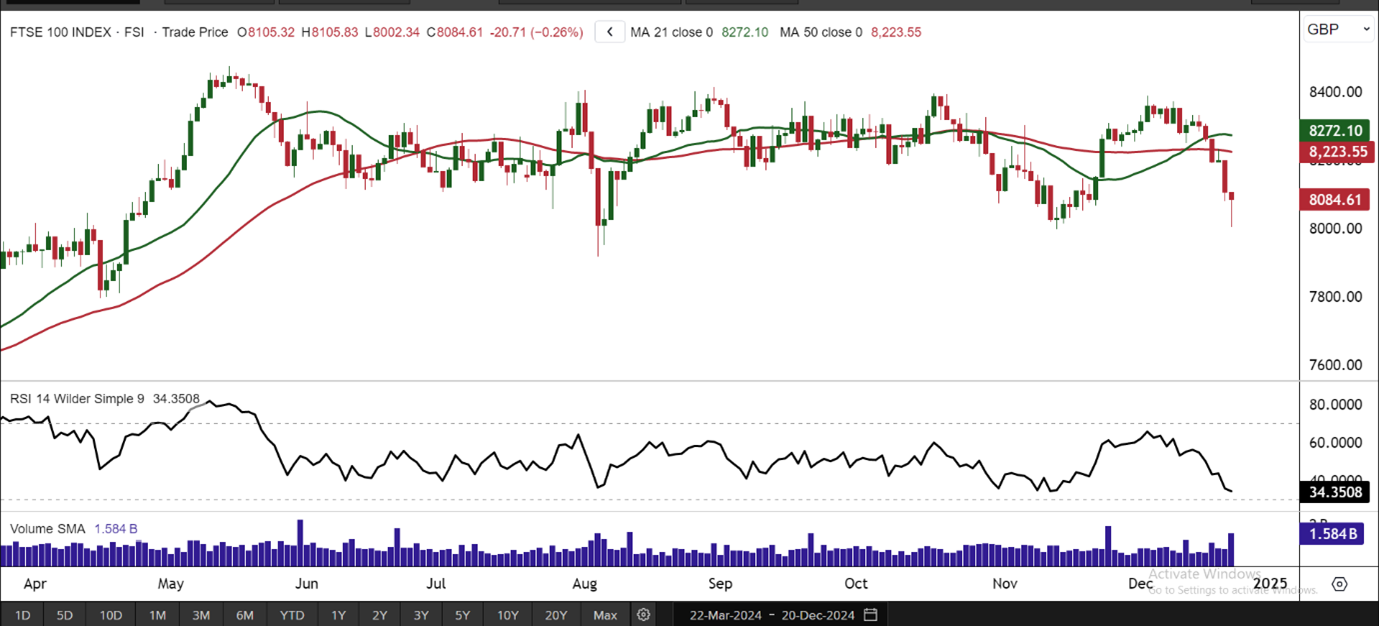
The FTSE 100 closed at 8,041.61 on Monday, down 0.20%, following a bearish candlestick pattern but holding strong support at 8,002.00, reflecting resilient investor sentiment after the U.S. inflation report. The index remains below its 50-period Simple Moving Average (SMA), signalling ongoing downward pressure in the near term. The Relative Strength Index (RSI) at 34.35 suggests bearish, with a slight negative bias. On the weekly chart, the FTSE 100 saw a modest decline of 2.60%, closing at 8,041.61. It ended above the 50-period SMA at 8,092.76, which provides some support, while a key level to watch is 7,932. Immediate resistance is at 8,400, and a breakout above this level could signal a potential shift toward a bullish trend. However, if the index falls below 8,020, it could signal further downside risks. Investors should closely monitor these key levels for clearer direction in the coming sessions.


 Jun 05, 2026




 Please wait processing your request...