
 AU
AU
 CA
CA
 US
US
 NZ
NZ
 IND
IND

 UK
UK

 Share
Share
 X (Formerly Twitter)
 Whatsapp
 Facebook
 LinkedIn
 Telegram
 Email This Article
 Copy Link
 Summarize with AI
 Chat GPT
 Perplexity
Image Souce: Krish Capital Pty Ltd
Index Update: The FTSE 100 index, a key benchmark index for the London stock exchange, went down around 0.01% on 20 November 2024. Technology, Basic Materials & Financials sector demonstrated a substantial growth. Moreover, sectors such as Real Estate, Consumer Cyclicals & Energy faced a significant decline.
Macro Update: British inflation rose unexpectedly to 2.3% in October, surpassing the Bank of England's 2% target, largely due to increased domestic energy tariffs. This uptick in inflation has led the BoE to tread cautiously on interest rate cuts, with financial markets adjusting expectations accordingly. Meanwhile, HSBC is revamping its "Premier" wealth banking brand in Britain, targeting mass affluent customers with enhanced services and benefits. Additionally, concerns have emerged over the accuracy of Britain's labor market statistics, potentially overstating unemployment figures and complicating the BoE's policy decisions. In a separate development, Ofgem has proposed an £8 billion investment fund to support the UK's net-zero goals and expedite energy transmission projects, aiming to reduce delays and costs.
Top Market Movers: Among top gainers on FTSE 100 index, Sage Group PLC (LSE: SGE) witnessed a rise of 19.11% followed by Severn Trent PLC (LSE: SVT) which gained around 3.53%.
Commodity Update: On Wednesday, the U.S. dollar lost some of its recent gains as investors were spooked by Ukraine's use of U.S. missiles in strikes on Russia, prompting fears of a potential nuclear escalation, although these concerns eased later. Attention also turned to former President Trump's selection of a Treasury Secretary as part of his team. In commodities, gold rose 0.48% to $2,643.75, silver gained 0.08% to $31.28, and copper increased 0.26% to $9,145 per ton. Brent crude edged up 0.1% to $73.40 a barrel, supported by tensions in Ukraine and growing Chinese crude imports, despite rising U.S. oil stocks.
Our Stance: European markets rebounded on Wednesday, with the STOXX 600 index rising 0.6% after a three-session decline, driven by gains in construction and banking sectors amid easing geopolitical concerns. In the U.S., the Nasdaq increased over 1%, and the S&P 500 closed higher on Tuesday, propelled by a surge in technology stocks as investors anticipated Nvidia's upcoming earnings report. Additionally, Walmart shares advanced following an upward revision of its annual forecasts. The recent uptick in both European and U.S. markets suggests a resurgence in investor confidence, particularly in sectors like technology and retail. This optimism is likely fueled by positive corporate earnings and a reduction in geopolitical tensions. However, investors should remain vigilant, as upcoming earnings reports and potential geopolitical developments could introduce volatility.
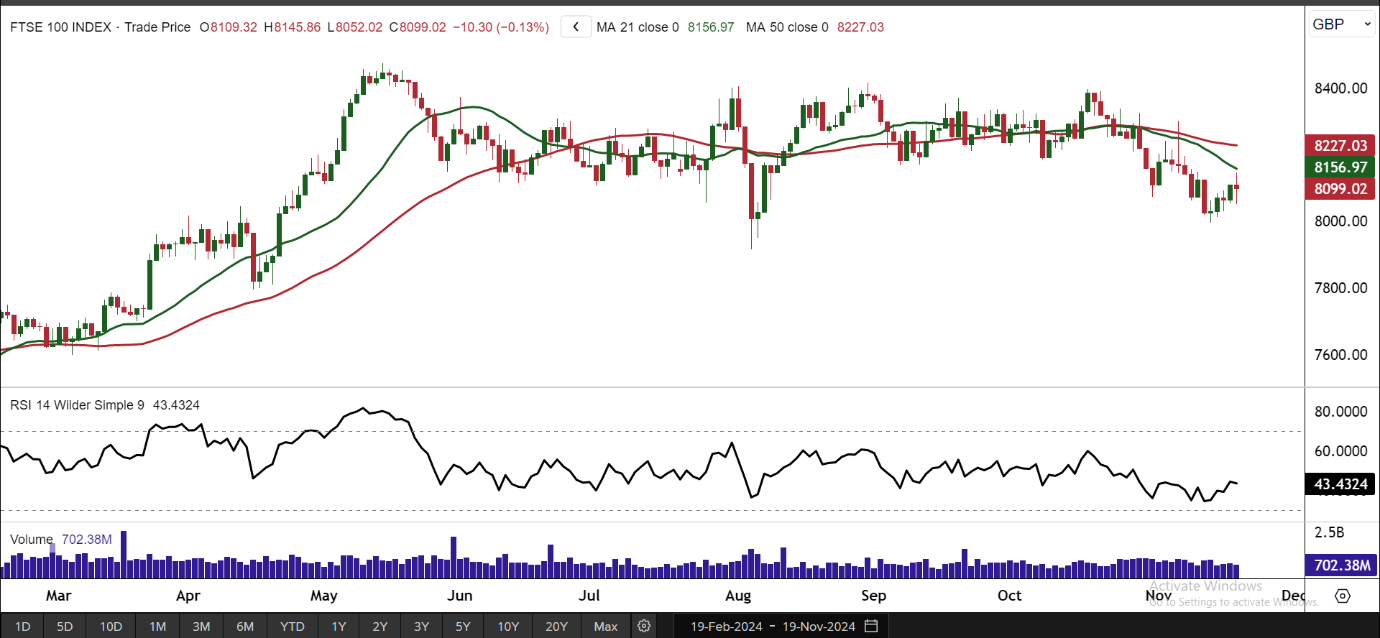
FTSE 100
The FTSE 100 closed at 8,099.02, down 0.13%, forming a bearish candlestick pattern that was further confirmed by rising volume, signaling a decline in investor sentiment. Despite this, the index remains below its 21-period Simple Moving Average (SMA), which acts as immediate resistance, limiting upside potential. The Relative Strength Index (RSI) stands at 43.43, recovering from oversold levels, indicating that the market may experience a potential bullish reversal or continuation, depending on how conditions evolve. On the weekly chart, the 50-period SMA provides a key support level around 8,032. Immediate resistance is found at 8,400, and a breakout above this level could indicate a shift toward a stronger bullish trend. However, if the index falls below 8,020, it could trigger further declines, with the next significant support at 7,932. Investors should monitor these critical levels as they will dictate whether the FTSE 100 enters a consolidation phase or faces additional weakness.


 Jun 05, 2026




 Please wait processing your request...