
 AU
AU
 CA
CA
 US
US
 NZ
NZ
 IND
IND

 UK
UK

 Share
Share
 X (Formerly Twitter)
 Whatsapp
 Facebook
 LinkedIn
 Telegram
 Email This Article
 Copy Link
 Summarize with AI
 Chat GPT
 Perplexity
Image Source : Krish Capital Pty Ltd
Index Update: The FTSE 100 index, a key benchmark index for the London stock exchange, went up around 0.69% on 15 January 2025. Real Estate, Financials & Utilities sector has witnessed a substantial growth. Moreover, Consumer Non-Cyclicals sector has faced a minor decline.
Macro Update: British inflation unexpectedly slowed to 2.5% in December, down from 2.6% in November, according to the Office for National Statistics, marking a sharper drop in core price growth closely monitored by the Bank of England. Economists had expected inflation to hold steady, but many analysts now predict it could surpass 3% in early 2025, with finance minister Rachel Reeves acknowledging the need for further action. UK banks are grappling with tighter profit margins and increased risks in mortgage lending, driven by rising swap costs and market concerns over Britain’s fiscal rules amid high government borrowing costs. Concurrently, two-thirds of British retailers plan to raise prices in 2025 to offset higher employer social security costs introduced by the new Labour government, with nearly half also considering reducing staff hours and headcounts.
Top Market Movers: Among top gainers on FTSE 100 index, Diploma PLC (LSE: DPLM) witnessed a rise of 4.31% followed by Lloyds Banking Group PLC (LSE: LLOY) which gained around 3.58%.
Commodity Update: The dollar’s strong rally encountered a setback on Wednesday as traders turned cautious ahead of the U.S. consumer inflation report, leading to reluctance to take on new positions. The dollar’s decline was largely due to December’s producer price index (PPI) data, which was softer than expected, fueling optimism that inflation may ease. This raised hopes that the Federal Reserve could have more room to cut interest rates. In commodities, gold rose 0.28% to $2,689.80, while silver gained 0.28% to $30.43. Copper fell 0.34%, reaching $9,122.50. Brent crude remained steady at $79.95, holding near a four-month high.
Our Stance: Emerging market currencies and stocks remained flat, reflecting investor caution ahead of a critical U.S. inflation report, which could influence borrowing costs in the world's largest economy. A strong U.S. jobs report last week dampened expectations of multiple rate cuts, strengthening the dollar and Treasury yields, while pressuring emerging market assets. Economists at ING anticipate a higher core inflation reading, potentially unsettling investors, particularly as concerns over upcoming tariffs loom. This reflects a broader cautious sentiment in global markets, awaiting clearer direction from U.S. economic indicators.
FTSE 100
The FTSE 100 closed at 8,201.54 on Monday, down by 0.28%, forming a bearish candlestick pattern, though it found solid support at 8,002.00. The index remains above its 21-period Simple Moving Average (SMA), indicating potential for short-term upward momentum. The 50-period SMA provides additional downside support, minimizing the risk of a sharp decline. With the Relative Strength Index (RSI) at 47.65, bullish sentiment persists. On the weekly chart, the FTSE 100 rose 0.30%, staying above the 50-period SMA at 8,130.76. Key support lies at 7,932, with resistance at 8,400. A breakout above 8,400 could signal stronger bullish momentum, while a drop below 8,020 may indicate further downside. Monitoring these levels is essential for predicting future price movements.
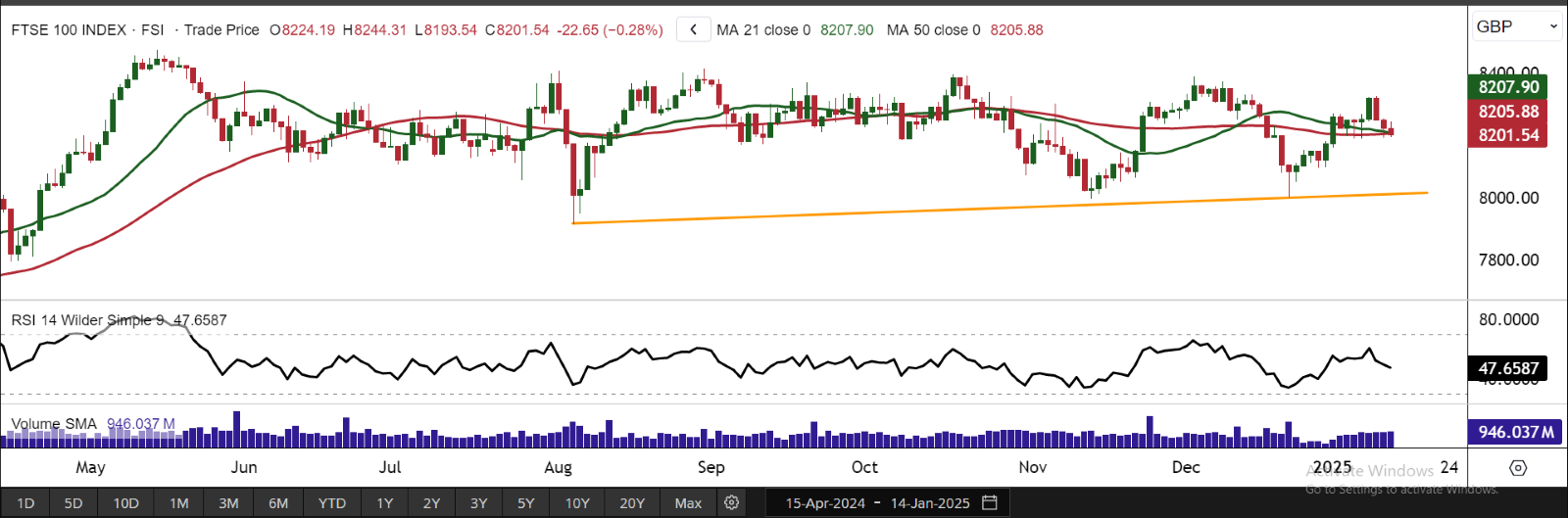
Data Source - EODHD/Others


 Jun 05, 2026




 Please wait processing your request...