
 AU
AU
 CA
CA
 US
US
 NZ
NZ
 IND
IND

 UK
UK

 Share
Share
 X (Formerly Twitter)
 Whatsapp
 Facebook
 LinkedIn
 Telegram
 Email This Article
 Copy Link
 Summarize with AI
 Chat GPT
 Perplexity
Index Update: The FTSE 100 index, a key benchmark index for the London stock exchange, went down around 0.37% on 19 November 2024. Healthcare, Real Estate & Utilities sector demonstrated a substantial growth. Moreover, sectors such as Industrials, Financials & Energy faced a significant decline.
Macro Update: Leading UK retailers, including Tesco, Marks & Spencer, Sainsbury's, and Amazon UK, have written to Finance Minister Rachel Reeves, raising concerns over the implications of the recent budget. They warned it would lead to higher prices, job losses, and reduced investment, urging a collaborative approach to find solutions. Separately, a survey by MillTechFX revealed that 88% of UK fund managers implemented currency hedges in 2024, up from 75% in 2023, reflecting heightened market volatility and the need to safeguard portfolios against fluctuations in forex markets. At the G20 Summit in Brazil, Prime Minister Keir Starmer held a significant meeting with Chinese President Xi Jinping, the first such interaction since 2018, advocating for stable and durable UK-China relations. Starmer emphasized opportunities for collaboration on trade, the economy, climate change, science, and technology to strengthen ties between the two nations.
Top Market Movers: Among top gainers on FTSE 100 index, DCC PLC (LSE: DCC) witnessed a rise of 2.77% followed by Imperial Brands PLC (LSE: IMB) which gained around 2.11%.
Commodity Update: On Tuesday, U.S. bond yields and the dollar remained below multi-month highs as traders awaited further details on President-elect Donald Trump's cabinet selections and analyzed the outlook for potential Federal Reserve rate cuts. In the commodities market, gold rose 0.57% to $2,628.60, silver gained 0.83% to $31.48, and copper climbed 0.08% to $9,104 per ton. Brent crude slipped 0.1% to $73.37 per barrel, following a rally fueled by halted production at Norway's Johan Sverdrup oilfield. Investor caution lingered, driven by concerns over the ongoing Russia-Ukraine conflict and its potential escalation.
Our Stance: European markets saw a positive start to the day as the STOXX 600 rose 0.4%, led by gains in miners and a recovery in real estate stocks, reflecting optimism amid corporate earnings and economic data releases. In the U.S., bullish sentiment dominated as Goldman Sachs and Morgan Stanley forecast the S&P 500 index to reach 6,500 by the end of 2025, citing strong U.S. economic growth, robust corporate earnings, and expectations of Federal Reserve rate cuts next year. Meanwhile, oil prices edged lower due to the resumption of production at Norway’s Johan Sverdrup oilfield, but geopolitical risks, including fears of escalation in the Russia-Ukraine conflict, kept declines in check. The positive outlook for U.S. equities and a rebound in European stocks signal improving investor confidence, driven by expectations of economic stability and earnings growth. However, geopolitical risks and fluctuating commodity prices highlight the need for cautious optimism in global markets.
FTSE 100
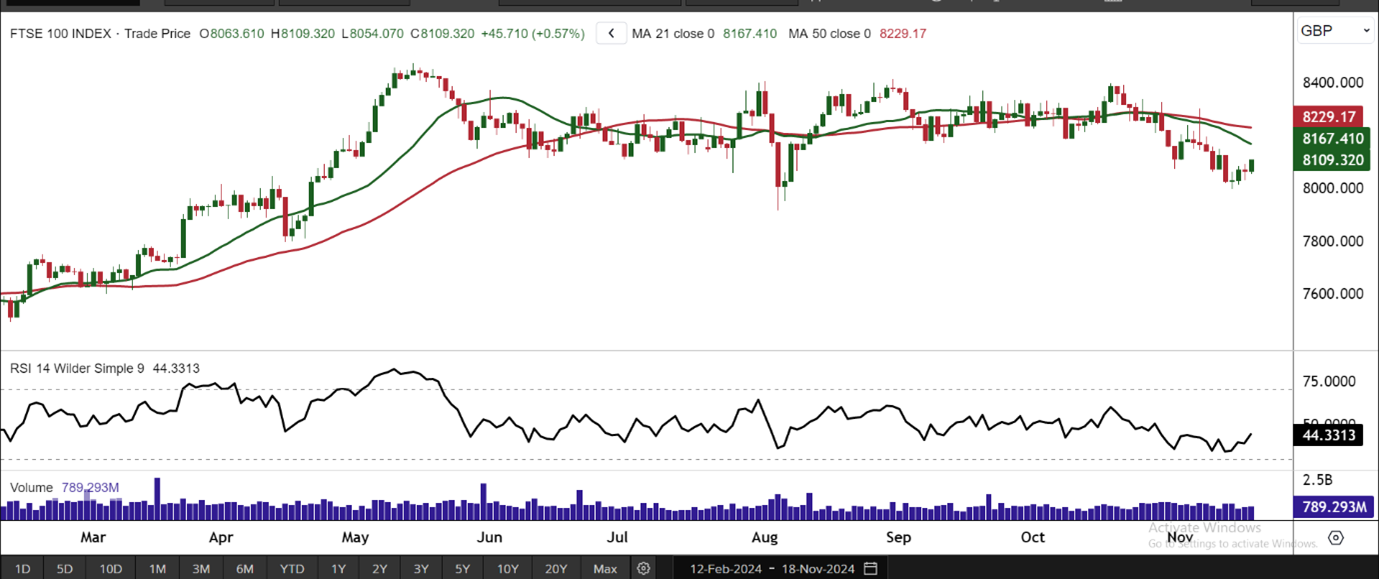
The FTSE 100 closed at 8,109.32, gaining 0.57% and forming a bullish candlestick pattern, supported by rising volume, signalling improving investor sentiment ahead of the UK BoE MPC Treasury Committee Hearings. However, the index remains below its 21-period Simple Moving Average (SMA), which acts as a resistance and limits immediate upside. The Relative Strength Index (RSI) at 44.33 is recovering from oversold territory, indicating potential bullish momentum or a reversal, depending on market conditions. On the weekly chart, the 50-period SMA provides key support at around 8,032.00. Immediate resistance is at 8,400, and a breakout above this could signal a stronger bullish trend. Conversely, a drop below 8,020 could lead to further declines, with the next major support at 7,932. Investors should watch these critical levels—resistance at 8,400 and support at 8,020—as they will determine whether the FTSE 100 enters a consolidation phase or faces further weakness.


 Jun 05, 2026




 Please wait processing your request...