
 AU
AU
 CA
CA
 US
US
 NZ
NZ
 IND
IND

 UK
UK

 Share
Share
 X (Formerly Twitter)
 Whatsapp
 Facebook
 LinkedIn
 Telegram
 Email This Article
 Copy Link
 Summarize with AI
 Chat GPT
 Perplexity
Image Source : Krish Capital Pty Ltd
Index Update: The FTSE 100 index, a key benchmark index for the London stock exchange, went up around 0.27% on 22 January 2025. Industrials, Consumer Cyclicals & Financials sector has witnessed a substantial growth. Moreover, Real Estate, Basic Materials & Utilities sector has faced a major decline.
Macro Update: Britain encountered mounting fiscal pressures in December, as the budget deficit surged to £17.8 billion, significantly surpassing the forecasted £14.1 billion and exceeding the previous year's figure by more than £10 billion. The increase was largely attributed to rising debt interest costs and a one-off government purchase of military housing. Finance Minister Rachel Reeves highlighted the importance of fostering economic growth, resulting in the removal of the antitrust regulator’s chair, Marcus Bokkerink, for insufficient focus on growth initiatives. He was replaced by former Amazon executive Doug Gurr, tasked with reducing barriers hindering businesses and promoting economic expansion. Additionally, pay settlements by British employers cooled significantly, with median pay awards dropping to 3.3% in the three months to December, the lowest since 2021, under the strain of increased payroll taxes by the Labour government.
Top Market Movers: Among top gainers on FTSE 100 index, Halma PLC (LSE: HLMA) witnessed a rise of 3.67% followed by Aviva PLC (LSE: AV.) which gained around 3.48%.
Commodity Update: The dollar dipped slightly in choppy trading on Wednesday, as markets awaited more details on President Donald Trump’s tariff strategy. Trump announced late Tuesday that his administration was considering a 10% tariff on Chinese imports starting February 1, coinciding with previously planned 25% tariffs on goods from Mexico and Canada. In commodities, gold rose by 0.17% to $2,763.70, silver climbed 0.13% to $31.54, while copper fell 0.45% to $9,250.00. Brent crude slipped by 0.01% to $79.26 per barrel as markets assessed the impact of Trump’s national energy emergency declaration on supply dynamics.
Our Stance: Global markets showed cautious optimism as investors reacted to U.S. President Donald Trump’s initial executive orders on energy, immigration, and trade. While his campaign rhetoric suggested steep, immediate tariffs on global imports and specific surcharges on Chinese goods, his first actions have been less aggressive. Trump directed agencies to investigate trade deficits and hinted at potential tariffs on Canada and Mexico from February 1, rather than implementing immediate, broad-based tariffs. Oil prices dipped as Trump declared a national energy emergency, announced plans to maximize oil and gas production, rolled back environmental protections, and withdrew the U.S. from the Paris climate pact. Wall Street responded positively, with the S&P 500 and Dow reaching one-month highs as fears of sweeping tariffs receded. However, concerns about potential trade conflicts and inflation persist, with Goldman Sachs reducing the probability of universal tariffs this year to 25%. The mixed signals underscore investor caution amid a fluid policy environment.
FTSE 100
The FTSE 100 closed at 8,548.29 on Tuesday, up 0.33%, forming a bullish candlestick pattern and breaking through its strong resistance level, closing above it. The index remains above its 21-period Simple Moving Average (SMA), signaling potential short-term upward momentum. The 50-period SMA adds further support, increasing the likelihood of continued gains. The Relative Strength Index (RSI) stands at 71.38, reflecting sustained bullish sentiment. These technical indicators suggest that the FTSE 100 could continue its upward trajectory if support levels hold and it stays above key moving averages, reinforcing the positive outlook for the near term. On the weekly chart, the FTSE 100 rose 3.11%, closing at 8,505.22, above the 50-period SMA at 8,148.56. Key support is at 7,932, with resistance at 8,400. Breaking the 8,400 resistance signals stronger bullish momentum, potentially targeting the next resistance at 8,700. A drop below 8,020 could signal further downside. Monitoring these levels will be crucial for predicting future price movements.
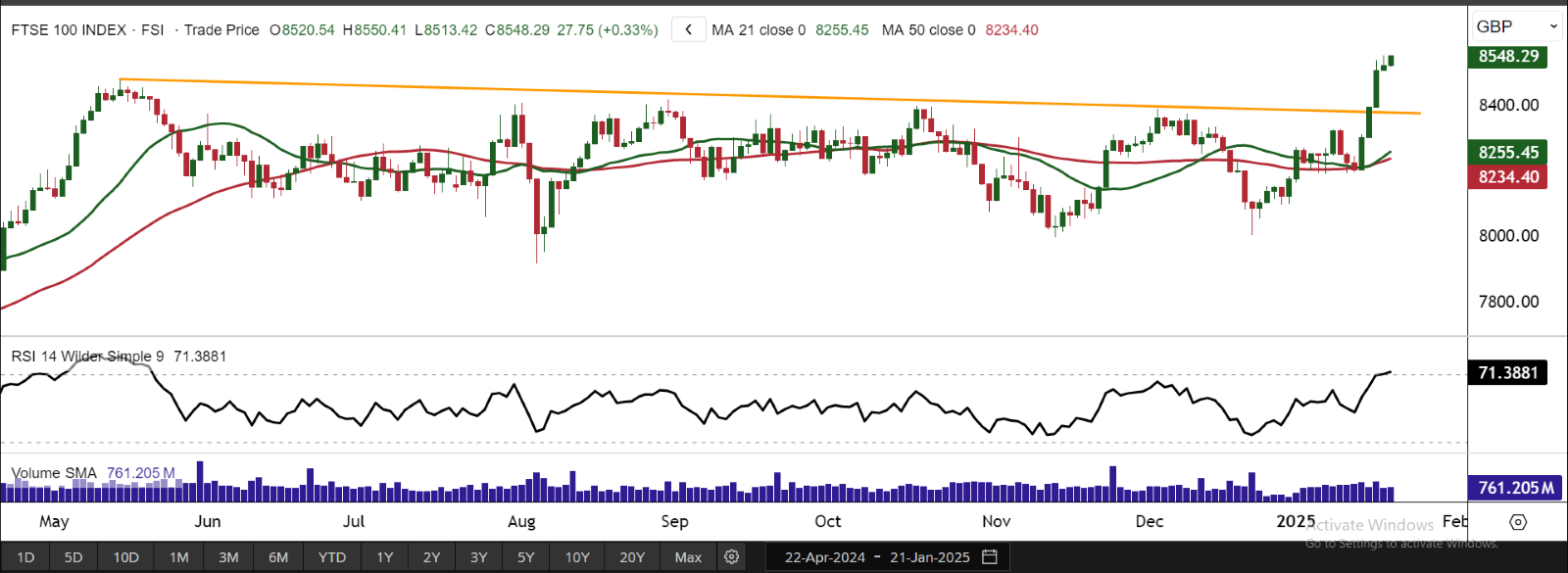
Data Source - EODHD/Others


 Jun 05, 2026




 Please wait processing your request...