
 AU
AU
 CA
CA
 US
US
 NZ
NZ
 IND
IND

 UK
UK

 Share
Share
 X (Formerly Twitter)
 Whatsapp
 Facebook
 LinkedIn
 Telegram
 Email This Article
 Copy Link
 Summarize with AI
 Chat GPT
 Perplexity
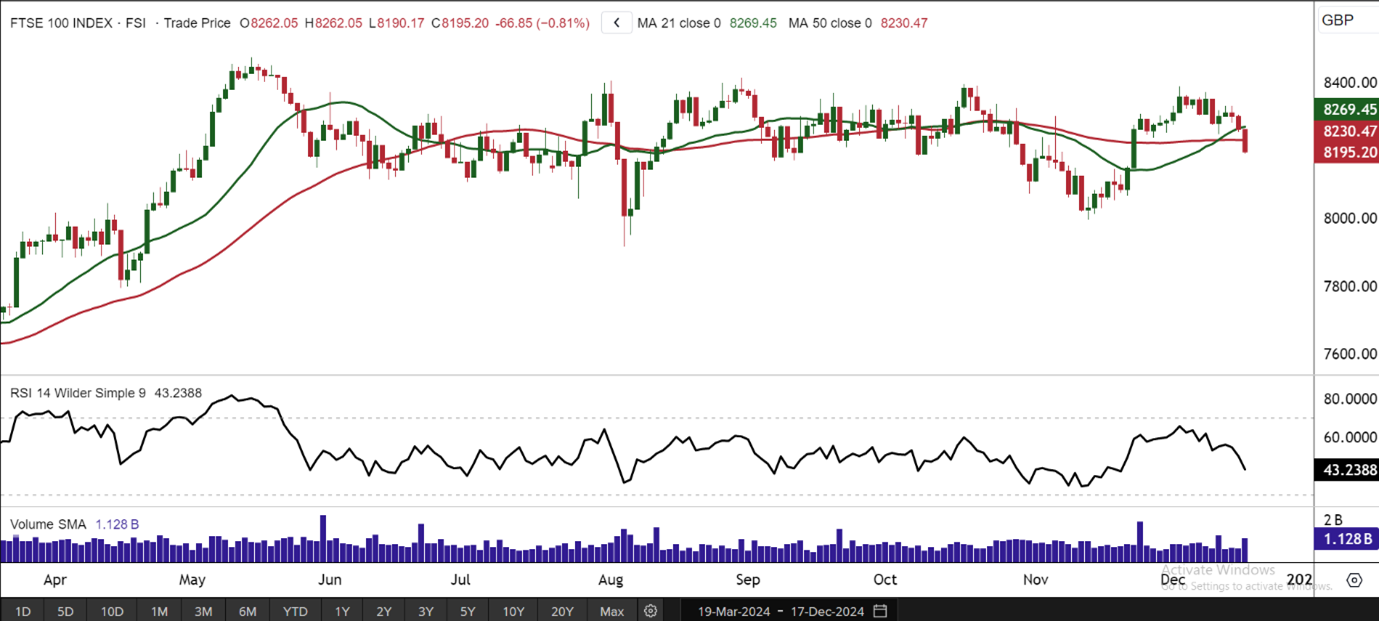
Image Source: Krish Capital Pty Ltd
Index Update: The FTSE 100 index, a key benchmark index for the London stock exchange, went up around 0.10% on 18 December 2024. Energy, Real Estate, & Financials sector faced a significant growth. Moreover, sectors such as HealthCare, Utilities & Basic Materials witnessed a substantial growth.
Macro Update: In November, British inflation climbed to an eight-month high of 2.6%, up from 2.3% in October, marking its highest level since March and moving further away from the Bank of England's 2% target. However, the steady rise in services prices, a key indicator of underlying inflationary pressures, provided some relief to the central bank. Despite this, investors slightly increased their expectations for interest rate cuts next year, following a reduction in bets earlier in the week due to strong wage growth data. Sterling weakened amid these developments. A survey by Brightmine revealed that median pay awards remained at 4% for the fifth consecutive month, a decline from the 6% average throughout 2023. Concurrently, Prime Minister Keir Starmer reiterated his Labour government’s commitment to raising defence spending to 2.5% of GDP, aligning with NATO’s call for enhanced military budgets to address ongoing threats from Russia. In an interview, Starmer declined to commit to a 3% target, emphasizing the planned trajectory to achieve 2.5% of GDP in defence spending.
Top Market Movers: Among top gainers on FTSE 100 index, Frasers Group PLC (LSE: FRAS) witnessed a rise of 1.73% followed by Melrose Industries PLC (LSE: MRO) which gained around 1.61%.
Commodity Update: The U.S. dollar reached new highs against the Australian and New Zealand dollars on Wednesday as traders anticipated an upcoming U.S. interest rate cut. In the commodities market, gold inched up by 0.01% to $2,662.50 per ounce, while silver dropped 0.04% to $30.91, and copper fell 0.22% to $8,989.50 per ton. Oil prices were stable, with Brent crude rising 0.16% to $73.31 per barrel. Market sentiment was cautious ahead of interest rate cuts, while U.S. inventory data offered mixed signals. Concerns about weakening demand in China and a potential supply glut dampened oil's recent momentum.
Our Stance: The Federal Reserve is anticipated to reduce its benchmark interest rate by 0.25 percentage points on December 18, 2024, bringing it to a range of 4.25% to 4.5%. This move, often referred to as a "hawkish cut," suggests that while the Fed is easing monetary policy, it remains cautious about future rate reductions, especially in light of the strong economic indicators. Recent data indicates that U.S. retail sales rose by 0.7% in November, surpassing economists' expectations of a 0.5% increase. This uptick was largely driven by a 2.6% increase in automobile sales, reflecting robust consumer spending as the year concludes. In the financial markets, the S&P 500 index has shown some volatility ahead of the Fed's decision. As of December 18, 2024, the SPDR S&P 500 ETF Trust (SPY) is trading at $604.29, reflecting a slight decrease of 0.43% from the previous close. Given the strong retail performance and overall economic resilience, the Fed's forthcoming rate cut appears to be a measured response aimed at sustaining economic growth while remaining vigilant about potential inflationary pressures. Investors should closely monitor the Fed's accompanying statements for insights into future monetary policy directions.
FTSE 100
The FTSE 100 closed at 8,195.20, falling by 0.81%, after forming a bearish candlestick pattern, signalling negative investor sentiment. The index continues to trade below both the 21-period and 50-period Simple Moving Averages (SMAs), which act as key resistance levels, indicating the possibility of further downside. The Relative Strength Index (RSI) is 43.23, reflecting bearish momentum with a slight continuation bias. On the weekly chart, the index declined by 0.10%, closing at 8,300.33, but remains above the 50-period SMA at 8,047.08, with support at 7,932. Immediate resistance lies at 8,400, and a breakout above this could signal a shift towards a bullish trend. Conversely, a fall below 8,020 would increase downside risk. Investors should monitor these key levels for consolidation or a potential breakout.


 Jun 05, 2026




 Please wait processing your request...