
 AU
AU
 CA
CA
 US
US
 NZ
NZ
 IND
IND

 UK
UK

 Share
Share
 X (Formerly Twitter)
 Whatsapp
 Facebook
 LinkedIn
 Telegram
 Email This Article
 Copy Link
 Summarize with AI
 Chat GPT
 Perplexity
Image Souce: Krish Capital Pty Ltd
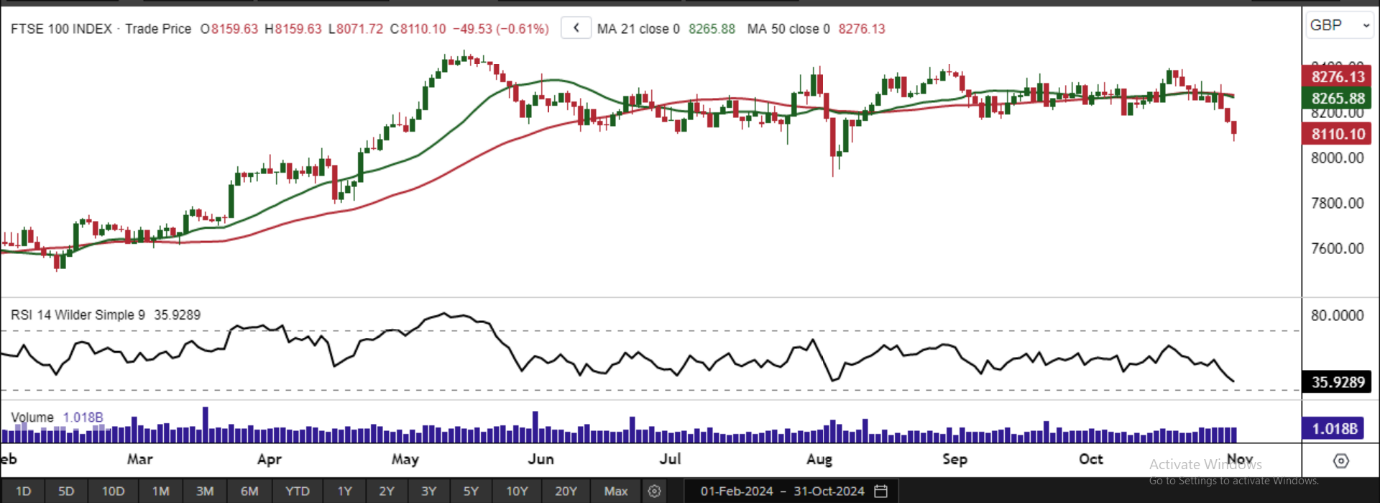
Index Update: The FTSE 100 index, a key benchmark index for the London stock exchange, went down around 0.61% on 31 October 2024. HealthCare, Industrials & Technology sector demonstrated a substantial decline. Moreover, sectors such as Consumer Cyclicals, & Utilities sector faced a significant growth.
Macro Update: Britain’s latest tax-heavy budget has extended expectations for higher Bank of England interest rates, though the pound has pulled back, hinting at market uncertainty over the BOE's approach. October saw a slight 0.1% increase in UK house prices, falling short of forecasts. Finance Minister Rachel Reeves' budget faced criticism for its high spending and tax increases but limited economic growth projections, despite Labour’s election promises. Meanwhile, the FCA urged UK financial firms to prepare for extreme scenarios, referencing a recent global tech disruption caused by a cybersecurity firm’s update failure, highlighting the importance of third-party risk management.
Top Market Movers: Among top gainers on FTSE 100 index, Standard Chartered PLC (LSE: STAN) witnessed a rise of 2.32% followed by Croda International PLC (LSE: CRDA) which gained around 2.02%.
Commodity Update: The dollar stabilized against major currencies on Friday as investors awaited the U.S. jobs report, which is crucial for assessing economic resilience ahead of the Federal Reserve's monetary policy meeting and the upcoming presidential election. Economists expect October’s nonfarm payrolls to show an increase of 113,000 jobs, though recent hurricanes may affect this figure. In commodities, gold rose 0.33% to $2,758.50 per ounce, silver increased 0.10% to $32.83, and copper gained 0.14% to $9,568.50 per ton. Brent crude futures climbed 1.95% to $70.61 per barrel amid rising geopolitical tensions in the Middle East.
Our Stance: Asian markets opened November cautiously, with most shares declining and Treasury yields nearing three-month highs. Investors are focused on the upcoming U.S. nonfarm payrolls report, the presidential election, and the Federal Reserve's policy meeting. Notably, Japan's Nikkei 225 fell over 2.6%, while China's Hang Seng index rose 1.6% following positive manufacturing data indicating potential economic stabilization. In the U.S., major stock indexes closed lower, influenced by Microsoft and Meta Platforms highlighting increased artificial intelligence costs that could impact future earnings. Despite surpassing earnings expectations, Meta's stock declined 4.1%, and Microsoft's fell 6%. The combination of rising AI-related expenses among tech giants and anticipation of significant U.S. economic events has heightened market volatility. Investors are exercising caution, balancing optimism from positive economic indicators in China against concerns over tech sector profitability and broader economic uncertainties.
FTSE 100
The FTSE index closed at 8,110.10, marking a modest decline of 0.61%. A bearish candlestick pattern has emerged, raising investor concerns, particularly as trading volume increases. Currently, the index is trading below the 21-period Simple Moving Average (SMA), which now acts as a resistance level. The Relative Strength Index (RSI) is at 35.92, indicating some bearish momentum. On the weekly chart, the 50-period SMA offers a more positive long-term outlook, with the index remaining above this critical support level. Key levels to watch include resistance at 8,400 and support at 8,100. A breakout above 8,400 could enhance market sentiment, while a drop below 8,009 may signal further declines. With the index confined within a tight range, any breakout—either upward or downward—could significantly affect the market trend. Monitoring these pivotal levels will be essential for anticipating potential market shifts.


 Jun 05, 2026




 Please wait processing your request...