
 CA
 NZ
 US
 AU
 IND

 UK

 Share
 X (Formerly Twitter)
 Whatsapp
 Facebook
 LinkedIn
 Telegram
 Email This Article
 Copy Link
 Summarize with AI
 Chat GPT
 Perplexity

Summary
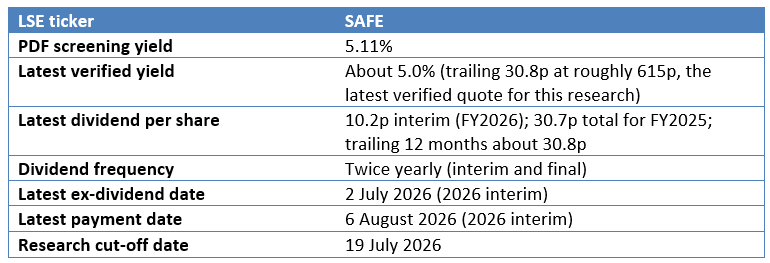
Safestore Holdings (LSE:SAFE) remains a London-listed UK REIT paying twice-yearly dividends, with a trailing payout of about 30.8p giving a yield near 5% as of 19 July 2026, close to a 5.11% screening figure. Its 2026 interim dividend rose about 1% to 10.2p and is covered by recurring EPRA earnings, but rising financing costs, a loan-to-value near 29% and slower dividend growth are the key risks to watch.
Key takeaways
- Safestore Holdings (LSE:SAFE) is a UK REIT and still pays two dividends a year; the 2026 interim was 10.2p, up about 1%, ex-dividend 2 July 2026 and payable 6 August 2026.
- A trailing dividend of about 30.8p gives a yield of roughly 5.0% near 615p, close to the 5.11% screening snapshot, which implies a price around 602p; yields move inversely with the share price.
- The total annual dividend rose every year from 25.1p (2021) to 30.7p (2025), with no cuts or suspensions, though growth has slowed to about 1%.
- Half-year EPRA earnings of 19.4p covered the 10.2p interim payout, but higher financing costs and a loan-to-value near 29% are pressuring recurring profit.
- This is general information only, not advice; the dividend looks funded from current earnings but its future growth hinges on interest rates and property values.
Dividend snapshot
Why this dividend matters now
Self-storage rarely makes headlines, yet Safestore Holdings (LSE:SAFE) has quietly become one of the London market's more watched income shares. On 11 June 2026 the company lifted its half-year dividend for the period ended 30 April 2026, extending an unbroken run of annual increases even as higher borrowing costs squeezed reported profit. That combination — a rising payout against a warier tone on financing — is why the dividend is in focus this summer.
This article is written to a research cut-off of 19 July 2026, drawing on Safestore's own results and regulatory announcements. A screening snapshot captured that day put the trailing yield at 5.11% — screening data, not a forecast, and a figure that moves inversely with the share price.
Safestore Holdings (LSE:SAFE) remains listed on the London Stock Exchange, is structured as a UK Real Estate Investment Trust (REIT), and continues to pay dividends twice a year; nothing in the latest filings points to an acquisition, delisting or suspension. The live question is not whether the dividend exists, but how comfortably it is covered as interest costs climb.
Company and business model
Safestore is the UK's largest self-storage operator and one of the biggest in Europe. As of the half-year results it ran around 215 stores across five countries — principally the UK and the Paris region through its Une Pièce en Plus brand, plus newer footholds in Spain, the Netherlands and Belgium.
The model is straightforward. Safestore rents space by the square foot to personal and business customers — roughly 107,000 of them at the half year — across maximum lettable area of about 9.5 million square feet, up 4.4% year on year.
As a REIT, Safestore is largely exempt from corporation tax on qualifying rental profits, provided it distributes at least 90% of them to shareholders. That rule is central to the income case: the structure obliges the company to pay out most recurring earnings, one reason self-storage REITs are held for yield as well as growth.
Latest dividend details
The most recent declared distribution is the interim dividend for the 2026 financial year:
- Interim dividend: 10.2p per share, a rise of about 1%
- Ex-dividend date: 2 July 2026
- Payment date: 6 August 2026
That follows the final dividend of 20.6p for the year ended 31 October 2025, paid in April 2026 — Safestore pays on a roughly one-third interim, two-thirds final rhythm. Adding the most recent final and interim payments gives a trailing 12-month dividend of about 30.8p per share; on the full 2025 financial year the total was 30.7p.
How the dividend yield is calculated
Dividend yield is the annual dividend per share divided by the share price. Using a trailing dividend of about 30.8p, the yield works out at roughly 5.0% at around 615p (the most recent verified quote for this research) and at 5.11% at about 602p, the level implied by the 19 July screening figure.
The arithmetic makes a point worth stressing: the yield rises when the price falls, even if the cash dividend is unchanged, so a higher headline yield can reflect a weaker share price rather than a more generous company. It also pays to separate three easily conflated ideas — the dividend yield (income relative to price), the dividend per share (the actual cash), and total shareholder return (dividends plus any change in the share price).
Five-year dividend history
Safestore has raised its total annual dividend every year over the past five financial years: 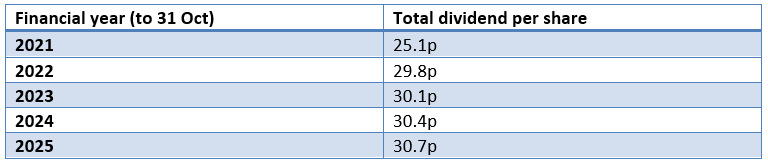
The pattern shows a large step up after the pandemic period, then slower, low-single-digit growth as the property cycle turned and interest rates rose.
Dividend growth, cuts or interruptions
Over this window there were no cuts, suspensions or special dividends in the record reviewed. The distribution has grown each year, and the latest 1% interim increase is consistent with that measured approach.
The slowdown is the story rather than any interruption. Growth of around 1% a year is well below the double-digit increases Safestore delivered in stronger property markets, reflecting softer valuation gains and higher financing costs — both of which weigh on the recurring earnings from which dividends are paid.
Earnings and cash-flow cover
For the half year to 30 April 2026, Safestore reported group revenue of £120.6m (up about 5.6% at constant currency), underlying profit before tax of £44.6m (up 2.3%) and adjusted EPRA earnings per share of 19.4p (up 2.1%).
EPRA earnings — the property industry's preferred measure of recurring profit — strip out property revaluation movements, giving a cleaner read on the cash generation that funds dividends. On that basis the 19.4p of half-year EPRA earnings comfortably exceeded the 10.2p interim payout.
For the prior full year to October 2024, adjusted diluted EPRA earnings of 42.3p covered the 30.4p dividend about 1.39 times. A cover ratio above one means recurring earnings more than fund the payout; the higher the multiple, the more headroom before a dividend would need to be trimmed. Safestore's cover has been positive but not lavish, typical for a REIT.
Statutory profit tells a noisier story. Half-year statutory profit before tax fell sharply, to £36.3m, because the prior period had benefited from large property valuation gains that did not repeat. Those swings are accounting-driven and do not directly change the cash available for dividends, which is why EPRA earnings are the more useful guide.
Balance sheet, debt and refinancing
Leverage is the pivot on which the dividend case turns. At the half year, Safestore's loan-to-value (LTV) ratio stood at about 29.1%, with net assets of roughly £2.3bn. That LTV is up from around 25% at the October 2024 year end, reflecting continued investment in new stores alongside softer property valuations.
Other reference points from recent disclosures:
- Weighted average cost of debt of 3.96% at the October 2024 year end, with about 57% of borrowings fixed
- Net debt of £899.5m and EPRA net tangible assets of about 1,091p per share at that date
- A €70m US private placement issued in December 2024, maturing December 2032 at a 4.03% fixed rate
The direction of travel matters. As older, cheaper debt is refinanced at today's higher rates, the blended cost of borrowing tends to rise, and interest is a first claim on cash before dividends. Management flagged at the half year that full-year results were likely to land at the lower end of market expectations because of higher financing costs — a direct signal that debt is the pressure point to watch. An LTV near 29% is moderate for a property company, but it has been rising, narrowing the margin of safety around the payout.
Operational factors affecting distributions
Underlying trading has held up, with like-for-like revenue growing across all regions and recently opened stores expected to add £30m–£35m of EBITDA over time as they fill.
Occupancy is the swing factor. At the October 2024 year end, closing occupancy was about 74.6% of maximum lettable area, down from 77.0% a year earlier, partly because new space takes time to let. Storage demand is sensitive to housing transactions, business activity and life events, so a slow housing market tends to soften new enquiries. Because storage is let flexibly and priced monthly, Safestore can push rates on its existing base even when new lettings slow — a lever that has underpinned revenue growth, but one with limits if occupancy keeps drifting.
Interest rates and the UK property market
Safestore sits at the intersection of two macro forces: interest rates and property values. Higher rates raise refinancing costs and lift the yields investors demand on property, which can push valuations down and nudge LTV up; lower rates would ease both pressures. UK commercial property values have been subdued as yields repriced, and self-storage — though more resilient than some sectors — is not immune.
For an income investor the read-through is nuanced. The recurring rental income that funds the dividend has proved fairly durable; it is the valuation of the underlying property and the cost of the debt against it that have been under pressure. A stabilisation or fall in rates would be the clearest tailwind for both the balance sheet and the pace of dividend growth.
What could support the next dividend
Several factors could underpin future distributions:
- REIT status, which obliges Safestore to distribute the bulk of its qualifying rental profit
- A long record of annual increases and EPRA dividend cover above one
- Revenue growth from a maturing pipeline of new stores adding future EBITDA
- Pricing power over an established customer base of around 107,000
- A largely fixed-rate debt book that limits, though does not remove, exposure to rate rises
None of these guarantees an increase; they describe the conditions under which the board has, so far, chosen to keep raising the payout.
Principal risks to the dividend
The risks are as important as the supports, and REIT distributions can be reduced:
- Financing costs: refinancing maturing debt at higher rates directly reduces the earnings that fund dividends; management has already pointed to this pressure
- Leverage: an LTV that has risen towards 29% leaves less room if valuations weaken further
- Property valuations: further declines would lift LTV and could test covenants over time
- Occupancy: a softer housing market or weaker business demand could hold back lettings at new stores
- Interest rates: a higher-for-longer environment would keep both financing costs and property yields elevated
- Payout policy: as a REIT, distributions track earnings, so a fall in recurring profit could slow growth or, in a severe case, reduce the dividend
- Currency: the European operations introduce euro exposure to sterling-reported results
Balanced outlook
The picture at 19 July 2026 is one of steady income under some pressure. Safestore continues to raise its dividend, cover on recurring earnings remains above one, and trading is growing. Set against that, the pace of increase has slowed to around 1%, leverage has edged higher, and management has warned that financing costs will weigh on full-year results. This is a cash-generative business navigating a higher-rate environment, with a dividend funded from current earnings but with less headroom than in the low-rate years.
Conclusion
So, could self-storage deliver more than capital growth? On the evidence to 19 July 2026, Safestore Holdings (LSE:SAFE) offers a yield of roughly 5.0% — close to the 5.11% screening figure once the inverse relationship between price and yield is taken into account — backed by EPRA earnings that currently cover the payout and a multi-year record of increases.
Income has plainly been part of the return, not an afterthought to capital growth. But the same higher-rate backdrop that has weighed on the share price and lifted the yield is also raising financing costs and slowing dividend growth. The distribution appears supported by recurring earnings today; whether it keeps rising at the recent modest pace depends heavily on where interest rates and property values head next. This article is general information only and is not advice or a recommendation to buy, hold or sell.


 Nov 27, 2026





 Please wait processing your request...