
 CA
 NZ
 US
 AU
 IND

 UK

 Share
 X (Formerly Twitter)
 Whatsapp
 Facebook
 LinkedIn
 Telegram
 Email This Article
 Copy Link
 Summarize with AI
 Chat GPT
 Perplexity

Summary
Hunting plc (LSE:HTG) issued an H1 2026 trading update on 14 July 2026 reporting EBITDA of about $62m at roughly 12% margin and holding full-year EBITDA guidance at $145m-$155m. Subsea Technologies and Perforating Systems drove the performance, including $63.5m of titanium stress-joint orders for a Guyana development. The sales order book rose to about $387m from $358m at end-2025, with a tender pipeline near $1.0bn. The group carried about $(19)m of net borrowings at 30 June 2026 after $32.6m of buybacks and $10.1m of dividends, guiding to $60m-$65m net cash by year-end. OCTG and Advanced Manufacturing were softer on order phasing, expected to recover in the second half. Shares rose about 4.9% to around 472p. A CEO succession search and a 2027 auditor change to KPMG were confirmed. Oil-price cyclicality remains the central risk. Half-year results are due 21 August 2026.
Five Key Takeaways
- H1 2026 EBITDA was around $62m at an approximate 12% margin, with management holding full-year guidance of $145m-$155m.
- The period-end sales order book grew to about $387m from $358m at the end of 2025, alongside a tender pipeline near $1.0bn.
- Subsea momentum was underpinned by $63.5m of titanium stress-joint orders tied to a Guyana development.
- The balance sheet swung to roughly $(19)m of net borrowings at 30 June 2026 after buybacks, dividends and a duty settlement, with year-end net cash guided to $60m-$65m.
- Oil-price cyclicality remains the central risk; management flagged near-term volatility linked to Middle East tensions.
Company Overview
Hunting is a diversified provider of tools, technology and manufacturing services to the global energy industry, with a growing footprint in non-oil-and-gas markets. Founded in 1874 and headquartered in London, the group is a FTSE 250 constituent trading on the Main Market under the ticker HTG. Its Perforating Systems unit supplies the shaped charges, guns and electronic firing systems used to create the perforations through which oil and gas flow into a wellbore, a business heavily exposed to North American shale completions. The OCTG operation manufactures and machines oil country tubular goods, the steel pipe and connections that line a well. Subsea Technologies makes seabed equipment, including titanium stress joints, flexible components that absorb the movement between a floating production vessel and the risers running to the seabed. Advanced Manufacturing and other units extend the group's precision engineering into aerospace, medical and industrial markets, diversifying away from pure drilling exposure, and Hunting also owns Organic Oil Recovery, a microbial enhanced-oil-recovery technology. The strategic thread is a shift from short-cycle, commodity-priced consumables toward longer-cycle, higher-margin technology and international project work. This matters for investors: short-cycle products respond quickly to swings in drilling activity and the oil price, giving volatile revenue, whereas longer-cycle subsea and project work is booked into an order backlog months or years ahead, smoothing revenue and improving visibility. Hunting's ambition is to lift the weight of the latter, which is why it now emphasises the sales order book and tender pipeline. It also frames a growing slice of output as non-oil-and-gas, worth $82.9m in 2025, up from $75.1m.
What Has Happened Recently?
On 14 July 2026 Hunting issued a trading update covering the first half, and the shares rose roughly 4.9% to around 472p on 15 July against a prior close near 450p, having ranged between about 288.5p and 552p over the preceding year. The core message was continuity: first-half EBITDA of approximately $62m at a margin near 12%, and full-year EBITDA guidance held at $145m-$155m, implying a roughly 13%-14% margin for the year. Because Hunting's earnings are weighted toward the second half, the first-half run-rate is consistent with the annual target rather than a downgrade. Equity Development captured the tone in a note titled "Subsea boosts profitability in a positive Q2", dated 15 July 2026. The order book was a focal point: a period-end sales order book of about $387m, up from $358m at the end of 2025, supported by a tender pipeline approaching $1.0bn. Within that, the group highlighted $63.5m of titanium stress-joint orders linked to a development offshore Guyana, one of the industry's most active deepwater basins. Chief Executive Jim Johnson said the half saw continued strong momentum in Subsea and Perforating Systems supporting unchanged full-year expectations, while cautioning on near-term volatility connected to Middle East tensions. The company also confirmed a search for a new chief executive was under way, and that KPMG had been recommended as external auditor from 2027, with Deloitte completing the 2026 audit.
Analysis of the Latest Development
The update illustrates the two-speed nature of Hunting's portfolio. Subsea and Perforating Systems are carrying the group. Perforating Systems was described as significantly ahead of expectations, driven by demand for unconventional well-completion products in North America — a notable turnaround given the unit generated EBITDA of only $1.4m in 2024 before recovering to $13.9m in 2025. Subsea continues to convert a strong pipeline, with the Guyana stress-joint award a tangible example of Hunting winning content on major deepwater projects. Against that, OCTG, Advanced Manufacturing and other operations saw lower first-half activity attributed to order phasing rather than lost work, with recovery expected in the second half. This is why the annual guidance is back-end loaded and why the first-half margin of about 12% sits below the full-year expectation. The investment question is whether that second-half recovery materialises as order timing normalises; the growing order book and near-$1.0bn pipeline lend support, but conversion timing in this industry is rarely precise. The order book fell from about $428.8m at the end of the first quarter to $387m at 30 June, a reminder that backlog is drawn down as work is delivered; the comparison against the $358m end-2025 figure is the more meaningful read on direction. Investors should treat the maintained guidance as a plan still dependent on second-half execution rather than a result already banked.
Financial Performance and Balance Sheet
For the full year 2025, Hunting reported revenue of $1,018.8m, down 3% on the prior year's $1,048.9m, while EBITDA rose 7% to $135.7m and the EBITDA margin improved to 13% from 12%. Adjusted profit before tax was $79.7m, and the group swung to a statutory profit before tax of $65.5m from a loss of $33.5m in 2024. Adjusted diluted earnings were 34.1 cents per share, up 9%, and the total dividend was raised 13% to 13.0 cents, with a final dividend of 6.8 cents, reflecting a progressive distribution policy. Free cash flow was $96.6m and the group closed 2025 with net cash of $62.9m and net assets of $855.3m. The first half of 2026 shows the seasonality clearly. Net cash stood at $8.3m at the end of the first quarter after a working-capital build, and by 30 June the group carried roughly $(19)m of net borrowings. That swing reflects deliberate cash deployment rather than operational weakness: $10.1m of dividends, $32.6m of buybacks including $6.0m under a second programme, $11.6m of treasury-share purchases and an $8.8m settlement of a UK import-duty provision. Management expects the balance sheet to rebuild to net cash of $60m-$65m by year-end, consistent with second-half cash generation and an aim of converting 50% or more of EBITDA into free cash flow.
Principal Assets, Products and Operations
Operationally, Hunting is reshaping its footprint as much as chasing volume. A group-wide cost programme targeting about $15m of annual savings across 2026 and 2027 is under way, and the group is consolidating its European operations, with Aberdeen OCTG activity transferring to Badentoy and the Fordoun site earmarked for closure. From 2027 the company intends to merge its EMEA and Asia Pacific operations into a single International segment, simplifying reporting and management. On the technology side, Organic Oil Recovery is expected to contribute roughly $10m-$15m of revenue in 2026, with management pointing to an ambition to scale it toward around $100m annually by 2030, and the microbial process now has a growing base of active customers. Hunting has also signalled appetite for bolt-on acquisitions in subsea and intelligent-completions technology, consistent with tilting the mix toward higher-value, longer-cycle work. The Guyana stress-joint content and the perforating recovery show the strategy in action, but executing restructuring, M&A and a chief-executive transition simultaneously is a meaningful management load. The order book and tender pipeline are, in effect, the group's most important operational assets, converting the strategic tilt toward longer-cycle work into visible future revenue.
Potential Growth Catalysts
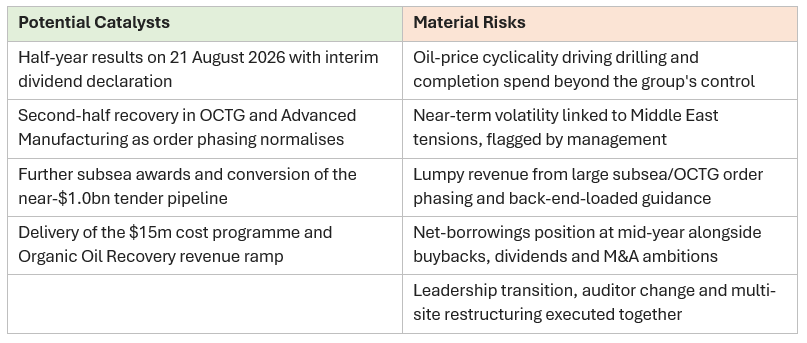
Several potential catalysts sit ahead. The half-year results on 21 August 2026 will confirm whether reported figures match the trading-update indications and should carry an interim dividend declaration under the progressive policy. Continued order intake in subsea, deepwater basins such as Guyana and further titanium stress-joint awards could extend the visible backlog, while conversion of the near-$1.0bn tender pipeline would firm up 2027 revenue. A second-half recovery in OCTG and Advanced Manufacturing, delivery of the $15m cost programme and progress at Organic Oil Recovery each offer earnings support. Sustained North American completion activity would keep the Perforating Systems tailwind running, and the appointment of a permanent chief executive may remove an overhang. Independent commentary has been supportive: Equity Development's 15 July note framed the quarter as one in which subsea activity boosted profitability, and consensus analyst price targets cited in secondary coverage sat around 553.5p, though such targets are third-party opinion rather than fact.
Material Risks and Challenges
The risks are equally concrete, and the central one is structural. Hunting's fortunes remain tied to the oil and gas capital-expenditure cycle, which is driven by commodity prices the company cannot control; a sustained fall in oil prices would depress drilling and completion activity and pressure both volumes and margins. Management explicitly flagged near-term volatility linked to Middle East tensions. Revenue can be lumpy because large subsea and OCTG orders are subject to phasing, as the softer first-half manufacturing performance showed, so the second-half-weighted guidance carries execution risk. The swing to net borrowings at mid-year, while planned, leaves less headroom should working capital or trading disappoint, and the group is simultaneously buying back stock, paying a rising dividend and pursuing acquisitions. Leadership transition, an auditor change and a multi-site restructuring add operational risk. Currency is a further factor: Hunting reports in US dollars while its shares trade in sterling, so exchange-rate moves affect returns for UK holders regardless of operational performance. None of these is unusual for an energy-services group, but together they underline that the equity is cyclical rather than defensive, and not a risk-free investment.
Catalysts versus Risks at a Glance
What Investors Should Monitor Next
For those tracking the story, the 21 August 2026 half-year results are the immediate milestone, both for confirmation of the roughly $62m first-half EBITDA and for the interim dividend. Beyond that, watch the order book and tender pipeline for signs the second-half recovery is landing, the pace of net-cash rebuild toward the $60m-$65m year-end target, the phasing recovery in OCTG and Advanced Manufacturing, and progress on the $15m cost programme. The Organic Oil Recovery revenue ramp, any subsea bolt-on acquisitions and the timing of a permanent chief-executive appointment are the longer-dated items. Oil-price direction and Middle East developments remain the macro variables that could override company-specific progress in either direction.
Balanced Conclusion
Hunting enters the second half of 2026 with genuine momentum in the parts of its portfolio it most wants to grow: subsea technology and North American perforating. A larger order book, a substantial tender pipeline and the maintained guidance give the update a constructive complexion, and the deliberate deployment of cash into buybacks and dividends signals management confidence. Yet the investment case rests on a back-end-loaded year delivering as promised, on the manufacturing units recovering from order phasing, and above all on an oil and gas cycle that no company in this sector can steer. The mid-July update kept the thesis on track without resolving its central uncertainty. The August results will show whether the subsea-led profitability improvement is the start of a durable trend or simply a strong half within a business that remains, at its core, cyclical. This article is general information and not investment advice.


 Nov 25, 2026





 Please wait processing your request...