
 AU
AU
 CA
CA
 US
US
 NZ
NZ
 IND
IND

 UK
UK

 Share
Share
 X (Formerly Twitter)
 Whatsapp
 Facebook
 LinkedIn
 Telegram
 Email This Article
 Copy Link
 Summarize with AI
 Chat GPT
 Perplexity
Company Overview
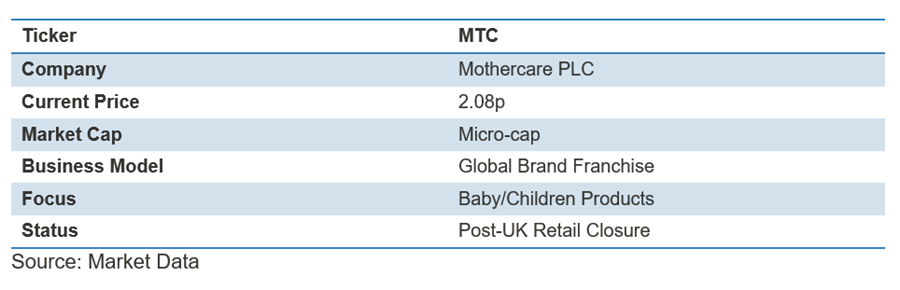
Mothercare PLC is an internationally recognised brand in the baby and children’s products sector that has transitioned from operating physical retail stores to focusing on an asset-light brand licensing and franchise model. After exiting the UK retail market, the company repositioned itself to monetise its long-established brand equity through licensing agreements and franchise partnerships in overseas markets. This strategic shift reflects the view that the Mothercare brand, built over decades of parental trust and specialist positioning, represents the company’s most valuable asset, while traditional brick-and-mortar retail operations became unsustainable in a highly competitive domestic environment. By adopting a franchise-led international strategy, the company aims to reduce capital intensity and improve profitability relative to its former retail model.
The global baby and children’s products market spans clothing, nursery equipment, toys, feeding products and accessories distributed through specialist retailers, department stores and digital platforms. Demand is underpinned by ongoing global birth rates and consistent parental spending on child-related goods. Mothercare’s heritage as a specialist brand in the mother and baby category conveys perceived quality and safety, attributes that remain important in consumer decision-making. The company’s current strategic emphasis lies in leveraging this brand strength internationally, enabling geographic expansion without direct ownership of retail infrastructure.
At a share price of approximately 2.08p, Mothercare trades as a micro-cap entity, reflecting investor caution about the sustainability of its transformed business model. Market scepticism centres on whether brand licensing revenues can generate consistent profitability and support long-term growth. The investment case depends on management’s ability to execute the franchise strategy effectively while preserving brand integrity and controlling corporate costs.
Business Model and Revenue Streams
Mothercare’s business model now revolves around licensing its brand to international franchise partners. Under these arrangements, local operators run retail operations under the Mothercare brand and remit licensing fees or royalties, often calculated as a percentage of sales. This structure significantly reduces fixed costs compared to direct retail ownership and allows the company to scale through partnerships rather than capital-intensive expansion. Additional income may be derived from supplying products to franchisees or supporting omnichannel initiatives under the brand umbrella.
The success of this model relies on selecting capable franchise partners and maintaining rigorous brand governance to ensure consistent product quality and customer experience. Poor execution by franchisees could undermine brand reputation and limit expansion prospects. Revenue growth depends on the performance of franchise partners in their respective markets, as well as the pace of new market entry. Initial investment in partner onboarding, training and brand support is typically required before material revenue contributions emerge.
The company may also explore digital channels aligned with franchise networks to enhance brand visibility and capture e-commerce demand. Capital allocation remains critical, as the strategy must prioritise initiatives that generate scalable revenue without reintroducing the cost burdens associated with direct retail operations. Monitoring trends in licensing revenue growth, franchise expansion and geographic diversification provides insight into the strategy’s effectiveness.
Financial Performance and Valuation
Following the closure of UK retail operations, Mothercare’s financial profile has shifted away from high fixed retail costs toward a leaner corporate structure. The expectation is that franchise-derived income will progressively offset legacy cost burdens and improve operating performance. However, during the transition phase, profitability may remain modest as franchise revenues scale.
The company’s micro-cap valuation at approximately 2.08p suggests cautious market sentiment regarding the brand’s monetisation potential. Investors must assess whether the franchise model can sustainably generate revenues sufficient to cover corporate overhead and deliver shareholder returns. Comparisons with other brand licensing businesses may provide context, though Mothercare’s turnaround status introduces additional uncertainty.
Key performance indicators include growth in licensing income, operating margins and cash generation. Adequate liquidity is essential to support expansion into new territories and maintain brand marketing efforts. Should franchise performance disappoint or cash reserves diminish, the company may face renewed financial strain. Conversely, successful geographic expansion and improved profitability could prompt a reassessment of valuation.
Market Position and Competitive Landscape
Mothercare operates in a competitive global children’s products market that includes major multinational retailers, specialist baby brands and online platforms. Its competitive advantage lies in brand heritage and longstanding consumer trust associated with safety and quality. However, competitive intensity has increased significantly as large retailers expand their own-label offerings and digital marketplaces provide broad product selection and convenience.
The franchise model places emphasis on local market knowledge and operational expertise of partner retailers. Success depends on selecting capable franchisees able to maintain brand standards and compete effectively within their regions. In established markets, brand recognition may facilitate expansion, while in emerging markets additional marketing investment may be required to build awareness.
The brand must continue evolving to remain relevant to new generations of consumers. Failure to maintain quality standards or adapt to shifting preferences could erode competitive positioning. Effective brand stewardship and support for franchise partners remain central to sustaining market relevance.
Risk Factors
The transformation from retailer to brand licensor introduces execution risk. The franchise model must prove capable of generating sufficient recurring income to replace former retail revenues. If franchise partners underperform or fail to uphold brand standards, revenue and brand equity could suffer.
Brand value is critical to the company’s long-term viability. Any decline in consumer perception, product quality concerns or reputational damage could limit the attractiveness of the brand to both customers and franchisees. Additionally, competitive pressures from large retailers and digital platforms pose ongoing challenges.
Financial and operational risks also warrant consideration. International expansion requires capital, and limited resources may constrain growth opportunities. Currency fluctuations, regional economic instability and regulatory variations across markets introduce further uncertainty. Management’s ability to oversee a geographically dispersed franchise network while maintaining governance standards is an ongoing operational challenge.
Investment Outlook and Conclusion
Mothercare PLC represents a turnaround investment predicated on successful execution of its international franchise strategy. The company’s enduring brand equity provides a foundation for potential recovery, yet the sustainability of the new business model remains subject to proof through consistent financial performance.
The investment outlook hinges on growth in franchise partnerships, expansion into new territories and evidence of improving profitability. Positive momentum in these areas could support re-rating potential, while stagnation or operational setbacks would reinforce existing scepticism.
In summary, Mothercare offers speculative exposure to a brand-led recovery strategy. Investors considering the shares should possess a high tolerance for execution risk and carefully monitor operational progress. As with many small-cap turnaround situations, prudent position sizing and diversification are essential risk management measures.


 Jun 05, 2026




 Please wait processing your request...