
 AU
AU
 CA
CA
 US
US
 NZ
NZ
 IND
IND

 UK
UK

 Share
Share
 X (Formerly Twitter)
 Whatsapp
 Facebook
 LinkedIn
 Telegram
 Email This Article
 Copy Link
 Summarize with AI
 Chat GPT
 Perplexity
Company Overview
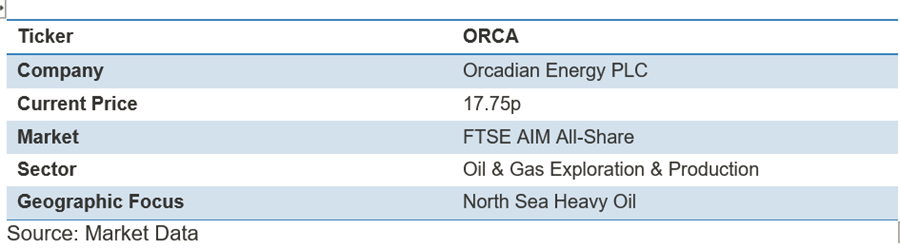
Orcadian Energy PLC is an independent oil and gas exploration and development company focused on heavy oil resources in the North Sea. The North Sea is one of the world’s most mature petroleum provinces, supported by established offshore infrastructure, regulatory clarity and a skilled workforce. Orcadian’s strategy concentrates on developing previously discovered heavy oil accumulations that were historically considered uneconomic but may now be viable due to technological improvements and evolving cost structures. Heavy oil extraction typically requires specialised recovery techniques, creating technical complexity but also forming barriers to entry that can protect experienced operators. By targeting heavy oil rather than conventional light oil or gas prospects, the company pursues a differentiated niche within the broader upstream sector.
Operating in a mature basin provides access to existing infrastructure and supply chains, yet also introduces challenges including aging facilities, declining regional production and increasing regulatory emphasis on decarbonisation. Orcadian aims to leverage existing North Sea infrastructure while applying cost discipline to develop marginal resources profitably. The company’s prospects depend on executing projects efficiently within regulatory frameworks that are becoming progressively more stringent as governments balance energy security with environmental objectives.
The broader industry context is shaped by the global energy transition. Oil and gas producers face long-term structural pressures including decarbonisation commitments, investor scrutiny and regulatory tightening. Orcadian’s ability to advance projects into production before potential policy or market constraints intensify will influence its long-term viability and shareholder value creation.
Business Model and Revenue Streams
Orcadian Energy’s business model revolves around identifying, appraising and developing heavy oil resources that can generate acceptable returns under prevailing commodity prices. Revenue is expected to arise primarily from the sale of crude oil produced from developed fields, priced in line with international benchmarks such as Brent crude. Secondary revenue streams may include associated gas or liquids, though heavy oil development remains the core focus. Offshore development is capital intensive, requiring substantial investment in wells, production facilities and infrastructure before cash flow is realised.
Project economics are driven by oil prices, operating costs and capital expenditure requirements. Heavy oil production can incur higher costs than conventional light oil due to recovery techniques and reservoir characteristics. The viability of Orcadian’s projects therefore depends on maintaining development costs within economic thresholds while oil prices remain supportive. If oil prices fall significantly, project economics may deteriorate; conversely, sustained higher prices can enhance returns and expand development feasibility.
Once production is established, positive operating cash flows could support reinvestment, debt reduction or potential shareholder returns. Capital allocation discipline will be central to long-term value creation, particularly in balancing development opportunities against the need to manage financial risk.
Financial Performance and Valuation
Orcadian Energy’s financial profile reflects a development-stage company with limited production revenue. Current activities focus on appraisal and project advancement, resulting in ongoing expenditure without substantial operating income. Evaluating financial sustainability therefore requires analysis of cash reserves, burn rate and access to capital. Development of offshore heavy oil fields is likely to require significant additional funding, potentially through joint ventures, debt financing, asset sales or equity issuance. Each funding route carries implications for ownership dilution and risk sharing.
Traditional valuation metrics such as price-to-earnings ratios are less relevant in pre-production contexts. Instead, valuation typically centres on estimates of reserve potential, projected development costs and oil price assumptions, discounted to present value. Sensitivity to commodity prices is substantial, as even moderate price changes can materially alter net asset valuations. The company’s share price reflects market judgement regarding technical feasibility, funding prospects and commodity outlook.
Market Position and Competitive Landscape
Orcadian operates within a competitive global oil and gas industry dominated by large integrated energy companies and well-capitalised independents. The North Sea remains primarily controlled by major operators with established infrastructure and scale advantages. Orcadian’s competitive positioning rests on its niche expertise in heavy oil and its focus on opportunities that larger players may consider non-core or marginal.
Smaller independent companies can succeed in mature basins by applying technical precision and cost efficiency to overlooked assets. Strategic partnerships or infrastructure-sharing arrangements may enhance competitiveness. However, the company operates against a backdrop of long-term uncertainty in petroleum demand, as energy transition policies and renewable energy expansion gradually reshape global energy markets. Timely development is therefore critical in capturing value before regulatory or market constraints intensify.
Risk Factors
Oil price volatility represents the most significant risk. Project economics are highly sensitive to crude price assumptions, and sustained price declines could render developments uneconomic. As a price taker in global markets, Orcadian has no control over commodity pricing.
Exploration and development risks also remain material. Appraisal activities may yield lower-than-expected reserve volumes, higher development costs or operational challenges that delay timelines. Technical complexity inherent in heavy oil recovery increases execution risk.
Regulatory and environmental risks are increasingly prominent. Governments are tightening environmental standards, imposing carbon-related costs and scrutinising offshore developments. Changes in policy could increase operating costs or restrict new developments. Decommissioning obligations at end-of-field life represent additional long-term liabilities.
Investment Outlook and Conclusion
Orcadian Energy PLC offers exposure to North Sea heavy oil development with potential upside linked to successful project execution and favourable oil price conditions. Its specialised focus provides differentiation within a mature basin, and successful development could generate meaningful cash flows.
However, the investment case carries substantial uncertainty. Technical execution challenges, capital requirements, regulatory developments and commodity price volatility all influence outcomes. The global shift toward decarbonisation introduces structural headwinds for upstream petroleum projects, potentially compressing development windows.
For investors seeking leveraged exposure to oil prices and North Sea assets, Orcadian may represent a speculative opportunity with asymmetric return potential. Nonetheless, prudent portfolio positioning, ongoing monitoring of oil markets and careful assessment of funding plans are essential. The shares may be most suitable as a high-risk allocation within a diversified investment strategy.


 Jun 05, 2026




 Please wait processing your request...