
 AU
AU
 CA
CA
 US
US
 NZ
NZ
 IND
IND

 UK
UK

 Share
Share
 X (Formerly Twitter)
 Whatsapp
 Facebook
 LinkedIn
 Telegram
 Email This Article
 Copy Link
 Summarize with AI
 Chat GPT
 Perplexity
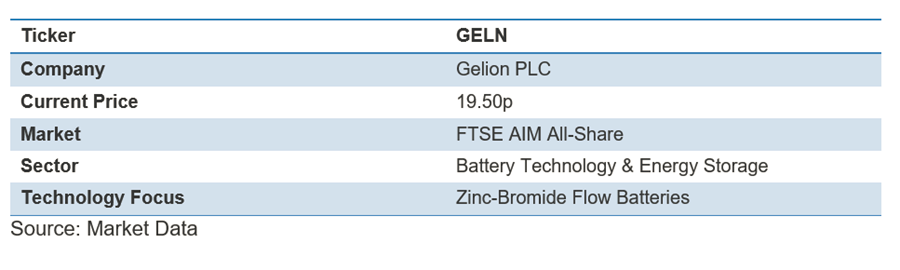
Company Overview
Gelion PLC is an advanced battery technology business focused on developing and commercialising zinc-bromide flow battery systems for stationary energy storage. The company operates within the fast-growing global energy storage market, which is expanding alongside the transition to renewable energy and decentralised grid infrastructure. Flow battery technology offers potential advantages over lithium-ion systems for long-duration storage, including scalability, enhanced safety characteristics, improved recyclability and cost competitiveness at larger durations. Gelion’s zinc-bromide chemistry aims to combine established flow battery architecture with abundant and recyclable materials, positioning the company to participate in the accelerating deployment of grid-scale and utility-scale storage solutions.
Founded on the view that long-duration energy storage is essential for renewable integration and grid resilience, Gelion has assembled expertise across materials science, electrochemistry and energy systems engineering. Its research and development efforts centre on improving cell efficiency, energy density, reliability and manufacturing economics. The company holds intellectual property covering zinc-bromide chemistry, system design and production processes. Moving from development to commercial scale represents a multi-year process requiring technical validation and significant capital investment. If successfully executed, this pathway could establish Gelion as a meaningful participant in the global energy storage supply chain.
Gelion’s strategy reflects recognition that large-scale storage is a structural requirement for decarbonised energy systems. Zinc-bromide batteries are designed to address long-duration applications, complementing lithium-ion technologies that are better suited to short-duration use cases. Supportive government policies, regulatory incentives for grid modernisation and corporate net-zero commitments create structural demand drivers. The central investment case depends on Gelion’s ability to capitalise on these tailwinds while successfully navigating technical development and manufacturing scale-up challenges.
Business Model and Revenue Streams
Gelion’s business model reflects the capital-intensive and development-focused nature of advanced battery commercialisation. At present, revenue generation remains limited as the company concentrates on refining technology, securing partnerships and preparing for manufacturing scale. As commercial deployment progresses, revenue is expected to arise from the sale of zinc-bromide battery systems to utilities, energy developers and industrial customers seeking long-duration storage solutions. Early-stage income may originate from demonstration projects, strategic collaborations or licensing agreements that provide interim funding while preserving long-term upside.
The economics of energy storage projects have improved as renewable costs decline and grid storage becomes more integral to energy infrastructure. Gelion aims to position its systems competitively against alternative long-duration technologies, offering advantages in safety, environmental profile and cost stability over product lifecycles. The company’s eventual manufacturing model could involve direct production, joint ventures with established manufacturers or technology licensing arrangements, each carrying different implications for margin capture, capital requirements and operational control.
Capital requirements remain a defining factor. Transitioning from prototype validation to industrial-scale manufacturing necessitates substantial investment in facilities, supply chains and working capital. Funding may come from equity issuance, debt financing or strategic partnerships. The timing, scale and pricing of future capital raises will materially influence shareholder returns and dilution levels.
Financial Performance and Valuation
Gelion’s financial profile reflects that of a pre-commercial technology company. Current operations are centred on research, development and scaling activities, leading to ongoing cash outflows and accounting losses. The investment thesis is therefore based on anticipated future commercial success rather than existing cash-generating capacity. This profile aligns more closely with venture-style investments than with established industrial enterprises, requiring high risk tolerance and long-term investment horizons.
Cash reserves and funding runway are key considerations. Sustaining development activities and reaching commercial milestones depends on maintaining sufficient liquidity. If technical timelines extend or development costs exceed expectations, further equity financing may be required, potentially diluting existing shareholders. Investors should monitor burn rates, funding updates and progress against technical milestones, as successful achievement of de-risking events improves access to favourable financing terms.
Traditional valuation metrics offer limited relevance given the absence of material revenues. Investors often rely on probability-weighted forecasts of future market penetration and profitability, discounted for execution and technology risks. Market pricing reflects collective assessment of the likelihood that Gelion’s zinc-bromide systems will secure a meaningful share of the global energy storage market.
Market Position and Competitive Landscape
The global energy storage market continues to expand rapidly as renewable penetration increases and grid systems modernise. Long-duration storage, generally defined as eight hours or more of discharge, remains a key technological challenge and opportunity. Flow batteries, including zinc-bromide systems, aim to address this need. However, competition is substantial, including pumped hydro storage, compressed air systems, thermal storage and hydrogen-based technologies.
Within the flow battery segment, Gelion competes with established players deploying vanadium-based systems and other chemistries. Some competitors possess larger installed bases, deeper capital backing and existing manufacturing capacity. Meanwhile, lithium-ion battery costs have declined more rapidly than many forecasts anticipated, enabling extended duration applications that compete with alternative chemistries. Gelion’s differentiation rests on potential cost and sustainability benefits of zinc-bromide chemistry, but commercial traction will depend on demonstrating reliability, performance and cost competitiveness in real-world deployments.
Establishing early commercial installations will be critical. Demonstration projects and partnerships with utilities or energy developers could validate performance claims and build credibility. Without early adoption, the company risks losing competitive momentum to more established or better-capitalised alternatives.
Risk Factors
Technology risk is central to Gelion’s investment profile. Laboratory validation does not guarantee successful industrial-scale production. Scaling challenges, durability issues or unforeseen engineering constraints could delay or impair commercial viability. Competitors may achieve breakthroughs more quickly, potentially reducing Gelion’s relative attractiveness.
Market adoption risk also exists. If alternative storage technologies prove more economical or if renewable deployment patterns evolve differently from expectations, demand for zinc-bromide systems may fall short of projections. Shifts in government policy or energy market structures could further influence demand dynamics.
Financing risk is substantial. The path to cash-flow breakeven is likely to require significant additional funding. Equity dilution, unfavourable financing terms or constrained capital markets could materially impact shareholder returns. In adverse scenarios, capital shortages could limit operational continuity.
Investment Outlook and Conclusion
Gelion PLC represents a high-risk, innovation-driven opportunity within the global energy storage market. Long-duration storage demand is expected to grow as renewable energy adoption accelerates, and zinc-bromide flow batteries offer a technically credible pathway to address this segment. If Gelion successfully achieves commercial scale and secures market share, the potential value creation could be meaningful.
However, the investment case carries considerable uncertainty. Technology execution, competitive dynamics, financing requirements and market adoption all present material risks. The company is likely to remain in a development phase for several years, and volatility should be expected. Gelion may suit investors seeking exposure to early-stage clean energy technology, provided it represents a speculative allocation within a diversified portfolio. Investors should approach with realistic expectations regarding timeline, dilution risk and the possibility that commercialisation outcomes may not align with projections.


 Jun 05, 2026




 Please wait processing your request...