
 AU
AU
 CA
CA
 US
US
 NZ
NZ
 IND
IND

 UK
UK

 Share
Share
 X (Formerly Twitter)
 Whatsapp
 Facebook
 LinkedIn
 Telegram
 Email This Article
 Copy Link
 Summarize with AI
 Chat GPT
 Perplexity
Why Is LON:BME Stock Down 4.6% Today in March 2026 and What Does It Signal for FTSE 250 Investors?
Key Takeaways (March 2026)
- LON:BME stock dropped about 4.6% on 6 March 2026, closing near £1.80 amid broader UK market weakness.
• Shares remain nearly 49% below their 52-week high, reflecting long-term pressure on the UK retail sector.
• The discount retail industry faces slowing consumer demand, rising wage costs, and pricing pressure.
• Analysts’ average price target around £2.15–£2.36 implies potential upside of ~20%.
• Dividend yield remains attractive around 7–8%, although payouts may decline slightly in the next fiscal year.
Why Did LON:BME Stock Fall 4.6% on 6 March 2026?
The latest decline in B&M European Value Retail SA (LON:BME) shares reflects a combination of macro market pressure, UK consumer slowdown, and company-specific concerns about growth momentum.
On 6 March 2026, the stock fell around 4.6% during a weak trading session, while the broader FTSE 100 index also dropped over 1%, indicating risk-off sentiment across UK equities.
The fall also comes amid a longer-term downtrend. The stock is almost 49% below its 52-week high of £3.50, highlighting investor caution toward UK retail stocks as inflation, wage increases, and subdued consumer confidence continue to impact margins.
Another factor affecting sentiment is slower earnings growth expectations. Analysts forecast earnings growth of only around 1.7% annually over the next few years, significantly below broader market growth rates.
This combination of macro pressure, low growth expectations, and cautious investor sentiment explains why the FTSE 250 discount retail stock experienced another sharp decline.
What Global Market and UK Economic Factors Are Impacting FTSE 250 Retail Stocks?
Global Market Dynamics
Several macroeconomic trends are influencing investor sentiment toward retail stocks globally:
- Persistent inflationary pressure on supply chains and logistics
• Rising labour costs across Europe and the UK
• Shift in consumer spending toward essential goods and services
• Higher interest rates impacting discretionary consumption
Discount retailers historically perform well during economic downturns, but margin pressure and rising operating costs are now offsetting that advantage.
UK Economy Outlook
The UK retail sector remains under pressure due to:
- Weak consumer confidence
• Rising National Insurance and minimum wage costs
• Slower real wage growth
• Cost-of-living pressures affecting discretionary purchases
These factors have created a challenging environment for mid-cap retail stocks in the FTSE 250.
FTSE 100 and FTSE 250 Market Context
The FTSE 250 index has experienced higher volatility compared with large-cap UK equities.
Key reasons include:
- Higher exposure to domestic UK economic cycles
• Sensitivity to consumer spending trends
• Investor rotation into defensive large-cap dividend stocks
As a result, several mid-cap retailers like LON:BME have underperformed broader markets.
What Is the Current Business Model of B&M European Value Retail?
B&M European Value Retail SA operates a discount retail chain selling:
- Homeware
• Electrical appliances
• Food and fast-moving consumer goods
• Seasonal products
• Garden and DIY items
The company operates thousands of stores across:
- United Kingdom
• France
• Europe
The retailer focuses on a high-volume, low-price strategy, positioning itself 15% cheaper than supermarkets on key items as part of its turnaround strategy.
This “value retail” model historically performs well during economic downturns, but operating costs and competition have reduced profitability in recent years.
What Latest Financial and Operational Updates Are Driving Sentiment?
Recent company developments shaping investor perception include:
- Revenue growth of about 2.9% year-on-year in FY26 Q3 trading updates.
• UK like-for-like sales experienced mixed performance but improved in December trading.
• Management launched a “Back to Basics” turnaround strategy focusing on price competitiveness and store efficiency.
• Previous profit decline driven by rising costs and weaker UK demand.
Despite operational challenges, the company continues expanding its store footprint.
What Is the Dividend Outlook for LON:BME?
One reason the stock remains attractive to income investors is its high dividend yield.
Key dividend insights:
- Dividend yield estimated around 7–8% in recent estimates.
• FY2025 dividend roughly £0.15 per share.
• Analysts expect dividends around £0.11 per share in FY2026, indicating a possible decline.
While dividends may fluctuate, the company has historically paid special dividends during strong cash flow periods.
How Does B&M Compare With Industry Peers?
Peer Benchmarking (UK Retail Sector)
Key competitors include:
- Tesco PLC
• Next plc
• Marks and Spencer Group plc
Comparison highlights:
- B&M offers higher dividend yield than most peers
• Lower valuation multiples (P/E near 7x) indicate value pricing
• Growth expectations are significantly lower
This positions B&M as a value income stock rather than a growth retailer.
What Do Analysts Forecast for LON:BME Share Price?
Analyst Price Targets
Consensus estimates from analysts show moderate upside potential.
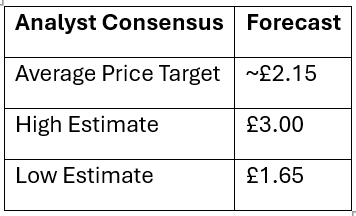
Source: analyst consensus estimates
Another estimate places the average target near £2.36, implying upside potential of about 20–30% from current levels.
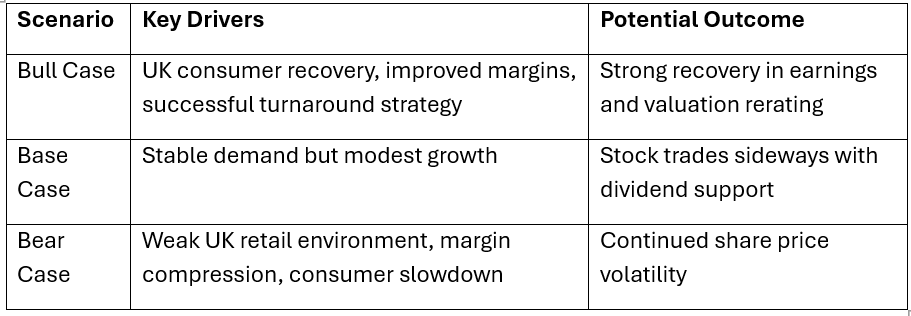
What Is the Bull vs Bear Scenario for BME Stock?
Scenario Matrix
Is LON:BME Stock Bullish, Bearish, or Neutral?
Short-Term Outlook (3–6 months)
Neutral to Bearish
Reasons:
- UK consumer demand remains fragile
• Cost inflation affecting margins
• Investor sentiment toward retail sector still cautious
However, short-term rebounds could occur during strong seasonal sales periods.
Medium-Term Outlook (1–3 years)
Neutral to Moderately Bullish
Drivers:
- Store expansion
• Turnaround strategy execution
• Recovery in UK retail spending
If management successfully improves operational efficiency, the stock could re-rate.
Long-Term Outlook (3–5 years)
Moderately Bullish
Reasons:
- Strong discount retail positioning
• Resilient value retail model during downturns
• Attractive dividend income potential
What Investment Strategies Could Investors Consider?
Short Term Strategy (3–6 months)
Investors may consider:
- Watching for earnings updates and trading statements
• Monitoring UK consumer spending data
• Trading around volatility rather than long-term positions
Medium Term Strategy
Possible approach:
- Gradual accumulation during market weakness
• Dividend income strategy
• Monitoring turnaround execution
Long Term Strategy
Long-term investors may focus on:
- Dividend compounding
• Recovery in UK retail sector
• Expansion in European markets
What Are the Key Risks Investors Should Watch?
Major risks include:
- Weak UK consumer demand
• Rising labour and logistics costs
• Competitive pressure from supermarkets and online retailers
• Execution risk in turnaround strategy
What Is the ESG Profile of B&M?
ESG considerations include:
Environmental
• Supply chain sustainability initiatives
Social
• Large workforce across UK and Europe
Governance
• Recent leadership changes and operational restructuring
Governance execution will be critical for rebuilding investor confidence.
FAQ – LON:BME Stock
Why did BME stock fall today?
The decline reflects broader market weakness, cautious investor sentiment, and concerns about slow growth in the UK retail sector.
Is BME a high dividend stock?
Yes. The stock has historically offered 7–8% dividend yield, although payouts may fluctuate.
Is BME undervalued?
Some analysts believe the stock trades at a discount valuation with potential upside of around 20%.
Is BME a turnaround play?
Yes. The company is currently executing a strategic turnaround focused on pricing and store efficiency.
Final Investment Conclusion: Is LON:BME a Contrarian Opportunity in 2026?
The recent 4.6% decline in LON:BME shares reflects ongoing uncertainty around UK consumer demand, rising retail operating costs, and investor caution toward mid-cap UK stocks.
However, the stock also presents a compelling contrarian investment narrative.
On one hand, the company faces real challenges: slower earnings growth, margin pressure, and a competitive retail environment. On the other hand, B&M still holds strong advantages including its discount retail model, large store network, and high dividend yield.
For investors seeking income and potential recovery upside, the stock may represent a long-term value opportunity. But for short-term traders, volatility could remain high until clearer signs of operational improvement emerge.
Ultimately, the investment thesis hinges on whether management can successfully execute its turnaround strategy while navigating a challenging UK retail environment.


 Jun 05, 2026




 Please wait processing your request...