
 AU
AU
 CA
CA
 US
US
 NZ
NZ
 IND
IND

 UK
UK

 Share
Share
 X (Formerly Twitter)
 Whatsapp
 Facebook
 LinkedIn
 Telegram
 Email This Article
 Copy Link
 Summarize with AI
 Chat GPT
 Perplexity
Key Takeaways – March 2026
- Vistry Group (LON: VTY) shares fell about 4.6% on 6 March 2026, reflecting pressure across UK housebuilding stocks.
• Investors remain cautious due to high mortgage rates, slower UK housing demand, and macroeconomic uncertainty in early 2026.
• The UK housing sector outlook remains mixed, with affordability challenges offset by structural housing shortages.
• Vistry’s partnership-led business model continues to attract long-term institutional interest despite short-term volatility.
• Analysts remain divided but generally see long-term potential in UK residential construction and affordable housing demand.
• Dividend expectations remain supported by cash flow visibility from partnerships with housing associations and local authorities.
Why Are UK Housing Stocks Like Vistry Facing Pressure in March 2026?
The FTSE 250 housebuilder stock Vistry Group (LON: VTY) declined around 4.6% on 6 March 2026, as investors reassessed the outlook for UK housing demand, mortgage affordability, and macroeconomic conditions.
Across the UK stock market, housebuilding shares have been volatile as the Bank of England’s interest-rate trajectory, UK inflation trends, mortgage costs, and housing affordability continue to influence sentiment. While the FTSE 100 and FTSE 250 indices remain broadly resilient in 2026, cyclical sectors like construction, homebuilding, and real estate development remain highly sensitive to macro signals.
Vistry’s share price movements also reflect broader concerns across UK property stocks, FTSE 250 residential developers, and UK housebuilding companies, where investors are evaluating housing demand, land acquisition costs, government housing policies, and economic growth forecasts.
What Is Happening in the UK Economy and Global Markets That Could Impact Vistry?
Global markets in March 2026 remain shaped by several macroeconomic drivers.
The UK economy is navigating a period of moderate growth, persistent inflation pressures, and cautious consumer spending. Higher borrowing costs have reduced mortgage affordability for many homebuyers.
Key macro drivers influencing UK housebuilders include:
- Interest rates remaining relatively elevated despite expectations of gradual cuts later in 2026
• Mortgage affordability constraints affecting first-time buyers
• Construction cost inflation moderating but still above historical averages
• Government housing initiatives focusing on affordable housing supply
• Structural UK housing shortage supporting long-term demand
Meanwhile, the British pound (GBP) has shown moderate stability against the US dollar and euro, but currency volatility still influences construction materials imports and developer margins.
For investors tracking FTSE 250 stocks and UK property shares, macroeconomic data remains a key short-term catalyst.
What Does Vistry’s Current Business Model Reveal About Its Growth Strategy?
Vistry Group plc operates a partnership-focused housebuilding model, which differentiates it from many traditional UK developers.
The company increasingly focuses on partnership housing, working with:
- Local authorities
• Housing associations
• Institutional investors
• Government housing initiatives
This model provides greater earnings visibility compared with traditional speculative housebuilding.
Key business model pillars include:
- Partnership housing developments
• Affordable housing supply programs
• Mixed-tenure communities
• Urban regeneration projects
According to recent company updates, Vistry continues to prioritize capital-light development and asset-turnover strategies, which support stronger return on capital employed (ROCE) compared with some peers.
Could Recent Operational Updates Be Affecting Investor Sentiment?
Recent investor concerns reflect broader industry dynamics rather than a company-specific crisis.
Factors affecting sentiment include:
- Softening UK housing transaction volumes
• Investor caution ahead of spring housing market data
• Profit-taking after previous rallies in housebuilder stocks
• Market sensitivity to interest-rate policy signals
However, company reports have emphasized strong forward order books and continued demand for affordable housing partnerships, which remain less cyclical than private home sales.
How Does Vistry Compare With Other UK Housebuilding Peers?
Peer comparison within the FTSE 100 and FTSE 250 housebuilder sector shows varied positioning.
Key competitors include:
- Barratt Redrow plc
• Taylor Wimpey plc
• Persimmon plc
Vistry’s key differentiator remains its partnership housing strategy, while many peers still rely heavily on private housing sales cycles.
Peer benchmarking highlights:
Strengths
- Higher exposure to government-supported housing projects
• Potentially more resilient cash flows
• Strong institutional partnerships pipeline
Challenges
- Lower margins compared with premium private housing projects
• Dependence on public housing budgets and planning approvals
What Is the Dividend Outlook for Vistry Stock?
Income investors continue to monitor Vistry due to its historically attractive dividend profile.
Dividend sustainability depends on:
- Cash generation from development partnerships
• Housing completions volume
• UK housing policy stability
Housebuilders typically generate strong cash flows in recovery phases of the housing cycle, which may support dividend growth once interest rates begin easing.
What Do Analysts and Brokers Forecast for Vistry Shares?
Leading analysts covering Vistry maintain varied outlooks.
Consensus broker views include:
- Jefferies – positive long-term outlook citing strong partnerships model
• Barclays – sees potential recovery alongside UK housing demand improvements
• RBC Capital Markets – cautious near-term but constructive long-term
• JP Morgan – highlights structural demand for affordable housing
Most analysts suggest that UK housing demand recovery could unlock valuation upside, though near-term volatility may persist.
What Are the Key Risks Investors Should Watch?
Key risks affecting Vistry include:
- Higher-for-longer interest rates affecting housing affordability
• Planning delays in UK construction projects
• Construction material costs volatility
• Changes to government housing policy
• Potential slowdown in UK economic growth
Housing developers remain among the most macro-sensitive sectors in the FTSE 250.
Scenario Analysis: Bull vs Bear Case for Vistry Stock
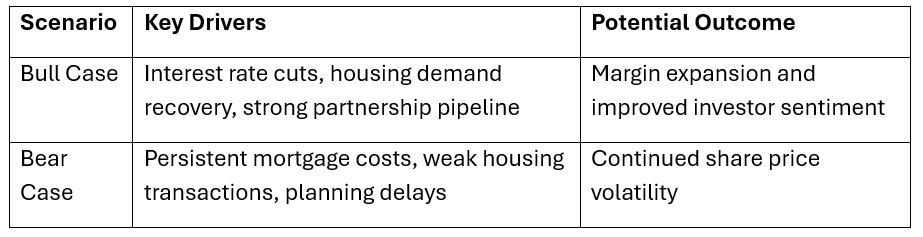
What Is the Short-Term Outlook for Vistry Shares?
Short-term (3–6 months) sentiment may remain neutral to slightly bearish due to macro uncertainty.
Drivers investors will watch include:
- UK interest-rate signals
• Housing transaction data
• Spring housing market demand trends
If mortgage rates begin easing, the sector could rebound quickly.
What Is the Medium-Term Outlook for the UK Housing Sector?
Medium-term outlook (1–3 years) appears more constructive.
Key supporting factors:
- Severe UK housing supply shortage
• Population growth and urban demand
• Government initiatives supporting housing delivery
Vistry’s partnership model could benefit disproportionately from these structural trends.
What Is the Long-Term Investment Case for Vistry?
Long-term outlook (5+ years) remains structurally positive for the UK housing sector.
Structural drivers include:
- Chronic housing undersupply in the UK
• Long-term population growth
• Continued government housing policy support
Developers with diversified business models and strong partnerships, like Vistry, may be better positioned for sustainable growth.
What Strategies Could Investors Consider?
Short-term investors
- Monitor macro data and interest-rate expectations
• Watch sector sentiment and housing transaction indicators
Medium-term investors
- Consider phased accumulation during volatility
• Track housing policy announcements
Long-term investors
- Focus on structural housing demand
• Evaluate cash flow sustainability and dividends
How Does ESG Positioning Influence Vistry’s Investment Case?
ESG considerations are increasingly important in the UK construction and real estate sector.
Vistry emphasizes:
- Sustainable housing developments
• Lower-carbon construction techniques
• Community regeneration initiatives
Sustainability credentials are becoming a key differentiator for institutional investors.
FAQ – Vistry Stock Analysis
Why did Vistry shares fall on 6 March 2026?
The decline reflects broader pressure on UK housebuilders amid interest-rate uncertainty and housing market sentiment.
Is Vistry a cyclical stock?
Yes. Like most housebuilders, its performance is tied to economic cycles and housing demand.
Does Vistry pay dividends?
The company has historically returned capital through dividends supported by development cash flows.
Is the UK housing market expected to recover?
Many analysts expect gradual recovery as mortgage rates decline and housing demand stabilizes.
Final Investment Conclusion: Is Vistry Stock Bullish or Bearish?
From a purely analytical perspective:
Short-term: Neutral to slightly bearish due to macro uncertainty and housing market sensitivity.
Long-term: Structurally bullish given:
- UK housing shortages
• Government support for housing development
• Vistry’s partnerships-driven strategy
For investors focused on FTSE 250 housing stocks and long-term property market trends, Vistry remains a company worth monitoring closely.


 Jun 05, 2026




 Please wait processing your request...