
 AU
AU
 CA
CA
 US
US
 NZ
NZ
 IND
IND

 UK
UK

 Share
Share
 X (Formerly Twitter)
 Whatsapp
 Facebook
 LinkedIn
 Telegram
 Email This Article
 Copy Link
 Summarize with AI
 Chat GPT
 Perplexity
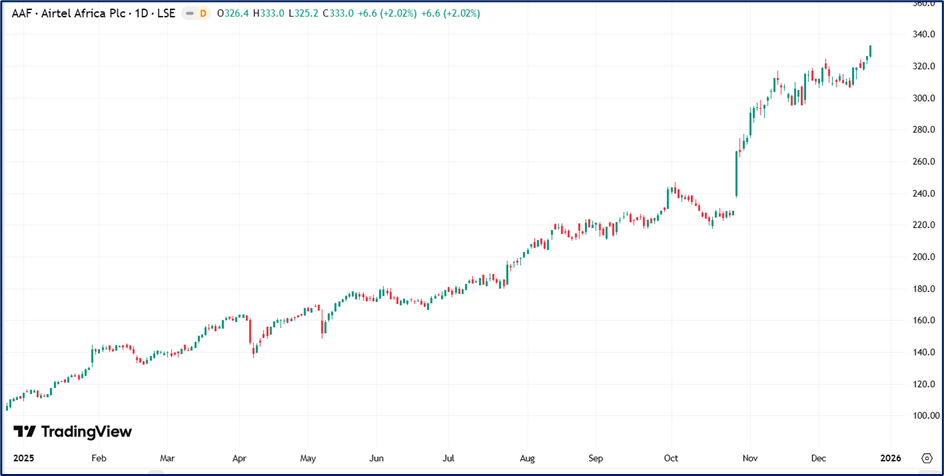
Airtel Africa PLC (LSE: AAF) saw its stock climb approximately 2% on December 22, 2025, continuing a robust trend that has seen it trade near its 52-week highs. While the broader FTSE 100 showed mixed movement, Airtel Africa’s outperformance signals growing investor confidence in its Pan-African growth story and digital finance pivot.
Key Reasons & Market Drivers for the Dec 22 Surge
The ~2% uptick on December 22 can be attributed to several converging factors:
Source: Kalkine Group
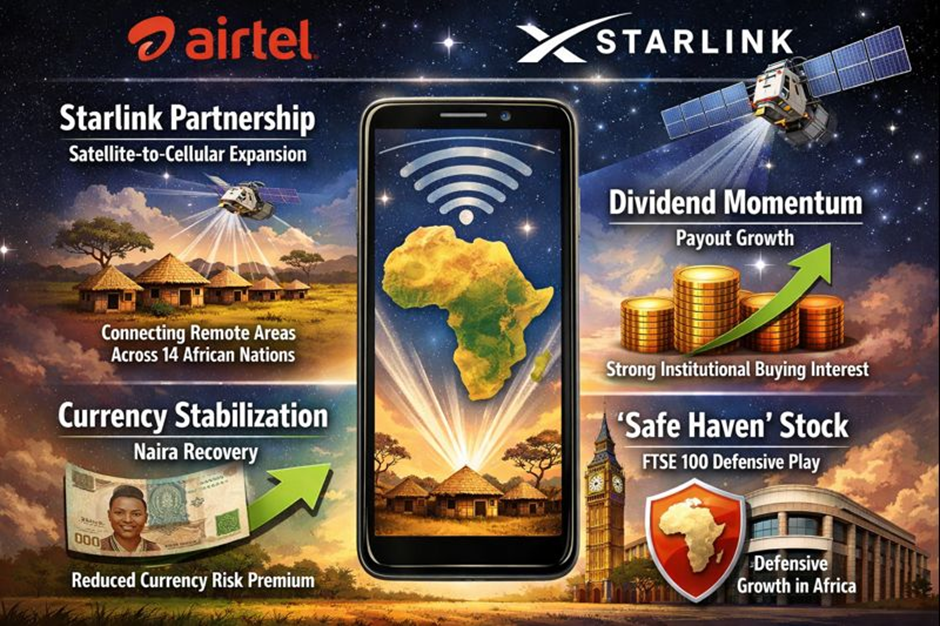
- Starlink Strategic Alliance: Just days prior, Airtel Africa announced a massive 14-nation partnership with SpaceX’s Starlink. This deal allows Airtel to provide "satellite-to-cellular" services in remote areas without the heavy capital expenditure of building physical towers. Investors are cheering this Capex-light expansion.
- Dividend Distribution Momentum: Following the December 12 interim dividend payment, the stock has seen renewed buying interest as institutional investors "roll over" positions.
- Currency Stabilization Sentiment: After a volatile period for the Nigerian Naira (NGN), recent stability in key operating markets has reduced the "currency risk premium" that typically weighs on the stock.
- Institutional "Safe Haven" Play: Within the FTSE 100, Airtel is increasingly viewed as a high-growth defensive play, offering exposure to African demographics with the regulatory oversight of a London listing.
Latest Business Model: Beyond Just SIM Cards
Airtel Africa has transitioned from a traditional "Telco" to a "Tech-Co" ecosystem. Its business model now rests on three distinct pillars:
- Mobile Services (Voice & Data): Leveraging a 4G-first strategy to convert voice users to data users. Data usage per customer has surged to approximately 7.0 GB/month.
- Airtel Money (Fintech): This is the "crown jewel." It operates as a mobile wallet and financial services platform, providing loans, insurance, and payments to the unbanked. It now accounts for over 20% of total revenue.
- Digital Infrastructure (Nxtra): A growing focus on data centers and fiber-to-the-home (FTTH) to support the continent's digital transformation.
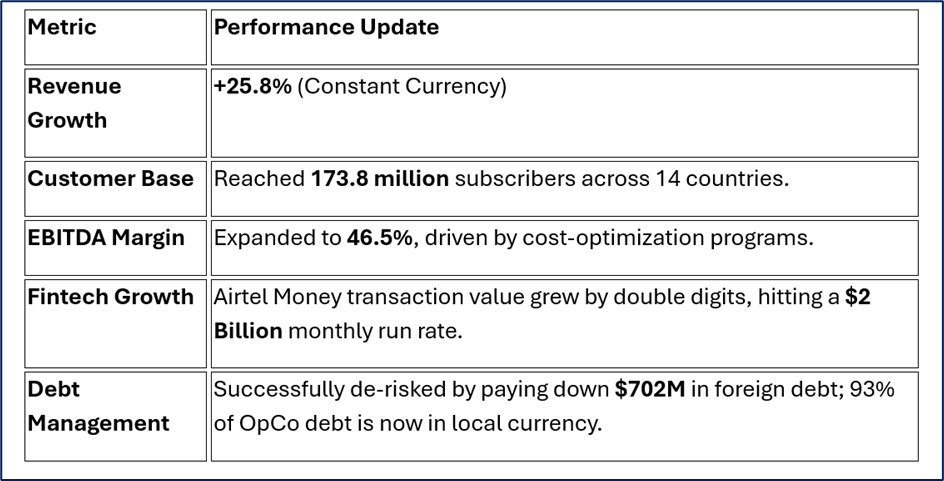
Latest Financial & Operational Updates (H1 2026/FY 2025)
Source: Company Data
SWOT Analysis: The 2025 Outlook
Source: Kalkine Group
Strengths
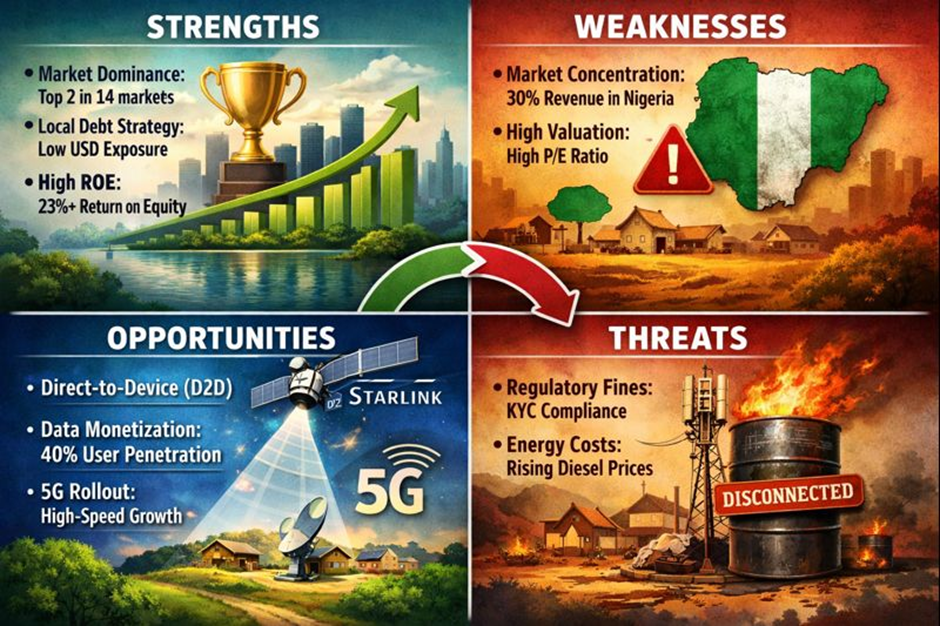
- Market Dominance: Top 2 position in nearly all 14 markets.
- Local Debt Strategy: Drastic reduction in US Dollar debt exposure protects against local currency crashes.
- High ROE: Boasts a return on equity of over 23%, significantly higher than European peers.
Weaknesses
- Market Concentration: Heavy reliance on Nigeria (over 30% of revenue) makes it sensitive to local regulatory shifts.
- High Valuation: A high P/E ratio compared to traditional telcos reflects growth expectations but leaves little room for error.
Opportunities
- Direct-to-Device (D2D): The Starlink partnership eliminates "dead zones" and opens new revenue from rural connectivity.
- Data Monetization: Only ~40% of the customer base are currently data users, representing a massive upgrade runway.
- 5G Rollout: Capturing high-value enterprise and home broadband segments.
Threats
- Regulatory Fines: Strict "Know Your Customer" (KYC) regulations in markets like Nigeria can lead to sudden subscriber disconnections.
- Energy Costs: High diesel prices for powering rural towers remain a persistent margin drag.
Key Risks to Watch
- Hyperinflationary Accounting: Ongoing inflation in markets like Ethiopia and Nigeria requires complex accounting adjustments that can obscure underlying performance.
- Regulatory Scrutiny: Increased taxes on mobile money transactions by cash-strapped African governments could dampen fintech margins.
- Infrastructure Dependency: Reliance on third-party tower companies (IHS, ATC) for physical assets.
Conclusion
Airtel Africa is no longer just a "risky emerging market bet." Its pivot toward Fintech and Satellite partnerships has transformed it into a high-tech growth engine within the FTSE 100. The 2% rise on December 22 reflects a market that is beginning to price in the long-term efficiency of its new hybrid (Satellite + Terrestrial) network model.
Source: Trading View, 22 December 2025


 Jun 03, 2026




 Please wait processing your request...