
 AU
AU
 CA
CA
 US
US
 NZ
NZ
 IND
IND

 UK
UK

 Share
Share
 X (Formerly Twitter)
 Whatsapp
 Facebook
 LinkedIn
 Telegram
 Email This Article
 Copy Link
 Summarize with AI
 Chat GPT
 Perplexity
_02_09_2026_15_52_57_359958.png)
Highlights
- Airtel Africa reported a 28.30% year-on-year revenue increase for 9M FY26.
- Profit after tax surged 136.60% year-on-year during the nine months ended December 2025.
- Management is targeting margin improvement through cost efficiency and scaling data and fintech services.
- Strategic monetisation initiatives, including the proposed Airtel Money listing, remain under consideration.
Airtel Africa PLC (LSE:AAF) is an FTSE 100 telecommunications group providing mobile and mobile money services across Africa. The company operates in 14 countries spanning Central, East and West Africa. Formed in 2018, Airtel Africa is headquartered in London, United Kingdom.
Financial Performance
For the nine months ended 31 December 2025 (9M FY26), the company delivered a notable improvement across key financial metrics, reflecting stronger operating outcomes compared with the prior corresponding period.
Revenue for 9M FY26 rose to USD 4,667.00 million, up from USD 3,638.00 million in 9M FY25, representing a year-on-year increase of 28.30%. The revenue growth translated into improved profitability, with operating profit increasing to USD 1,526.00 million from USD 1,081.00 million, marking a 41.3% year-on-year rise over the same period.
Profit after tax reached USD 586.00 million in 9M FY26 compared with USD 248.00 million in the prior year period. This reflected a year-on-year increase of 136.60%, supported by higher operating leverage and improved earnings conversion during the nine-month period.
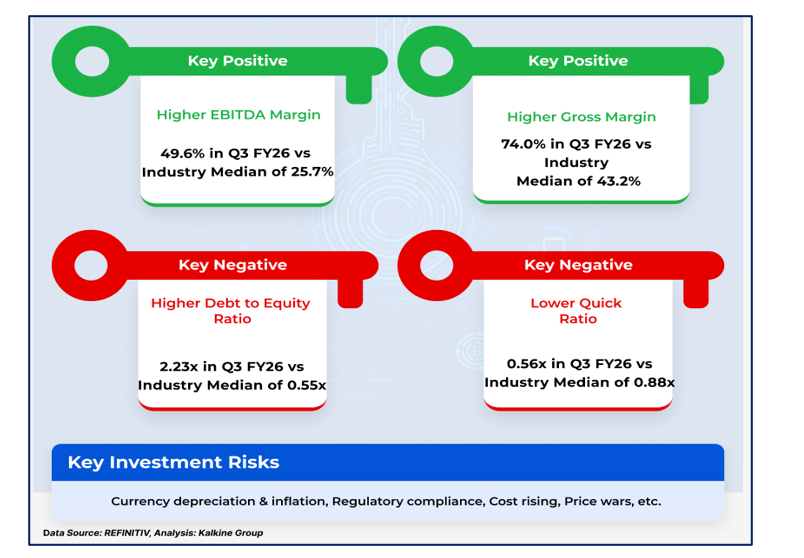
Key balance sheet indicators also showed movement during FY26. In Q3 FY26, the debt-to-equity ratio declined to 2.23x, down from 2.38x in Q1 FY26 and 2.27x in Q2 FY26, indicating a gradual reduction in leverage over the course of the financial year.
At the same time, the reinvestment rate increased to 6.30% in Q3 FY26, compared with 5.00% in Q1 FY26 and 2.70% in Q2 FY26. The higher reinvestment rate reflects increased capital deployment during the quarter, aligned with growth-related initiatives.
Overall, the 9M FY26 period was characterised by higher revenue, improved profitability, a declining leverage trend, and increased reinvestment activity, when compared on a year-on-year and sequential quarterly basis.
Company Outlook
The company plans to continue investing in network infrastructure and mobile money platforms, with the objective of capturing growth linked to digital adoption and financial inclusion across African markets.
Margin expansion remains a focus through disciplined cost efficiency measures, alongside scaling data services and fintech-related revenue streams that are expected to contribute higher returns.
In addition, the company intends to pursue strategic monetisation initiatives, including the proposed Airtel Money listing, to strengthen the balance sheet and support future growth funding.
Top 10 Shareholders
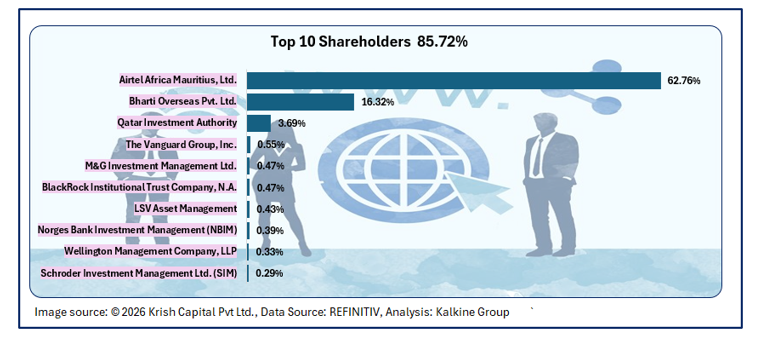
The top 10 shareholders collectively own about ~85.72% of the company's total shares. Airtel Africa Mauritius, Ltd. and Bharti Overseas Pvt. Ltd. hold maximum stakes in the company at ~62.76% and ~16.32%, respectively.
Stock Information
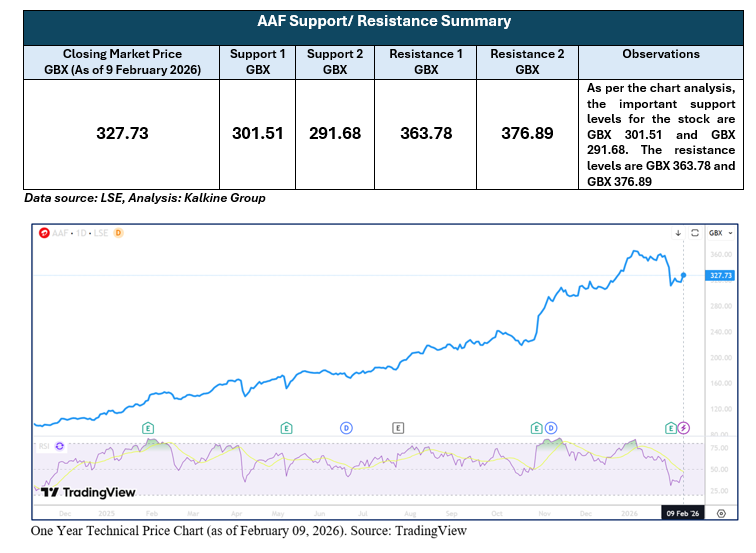
AAF has moved up by ~2.63% in the last week while gaining approximately ~10.82% over the last three months. The stock has a 52-week high and 52-week low of GBX 375.40 and GBX 135.10, respectively, and is currently trading above the average of the 52-week high-low level.
Note 1: Past performance is not a reliable indicator of future performance.
Note 2: The reference data for all price data, currency, technical indicators, support, and resistance levels is 9 February 2026. The reference data in this report has been partly sourced from EODHD/Others.
Technical Indicators Defined
Support: A level at which the stock prices tend to find support if they are falling, and a downtrend may take a pause backed by demand or buying interest. Support 1 refers to the nearby support level for the stock and if the price breaches the level, then Support 2 may act as the crucial support level for the stock.
Resistance: A level at which the stock prices tend to find resistance when they are rising, and an uptrend may take a pause due to profit booking or selling interest. Resistance 1 refers to the nearby resistance level for the stock and if the price surpasses the level, then Resistance 2 may act as the crucial resistance level for the stock.


 Jun 29, 2026




 Please wait processing your request...