
 AU
AU
 CA
CA
 US
US
 NZ
NZ
 IND
IND

 UK
UK

 Share
Share
 X (Formerly Twitter)
 Whatsapp
 Facebook
 LinkedIn
 Telegram
 Email This Article
 Copy Link
 Summarize with AI
 Chat GPT
 Perplexity
The London stock market witnessed a significant mover on 8 January 2026, as BAE Systems (LSE: BA) jumped approximately 6%, piercing through previous resistance levels to trade near £20.52. This rally comes on the heels of the FTSE 100’s historic push past the 10,000-point milestone, with aerospace and defence leaders acting as the primary engine for the index.
The surge is characterized by a "perfect storm" of geopolitical escalations, including fresh US-led interventions in South America and the capture of President Maduro, which have refocused global markets on the necessity of "hard power" and long-term defence spending.
Key Drivers of the 8 January Rally
The immediate 6% jump was fueled by a combination of high-conviction institutional buying and macro-economic shifts:
- Geopolitical Risk Premium: Investors are pricing in a structurally higher baseline for defence budgets following the US intervention in Venezuela. This has validated the "risk-hedge" status of BAE Systems.
- NATO Spending Pledges: Recent reiterations from NATO members to exceed the 2% GDP spending benchmark—with some aiming for 2.5% to 3%—provide a multi-year funding tailwind that underpins BAE’s massive order book.
- Sector Rotation: As broader tech and AI valuations face scrutiny, capital is rotating into "quality" industrials with visible cash flows and record backlogs.
- Space & Intelligence Momentum: Positive sentiment surrounding BAE’s "Space as a Service" and the launch of the Azalea RF satellite cluster has repositioned the firm as a high-tech niche leader beyond traditional munitions.

Source: Kalkine Group
Technical Analysis: The Bullish Breakout
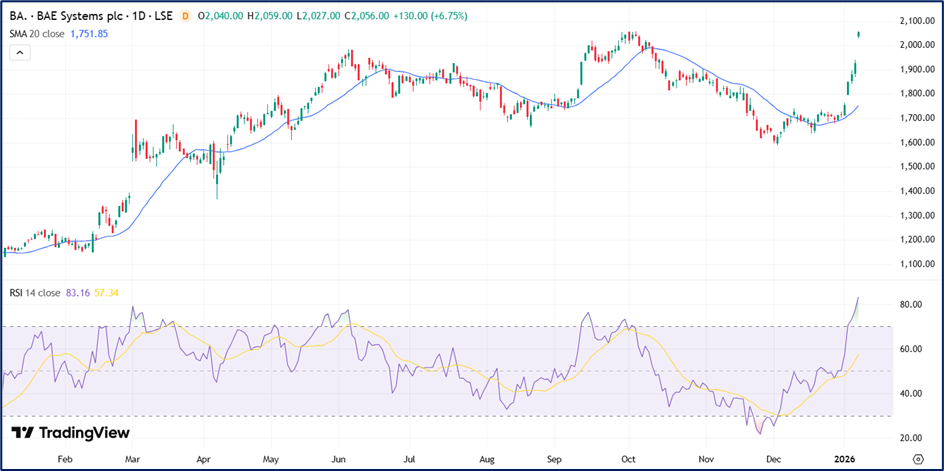
From a technical perspective, the price action on 8 January 2026 has confirmed a decisive breakout from a prior consolidation band. The stock is currently holding firmly above the £1,850 support zone, validating the current bullish trend leg.
- Moving Averages: BA. is trading well above its 50-day and 200-day moving averages, with the 20-day average sloping sharply upward, a classic signal of strong momentum.
- Volume & RSI: Trading volumes on this 6% move have significantly exceeded the 30-day average, suggesting institutional accumulation. The Relative Strength Index (RSI) is approaching 70, indicating overbought conditions in the short term, though previous cycles suggest the stock can remain at these levels during sustained rallies.
- Price Targets: Analysts are now eyeing the £2,300 to £2,370 region as the next major resistance level, representing a significant extension of the current trend.
Source: Trading View
Analyst Upgrades & Market Sentiment
While the market is largely bullish, the analyst community remains divided on current valuations:
- Kepler Capital Markets: Recently upgraded the stock from "Strong Sell" to "Hold," citing that the bearish thesis on valuation has been overwhelmed by the sheer volume of new orders.
- Erste Group Bank & Goldman Sachs: Maintain "Buy" ratings, with price targets ranging up to £2,500, highlighting BAE’s superior scale and dominant position in the AUKUS and Eurofighter programs.
- Bernstein (Adrien Rabier): Issued a more cautious "Market Perform" (Downgrade from Outperform), reducing the price target to £19.50. Bernstein argues that while BAE is a "high-quality" company, its growth is already well-understood by the market, leaving limited room for further "re-rating" compared to smaller European peers.
Business Model Evolution: Beyond Hard Armor
BAE Systems has transitioned from a traditional hardware manufacturer into a diversified technology powerhouse. Its latest business model rests on four key pillars:
- Digital Intelligence & Cyber: Focusing on AI-enabled targeting, electronic warfare, and national cyber-security defense.
- Space Value Chain: Through the acquisition of Ball Aerospace, BAE now provides satellite payloads, RF sensing, and on-board data processing.
- AUKUS & Maritime Supremacy: As a lead contractor for the tri-lateral submarine program, BAE has secured decades of high-visibility revenue.
- Sustainability & Green Propulsion: Developing low-carbon flight technologies and electric propulsion for future combat air platforms to meet government ESG mandates.
Financial and Operational Updates (2025–2026)
- Record Backlog: The order book sits at a staggering £78.3 billion, providing revenue visibility through the next decade.
- Revenue Growth: 2026 revenues are forecast to reach approximately £30 billion, up from £28.3 billion in 2024, driven by a 7-9% annual growth rate.
- Cash Generation: BAE expects free cash flow (FCF) for 2025-2026 to exceed £4 billion cumulatively, supporting a £1.5 billion three-year share buyback program.
- Operational Expansion: Construction is nearing completion on the new ship-build assembly hall in Glasgow and an advanced technology factory in the UK to support Electronic Systems.
Potential Risks and Headwinds
- Valuation Stretch: With a forward P/E ratio approaching 30x in early 2026, the stock is no longer "cheap" compared to its historical 10-year average of 14x.
- Supply Chain Constraints: Tightness in specialized semiconductors and a shortage of skilled labor continue to pressure operating margins, currently hovering around 11.5%.
- Political Shifts: While current geopolitical tensions are high, any sudden diplomatic breakthroughs or peace deals in major conflict zones could lead to a rapid de-rating of defence stocks.
- Project Delays: Large-scale programs like the Dreadnought submarines or the Global Combat Air Program (GCAP) carry inherent risks of cost overruns and schedule slippage.
Conclusion
The 6% surge on 8 January 2026 marks BAE Systems' transition from a stable dividend payer to a high-momentum growth stock. While some analysts warn that the current price reflects "perfection," the company’s record backlog and strategic expansion into space and cyber-intelligence suggest a business that is fundamentally more resilient than in previous decades. As the FTSE 100 explores new territory above 10,000, BAE remains a bellwether for global security spending and institutional risk appetite.


 Jun 03, 2026




 Please wait processing your request...