
 AU
AU
 CA
CA
 US
US
 NZ
NZ
 IND
IND

 UK
UK

 Share
Share
 X (Formerly Twitter)
 Whatsapp
 Facebook
 LinkedIn
 Telegram
 Email This Article
 Copy Link
 Summarize with AI
 Chat GPT
 Perplexity
Can NatWest Shares Defy Gravity After a Historic Surge?
The meteoric rise of NatWest Group has caught many retail and institutional investors by surprise, transforming a once-stagnant state-backed lender into one of the FTSE 100’s standout performers. This rally, driven by a convergence of favourable macroeconomic winds and sharp strategic pivots, begs the question of sustainability.
The primary engine behind this ascent has been the bank's successful return to full private ownership, a psychological and structural milestone that removed the "government overhang" which had depressed the valuation for over a decade. With the British government selling its final stake, the bank is no longer tethered to political timelines, allowing management to pursue aggressive capital allocation strategies that favour shareholders directly.
Furthermore, the high-interest-rate environment of 2023-2025 provided a massive tailwind to Net Interest Margins (NIM), allowing the bank to generate record profits from its lending activities while keeping deposit betas—the rate at which it passes interest hikes to savers—relatively managed.

Source: Kalkine Group
- Government Exit: The complete sale of the UK government’s stake has removed a persistent supply of shares that capped rallies, fundamentally altering the stock's supply-demand dynamics.
- Interest Rate Tailwinds: Higher-for-longer rates have supercharged net interest income, creating a profitability buffer that the bank has used to clean up its balance sheet.
- Capital Returns: Aggressive share buybacks and hefty dividend payouts have attracted income-focused investors, creating a floor for the share price even during market volatility.
Latest Business Model & Operational Efficiency
NatWest has aggressively streamlined its business model, pivoting away from volatile investment banking activities to focus on being a "simple, safe" UK-focused commercial and retail bank. The latest updates from late 2025 emphasize a digital-first strategy, with the bank closing physical branches to reduce overheads while investing heavily in its mobile app and AI-driven customer service tools. This operational leverage is evident in their cost-to-income ratio, which has seen tangible improvements as legacy costs fall away. The bank is now heavily weighted towards mortgages and commercial lending, sectors that—while sensitive to the economy—provide predictable, recurring cash flows.
- Digital Transformation: Closure of physical branches continues to reduce the cost base, with savings reinvested into high-margin digital lending platforms.
- Focus on Wealth: The bank is expanding its affluent and private banking arm (Coutts and others) to capture higher fee-based income, reducing reliance on pure interest income.
- Risk Management: Provisions for bad loans remain lower than historical averages, suggesting the bank’s loan book is higher quality than in previous cycles.
Financial Health & Recent Updates
Financial results for the latter half of 2025 painted a picture of a bank firing on all cylinders. The group reported a Return on Tangible Equity (RoTE)—a key measure of profitability—well above its medium-term targets, consistently hitting the high teens. Revenue guidance was recently upgraded to approximately £16.3 billion, defying skeptics who predicted a sharp drop-off as interest rates began to tick down. Crucially, the bank's "structural hedge"—a mechanism used to smooth out income volatility from interest rate changes—is now reinvesting at higher yields, which will support earnings for years to come even as the Bank of England cuts base rates.
- RoTE Outperformance: Consistently delivering Return on Tangible Equity above 15-17%, a premium figure compared to European peers.
- Income Guidance Upgrade: Management recently lifted income expectations, signalling confidence in the resilience of the UK consumer and corporate borrower.
- Strong Capital Buffer: A robust CET1 ratio (a measure of financial strength) allows for continued share buybacks without jeopardizing regulatory compliance.
Technical Analysis: A Bullish Trend or Overextended?
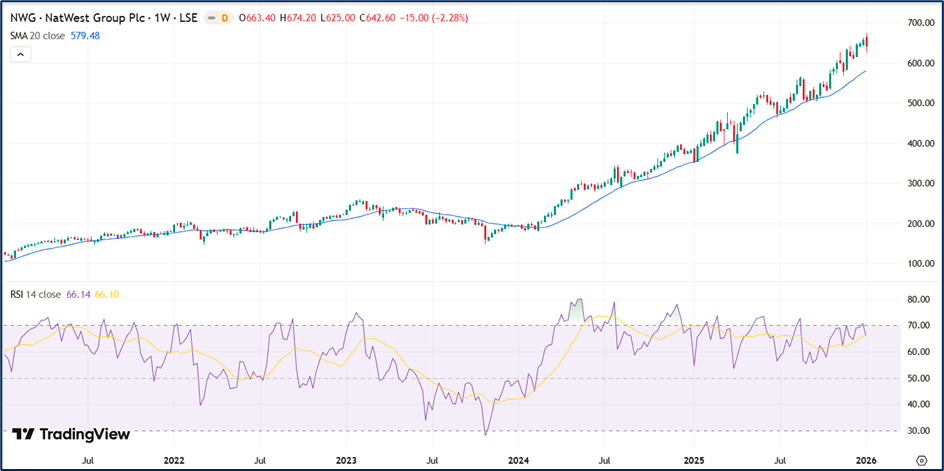
Source: Trading View
From a technical perspective, NatWest shares are currently trading in a strong uptrend, consistently making higher highs and higher lows. The stock is holding firmly above both its 50-day and 200-day moving averages, a classic "golden cross" configuration that typically signals long-term bullish momentum. However, the sheer velocity of the recent 262% move has pushed the Relative Strength Index (RSI) into territories that often precede a period of consolidation. While not necessarily a sell signal, the charts suggest the stock may need to "breathe" or trade sideways to digest recent gains before the next leg up. Support levels have formed at previous resistance points, indicating strong buyer interest on any dips.
- Trend Confirmation: Price action remains above key long-term moving averages, confirming a structural bull market is still intact.
- Momentum Indicators: RSI levels are elevated but not critically overbought, suggesting the rally is driven by genuine volume rather than speculative froth.
- Support Levels: Previous breakout zones are now acting as solid support, providing a safety net for traders entering at these elevated levels.
Analyst Sentiment: Upgrades, Downgrades, and Caution
The analyst community remains divided, reflecting the tension between past performance and future valuation. Recent notes from major houses like Barclays and JPMorgan have been mixed; while some have downgraded the stock to "Equal Weight" or "Hold" purely on valuation grounds—arguing the "easy money" has been made—others have raised price targets, citing the bank's ability to compound earnings through buybacks. The consensus has shifted from an aggressive "Buy" to a more measured "Hold/Accumulate," acknowledging that while the fundamental story is excellent, the risk-reward ratio is less compelling than it was 12 months ago.
- Valuation Concerns: Some analysts argue the stock is now "priced for perfection," leaving little room for error if UK economic data weakens.
- Target Hikes: Despite downgrades in ratings, many firms have actually increased their numerical price targets, acknowledging the stock's momentum.
- Dividend Appeal: Analysts universally agree the yield remains attractive, keeping the stock a core holding for income funds.
Risks to the Bull Case
Investors must remain cognizant of the macroeconomic risks that could derail this momentum. The primary threat is a faster-than-expected decline in UK interest rates, which would compress the Net Interest Margin that has fueled recent profits. Additionally, the UK economy remains fragile; any uptick in unemployment could lead to a spike in loan defaults, forcing the bank to increase impairment provisions and eat into profits. Regulatory intervention also remains a wildcard, with potential scrutiny on banking profits or changes in capital requirements always a possibility under a new government regime.
- NIM Compression: Rapid rate cuts by the Bank of England could erode profitability faster than the bank can cut costs.
- Economic Downturn: A recession in the UK would directly impact the bank’s mortgage and SME loan books.
- Political Risk: Windfall taxes or regulatory tightening on the banking sector could target excess profits.
Conclusion
NatWest's 262% surge is not merely a speculative bubble but a rational repricing of a bank that has successfully shed its state-owned baggage and optimized its operations. While the pace of the ascent is unlikely to be replicated in the short term, the fundamental drivers—capital returns, operational efficiency, and a hedged income stream—remain intact. The stock has likely transitioned from a "deep value" recovery play to a "compounder" phase, where returns will be driven more by dividends and steady earnings growth than by multiple expansion. For existing holders, the trend remains a friend; for new entrants, patience for a technical pullback might be the prudent strategy.


 Jun 03, 2026




 Please wait processing your request...