
 AU
AU
 CA
CA
 US
US
 NZ
NZ
 IND
IND

 UK
UK

 Share
Share
 X (Formerly Twitter)
 Whatsapp
 Facebook
 LinkedIn
 Telegram
 Email This Article
 Copy Link
 Summarize with AI
 Chat GPT
 Perplexity
NVIDIA Stock Surge: The China H200 Rebound and 2026 Growth Catalysts
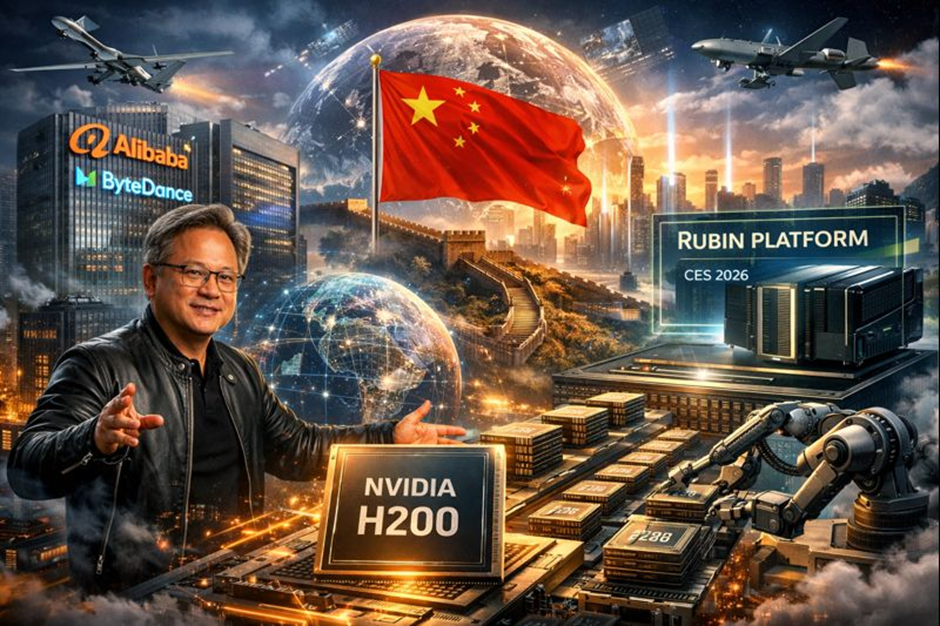
NVIDIA Corporation (NVDA) has witnessed a significant uptick in market sentiment following reports that Chinese regulators have signaled an "in-principle" approval for the country’s tech titans—including Alibaba, Tencent, and ByteDance—to begin preparing orders for the H200 AI chips. This development marks a pivotal shift in the geopolitical landscape, potentially unlocking a massive wave of demand that was previously stalled by trade uncertainties.
The 2026 NVIDIA Pulse: Key Reasons for the Surge & Latest Drivers
Source: Kalkine Group
The primary catalyst for the current surge is the strategic opening of the Chinese market for high-end AI accelerators.
- China’s In-Principle Approval: Reports indicate that Chinese authorities have moved to the next stage of procurement for the H200, allowing tech giants to discuss specific quantities. This contradicts earlier fears of a total ban and suggests a pragmatic approach where China balances domestic chip growth with the necessity of NVIDIA’s superior architecture.
- Massive Order Volume: Private indications suggest that players like Alibaba and ByteDance are interested in ordering over 200,000 units of H200 chips each, representing a multi-billion dollar revenue pipeline (Source: Bloomberg).
- The Rubin Platform Launch: Jensen Huang’s announcement at CES 2026 that the Rubin platform is in full production provides a clear roadmap beyond Blackwell, ensuring that NVIDIA maintains its "one-year update" cadence that rivals struggle to match (Source: NVIDIA Newsroom).
- Sovereign AI Infrastructure: Governments globally are increasingly treating AI as a matter of national security, leading to massive state-funded investments in localized data Centres powered by NVIDIA systems.
Current Business Model: Beyond Silicon
NVIDIA has evolved from a chip manufacturer into a Full-Stack AI Platform Provider.
- Data Centre-Centricity: The core of the business now resides in the Data Centre segment, which generates approximately 78% of total revenue. This includes the sale of HGX, DGX, and the new Blackwell/Rubin systems.
- The CUDA Moat: NVIDIA’s proprietary software stack, CUDA, remains the industry standard for AI development, creating high switching costs for engineers and researchers.
- Software-as-a-Service (SaaS): Through DGX Cloud and NVIDIA AI Enterprise, the company is growing recurring revenue by providing the software tools and infrastructure needed to train and deploy "Agentic AI" (Source: NVIDIA Investor Relations).
- Ecosystem Expansion: NVIDIA is aggressively moving into Automotive (DRIVE platform), Robotics (Isaac), and Industrial Digital Twins (Omniverse), diversifying its footprint while keeping the GPU at the Centre of the compute cycle.
Latest Financial, Operational, and Dividend Updates (company sourced)
- Record-Breaking Revenue: For the third quarter of fiscal 2026 (ended October 2025), NVIDIA reported record revenue of $57.0 billion, up 62% year-over-year. Data Centre revenue alone reached $51.2 billion (Source: NVIDIA Q3 FY26 Financial Results).
- Strong Profitability: GAAP gross margins remained robust at 73.4%, driven by the transition to higher-margin Blackwell products and increased production efficiencies.
- Future Guidance: Management expects fourth-quarter revenue to reach approximately $65.0 billion, reflecting continued insatiable demand for AI infrastructure (Source: CFO Commentary, Colette Kress).
- Shareholder Returns: In the first nine months of fiscal 2026, NVIDIA returned $37.0 billion to shareholders through buybacks and dividends. An additional $60.0 billion was recently authorized for future share repurchases.
- Dividend Status: The company maintained its quarterly cash dividend of $0.01 per share, with the most recent payment distributed in late December 2025 (Source: NVIDIA Press Release).
Latest SWOT Analysis
Source: Kalkine Group
Strengths
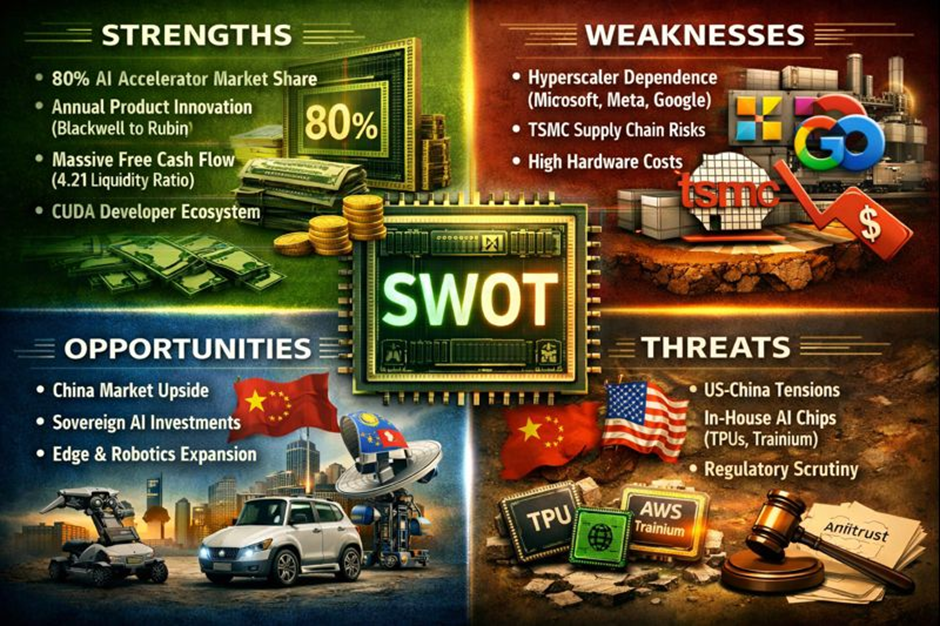
- Unrivaled Market Share: Controlling over 80% of the AI accelerator market.
- Innovation Velocity: Fulfilling the promise of an annual product update cycle (Blackwell to Rubin).
- Financial Fortitude: Massive free cash flow and a healthy liquidity ratio (approx. 4.21).
- Developer Lock-in: Millions of developers globally are trained on the CUDA ecosystem.
Weaknesses
- Customer Concentration: A small group of "Hyperscalers" (Microsoft, Meta, Google) accounts for nearly 40% of revenue.
- Supply Chain Vulnerability: Heavy reliance on TSMC for advanced CoWoS packaging and manufacturing.
- Pricing Perception: Rising hardware costs may eventually lead to buyer fatigue or push customers toward lower-cost alternatives.
Opportunities
- China Market Normalization: Potential for $2–$5 billion in upside if trade tensions continue to ease (Source: Investing.com).
- Sovereign AI: Capturing state-level investments in AI infrastructure across Europe, the Middle East, and Asia.
- Edge & Robotics: The transition from "Cloud AI" to "Physical AI" (autonomous robots and vehicles).
Threats
- Geopolitical Volatility: Ongoing US-China trade restrictions remain a primary headwind for long-term planning.
- Internal Competition: Major cloud providers (Google, Amazon) developing their own in-house AI silicon (TPUs/Trainium).
- Regulatory Scrutiny: Increasing antitrust focus on NVIDIA’s market dominance in the US and EU.
The 2026 Outlook and Risk Profile
The outlook for the remainder of 2026 is dominated by the Blackwell ramp-up and the transition to the Rubin architecture. Demand for training large language models (LLMs) and the emerging field of Inference (running the models) is showing no signs of slowing. However, the cyclical nature of the semiconductor industry remains a lingering risk. If the "AI payoff" for enterprises takes longer than expected, a slowdown in infrastructure spending could lead to a temporary revenue plateau. Furthermore, supply chain bottlenecks—specifically in High-Bandwidth Memory (HBM)—could limit NVIDIA’s ability to meet its full growth potential.
Conclusion
NVIDIA’s recent surge is more than just a reaction to a single news cycle; it is a validation of the company's ability to navigate complex global politics while maintaining a ruthless pace of innovation. By securing a potential re-entry into the massive Chinese market with the H200, while simultaneously pushing the boundaries of compute with the Rubin platform, NVIDIA has solidified its role as the indispensable engine of the AI era. While risks regarding supply chains and customer concentration persist, the company’s evolution into a full-stack platform suggests it is well-positioned to remain at the Centre of the global technological shift.


 Jun 03, 2026




 Please wait processing your request...