
 AU
AU
 CA
CA
 US
US
 NZ
NZ
 IND
IND

 UK
UK

 Share
Share
 X (Formerly Twitter)
 Whatsapp
 Facebook
 LinkedIn
 Telegram
 Email This Article
 Copy Link
 Summarize with AI
 Chat GPT
 Perplexity
The 4% Passive Income Quest: Why the FTSE 100 is 2026’s Yield King
Generating a £2,000 annual return on a £50,000 portfolio requires a 4% net dividend yield. While global tech markets are grappling with "AI fatigue" and stretched valuations, the FTSE 100 has entered 2026 as a standout performer, recently crossing the historic 10,000-point milestone.
The index remains a "cash machine" for income seekers because it is heavily weighted toward defensive, cash-generative sectors like financials, energy, and consumer staples. Unlike the S&P 500, which prioritizes growth, the UK’s blue-chip index is built on a culture of returning capital to shareholders. Analysts currently project the FTSE 100 to pay out a record-breaking £86 billion in dividends in 2026, supported by robust earnings in the banking and mining sectors.
High-Yield Contenders for Your 2026 Income Portfolio
Source: Kalkine Group
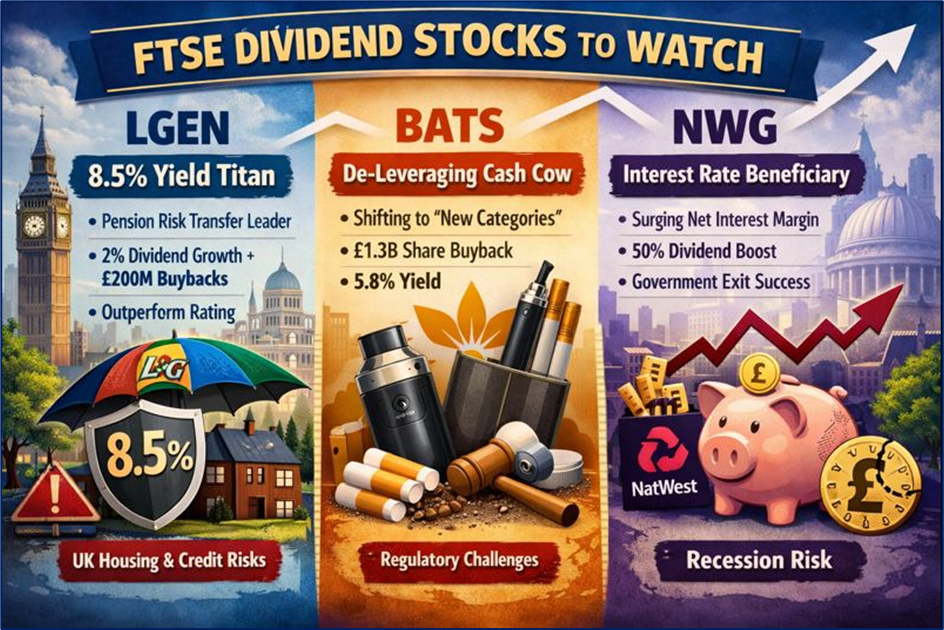
- Legal & General (LGEN): The 8.5% Yield Titan
- Key Drivers: As a leader in pension risk transfer (PRT) and retirement solutions, L&G benefits from an aging demographic and a massive structural shift in corporate pension management.
- Latest Financials: Management recently transitioned to a new capital return policy, pledging 2% annual dividend growth alongside £200 million in yearly share buybacks.
- Analyst View: Currently holds an "Outperform" consensus. Analysts highlight its market-leading solvency position despite a lower dividend cover of 0.30x, which reflects its accounting for long-term cash flows.
- Risks: High sensitivity to UK credit spreads and potential volatility in the UK housing market impacting its investment arm.
- British American Tobacco (BATS): The De-Leveraging Cash Cow
- Key Drivers: Despite the regulatory "war on smoking," BATS is successfully pivoting toward "New Categories" (Vapour and Oral tobacco), which are nearing profitability.
- Latest Financials: The company confirmed it is on track to meet 2025/2026 earnings targets and will initiate a £1.3 billion share buyback program this year.
- Analyst View: Morningstar recently raised its fair value estimate to £43.40. It offers a forward yield of approximately 5.8%, making it a cornerstone for high-yield seekers.
- Risks: Rapidly shifting global regulations on nicotine and the legal costs associated with its legacy US business.
- NatWest Group (NWG): The Interest Rate Beneficiary
- Key Drivers: Banks are no longer the pariahs of the FTSE. NatWest is enjoying the "Goldilocks" zone of interest rates—high enough to maintain fat net interest margins (NIM), but low enough to avoid a wave of consumer defaults.
- Latest Financials: The bank recently hiked its interim payout by over 50%, fueled by strong retail and commercial lending volumes.
- Analyst View: Upgraded by several houses in Q4 2025 following the UK government’s successful exit from its shareholding, removing a long-term "overhang" on the stock price.
- Risks: A potential UK recession in late 2026 could force higher impairment charges on loans.
Technical Analysis: The 10,000 Support Level
Source: Trading View
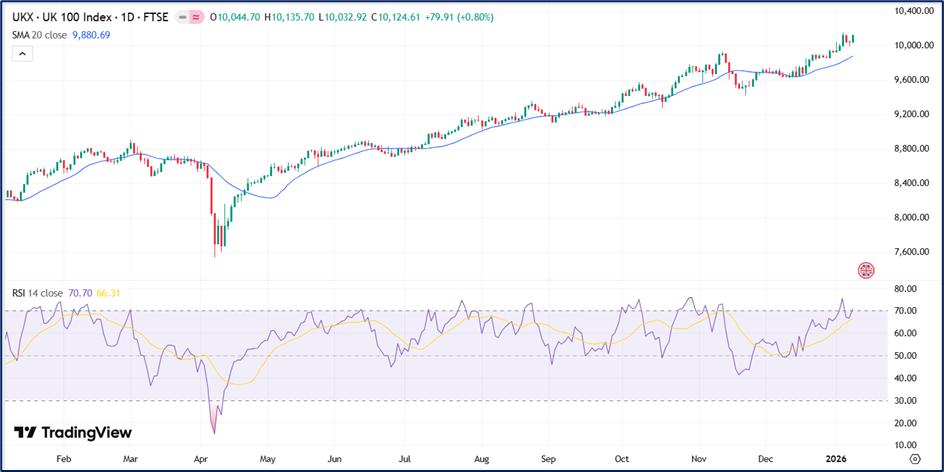
The FTSE 100 is currently exhibiting a strong bullish trend, having successfully used the 9,800 level as a launchpad to clear the psychological 10,000 barrier in early January 2026. From a technical perspective, the Relative Strength Index (RSI) is hovering near 71, suggesting the market is nearing "overbought" territory but still has room for momentum. The 50-day moving average has crossed above the 200-day moving average (a "Golden Cross"), signaling long-term structural strength.
For an investor with £50,000, this suggests that while the "easy money" of the 2025 rally has been made, the index is establishing a new, higher floor, making pullbacks toward 9,900 attractive entry points for income-focused buyers.
Strategic Risks and 2026 Headwinds
- Dividend Tax Traps: Following the most recent Autumn Budget, investors outside of ISA wrappers face a basic dividend tax rate increase to 10.75% starting April 2026. This effectively eats into your £2,000 target.
- Sector Concentration: The FTSE 100’s reliance on "Old Economy" stocks (Oil, Mining, Banks) means your income is tied to global commodity prices and interest rate cycles. If Brent Crude drops below $65 or the Bank of England cuts rates aggressively, dividend cover for the likes of BP or Shell could tighten.
- The "Value Trap" Risk: Stocks like Vodafone offer yields above 8% but have historically seen share price erosion that offsets the income gains. Investors must distinguish between "high yield" and "safe yield."
Final Outlook
To secure £2,000 in passive income from a £50,000 stake, an investor must target a portfolio yield of 4%. In the current 2026 climate, this is highly achievable without taking excessive risk. A diversified "barbell" strategy—combining ultra-high yielders like Legal & General (8.5%) with steady "Dividend Aristocrats" like Unilever or GSK (3.5%–4%)—creates a resilient income stream. The FTSE 100’s current valuation of roughly 13.5x forward earnings is not "cheap" by historic standards, but it remains significantly more attractive than the 20x+ multiples seen in US markets.


 Jun 03, 2026




 Please wait processing your request...