
 AU
AU
 CA
CA
 US
US
 NZ
NZ
 IND
IND

 UK
UK

 Share
Share
 X (Formerly Twitter)
 Whatsapp
 Facebook
 LinkedIn
 Telegram
 Email This Article
 Copy Link
 Summarize with AI
 Chat GPT
 Perplexity
Image source: Shutterstock
Highlights
- Hill & Smith’s FY24 revenue grew by 3.0% YoY to USD 855.10 billion
- Profit After Tax in FY24 surged by 18.5% YoY to USD 132.60 billion, largely driven by higher-margin US businesses
- The company has declared a 14% YoY increase in its FY24 dividend, set at GBX 49.0 per share
- Hill & Smith is focused on disciplined capital allocation, targeting GBP 50 million to GBP 70 million in annual M&A investments
Hill & Smith PLC (LSE:HILS) delivers sustainable infrastructure solutions across three core segments: Galvanizing Services, Engineered Solutions, and Roads & Security.
In the financial year 2024 (FY24), the company reported a revenue of USD 855.10 billion, marking a 3.0% YoY increase from USD 829.80 billion in FY23. This growth was driven by organic performance in US Engineered Solutions (+8% OCC) and Galvanizing Services (+6% OCC), along with contributions from four US-based acquisitions, which added approximately GBP 46 million to the revenue in FY24.
Profit After Tax for FY24 surged to USD 132.60 billion, an 18.5% YoY increase from USD 111.90 billion in FY23. The growth was largely attributed to the higher-margin US businesses, which significantly boosted profit expansion. Additionally, higher volume growth in the US and effective cost containment across other divisions helped drive overall profitability.
Recent Business Update
The company has announced a full-year dividend (FY24) of GBX 49.0 per share, marking an increase of approximately 14% compared to the same period last year. The dividend for the year that ended on 31 December 2024 is scheduled to be paid on July 4, 2025.
Company Outlook
The group anticipates continued good performance in the US, driven by infrastructure investment, electrification, and onshoring, which are fueling demand. This is crucial, as the US represents 76% of the company’s operating profit. India also remains a key growth contributor, particularly in the LNG infrastructure sector. However, the UK’s outlook is more cautious, impacted by public sector budget pressures, though signs of recovery are expected in H2FY25.
The company has reaffirmed its target of 5–7% organic revenue growth and 10%+ total revenue growth over the cycle, supported by a refreshed strategy and a decent M&A pipeline. Capital allocation remains disciplined, with annual M&A investments between GBP 50 million to GBP 70 million, backed by GBP 265.4 million in headroom and a low leverage ratio of 0.3x, ensuring ongoing financial flexibility.
Top 10 Shareholders
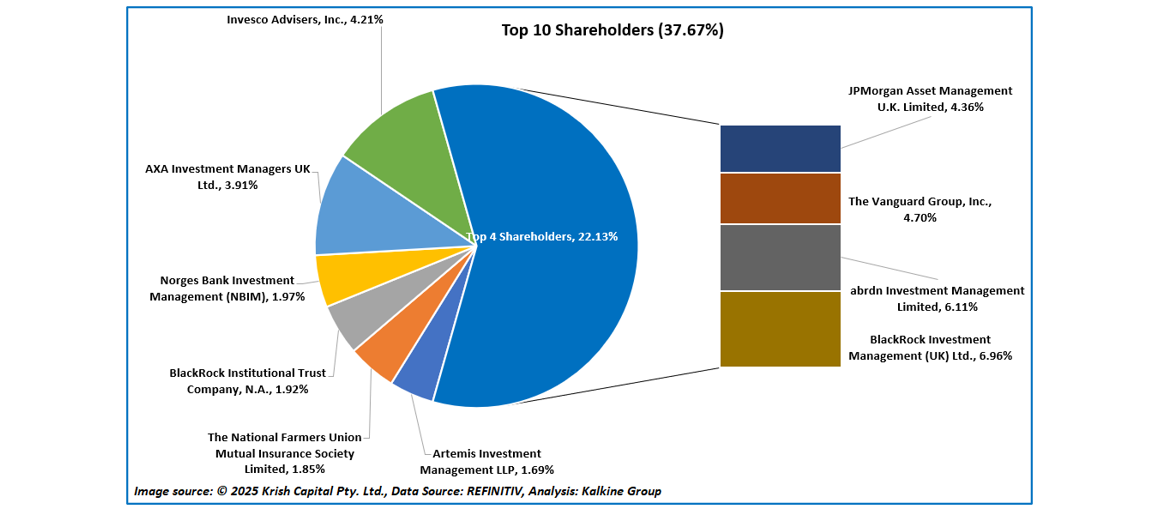
The top 10 shareholders of Hill & Smith collectively account for approximately 37.67% of the total shareholdings. BlackRock Investment Management (UK) Ltd. holds the largest stake with around 6.96%, followed by abrdn Investment Management Limited with approximately 6.11%, as shown in the chart below.
Stock Information
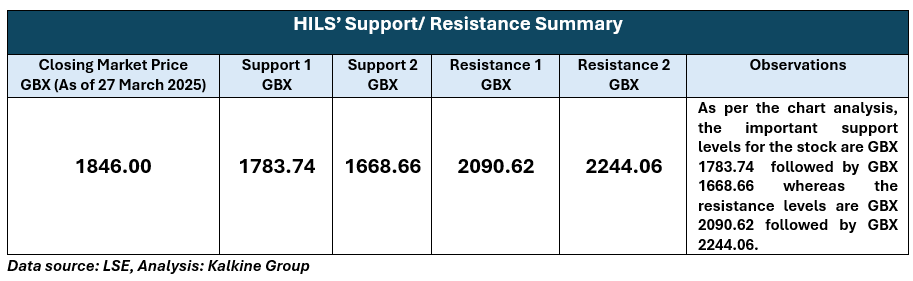
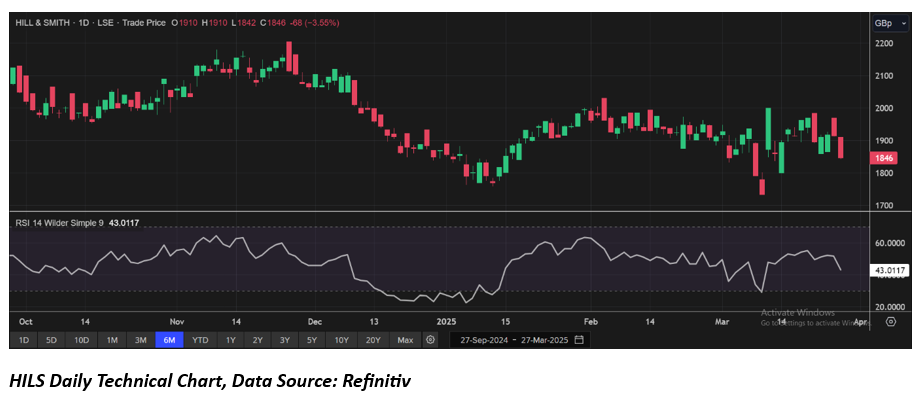
The stock price of HILS has declined by around 2.22% in the past three months and dropped by around 5.81% in the past nine months. The stock's 52-week range spans from a low of GBX 1,734.00 to a high of GBX 2,330.00. Currently, it is trading below the average of this 52-week high-low range, with a closing price of GBX 1846 as of March 27, 2025.
Note 1: Past performance is not a reliable indicator of future performance.
Note 2: The reference data for all price data, currency, technical indicators, support, and resistance levels is 27 March 2025. The reference data in this report has been partly sourced from EODHD/Others.
Technical Indicators Defined
Support: A level at which the stock prices tend to find support if they are falling, and a downtrend may take a pause backed by demand or buying interest. Support 1 refers to the nearby support level for the stock and if the price breaches the level, then Support 2 may act as the crucial support level for the stock.
Resistance: A level at which the stock prices tend to find resistance when they are rising, and an uptrend may take a pause due to profit booking or selling interest. Resistance 1 refers to the nearby resistance level for the stock and if the price surpasses the level, then Resistance 2 may act as the crucial resistance level for the stock.


 Jun 24, 2026




 Please wait processing your request...