
 AU
AU
 CA
CA
 US
US
 NZ
NZ
 IND
IND

 UK
UK

 Share
Share
 X (Formerly Twitter)
 Whatsapp
 Facebook
 LinkedIn
 Telegram
 Email This Article
 Copy Link
 Summarize with AI
 Chat GPT
 Perplexity
HSBC Holdings (LSE: HSBA) kicked off the 2026 trading year with a notable 1.5% to 2.1% jump, reaching an all-time closing high of approximately over GBX 1,198 in London.
As retail investors flock back to "Old Economy" giants, the global banking powerhouse is proving that its strategic pivot to Asia and aggressive capital returns are paying off.
Key Drivers: What Pushed the Stock Up?
Source: Kalkine Group
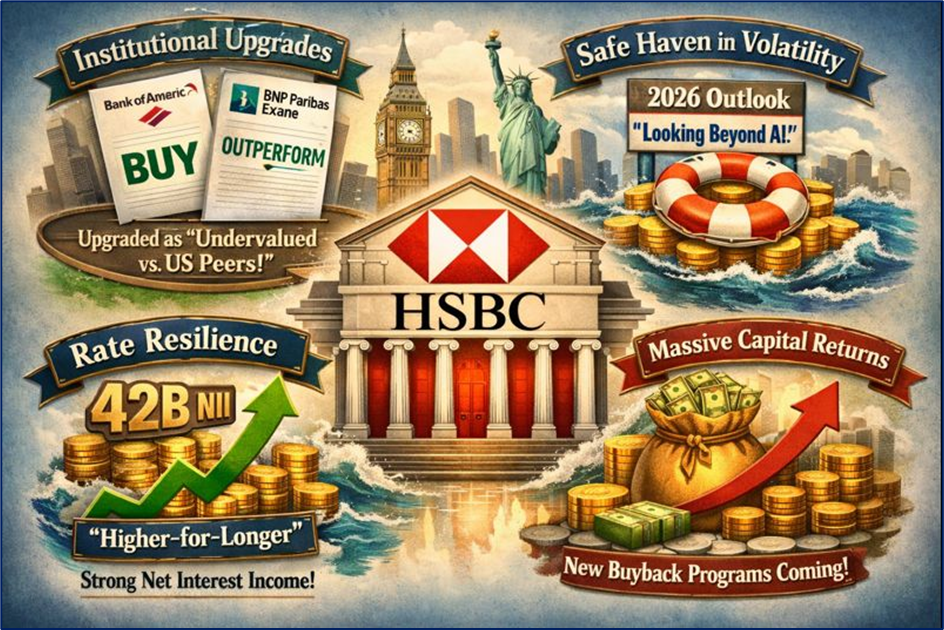
The rally on January 2, 2026, was not a fluke but a culmination of several bullish factors:
- Institutional Upgrades: Leading into the new year, major institutions like Bank of America and BNP Paribas Exane upgraded the stock to "Buy" and "Outperform," citing undervaluation compared to US peers.
- Safe Haven in Volatility: As the broader market grapples with AI-driven tech concentration, HSBC’s 2026 outlook emphasizes "looking beyond AI" into stable, high-yield financials.
- Rate Resilience: While the market expects some central bank cuts, HSBC's guidance for $42 billion in Net Interest Income (NII) remains firm, supported by a "higher-for-longer" yield environment in its core markets.
- Massive Capital Returns: The completion of previous share buybacks and the anticipation of new programs for 2026 have created a "floor" for the share price.
Latest Business Model: The 2026 "Four Pillars" Strategy
HSBC has moved away from its "everything for everyone" approach. Its latest model, fully operational as of January 1, 2025, divides the bank into four distinct engines:
- Hong Kong: Now a standalone segment, reflecting its status as the bank’s primary profit engine.
- UK: A ring-fenced powerhouse focused on personal and mortgage lending.
- Corporate & Institutional Banking (CIB): Focused on global trade finance, where HSBC controls access to 85% of global trade flows.
- International Wealth & Premier Banking: The high-growth arm targeting Asia’s rapidly expanding middle class and ultra-high-net-worth (UHNW) segments.
Financial and Operational Updates (Latest)
- Profitability: HSBC is targeting a mid-teens Return on Tangible Equity (RoTE) for the 2025–2027 period.
- Solvency: Its CET1 Capital Ratio stands at a robust 14.6%–14.7%, well above regulatory requirements, providing a massive buffer against economic shocks.
- Cost Efficiency: The bank is on track to deliver $1.5 billion in organizational simplification savings, though it expects a 3% growth in tech spending to stay competitive in the digital age.
- Upcoming Catalyst: Investors are looking toward February 25, 2026, for the release of the 2025 Annual Results, which is expected to confirm final dividend payouts and new buyback targets.
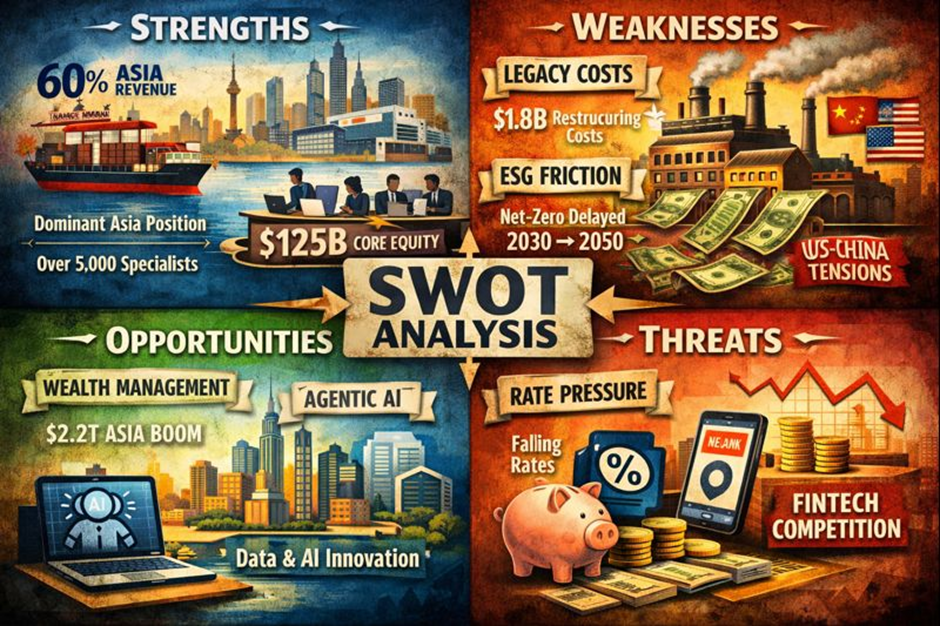
SWOT Analysis
Source: Kalkine Group
Risks to Watch
- Macro Headwinds: Persistent inflation in the UK and a fragile growth outlook could limit the performance of the domestic retail arm.
- Trade Disruptions: As a "trade bank," any escalation in global tariffs directly hits HSBC’s Global Trade Solutions revenue.
- Real Estate Exposure: Investors remain cautious about the bank's exposure to the commercial real estate sector, particularly in mainland China.
Conclusion
HSBC's performance on January 2 highlights a shift in investor sentiment toward value, income, and geographical diversification. With a clear focus on Asia and a commitment to returning billions to shareholders, the bank is positioned as a "dividend aristocrat" of the 2020s. However, its heavy reliance on the Hong Kong-China corridor means it remains a high-stakes play on global geopolitical stability.


 Jun 03, 2026




 Please wait processing your request...