
 AU
AU
 CA
CA
 US
US
 NZ
NZ
 IND
IND

 UK
UK

 Share
Share
 X (Formerly Twitter)
 Whatsapp
 Facebook
 LinkedIn
 Telegram
 Email This Article
 Copy Link
 Summarize with AI
 Chat GPT
 Perplexity
FTSE 100 Power Rankings: Buy, Sell, or Hold?
January 2026 Market Snapshot: Key Highlights
- Production Surge: Rio Tinto reports a massive +8% Copper Equivalent (CuEq) growth in 2025, beating high-end guidance (Rio Tinto Production Results).
- Dividend Alert: Major 2025 final dividend announcement confirmed for February 19, 2026, with yields projected between 5% and 8% (Discovery Alert).
- Price Action: Rio Tinto (RIO) hit fresh 52-week highs in late January, trading near GBX 7,004 on the LSE – 29 January 2026.
- Analyst Split: Morgan Stanley downgrades to Equal Weight citing "balanced risks," while Erste Group and Zacks maintain Buy/Strong Buy ratings (Morgan Stanley/Zacks).
- Global Catalyst: First shipment from the Simandou iron ore project in Q4 2025 marks a transformative milestone for 2026 revenue (Rio Tinto Source).
Will Rio Tinto Stock Dominate the FTSE 100 in 2026?
The global mining landscape in January 2026 is undergoing a seismic shift, placing Rio Tinto (RIO) at the epicenter of a "green metal" supercycle. As the FTSE 100 flirts with the psychological 10,000 mark, investors are aggressively seeking high-yield, inflation-hedged assets. Rio Tinto’s current business model has evolved from a pure iron ore play into a diversified powerhouse, leveraging record-breaking Oyu Tolgoi copper production and a burgeoning lithium portfolio in Argentina. With GBP/USD volatility impacting overseas earnings and the UK economy showing signs of a "bang" start to 2026, the question remains: is the current share price surge a peak or a launching pad for a 49% rally?
Is the UK Economy and FTSE 100 Positioning Rio Tinto for a Massive Breakout?
The UK economy enters January 2026 with a surprising resilience. While the Bank of England signals potential rate cuts by March, the FTSE 100 has outperformed global peers like the S&P 500, fueled by a 3% year-to-date climb in mining and financial sectors. GBP analysis suggests a fragile Pound Sterling near 1.33-1.34 against the USD, which ironically benefits Rio Tinto by inflating its dollar-denominated commodity earnings when converted back to GBP. In the FTSE 250, mid-cap recovery is trickling up, creating a constructive backdrop for heavyweights. Rio Tinto's operational excellence, particularly its record quarterly iron ore production in the Pilbara, aligns perfectly with a stabilized Chinese property sector and global infrastructure demands.
What Are the Short-Term, Medium-Term, and Long-Term Outlooks for the Mining Sector?
- Short-Term (3-6 Months): Bullish Caution. The market is bracing for the February 19 results. Momentum is driven by the "scarcity premium" of copper, which recently hit fresh highs. However, recent downgrades from HSBC and Morgan Stanley to "Hold" suggest the stock may consolidate after its 12.6% YTD climb.
- Medium-Term (1-2 Years): Highly Bullish. The ramp-up of the Simandou project in Guinea and full-scale underground production at Oyu Tolgoi are set to de-risk the portfolio. Analysts predict an 18% to 21% EBITDA upside if spot prices hold (Bloomberg Intelligence).
- Long-Term (3+ Years): Structural Winner. As the world decarbonizes, Rio Tinto’s Nuton bioleaching technology and expansion into low-carbon aluminum position it as a "tier-1" ESG pick. The shift from "volume to value" ensures sustainable dividend payouts even in volatile cycles.
Which Forward-Looking Investment Strategies Should You Take Right Now?
- Short-Term Strategy (3-6 Months): Investors should focus on "Dividend Capture." With the ex-dividend date looming in early March, buying on price dips below the 50-day moving average (~$79.27) could secure a high-yield payout.
- Medium-Term Strategy: Portfolio Rebalancing. Shift weight from pure iron ore miners to diversified players like Rio Tinto that have 11% YoY copper growth. This hedges against any potential Chinese industrial slowdown.
- Long-Term Strategy: DRIP (Dividend Reinvestment Plan). Utilizing Rio Tinto’s DRIP to compound shares during the current mining supercycle is the most logical path for wealth accumulation, especially as Simandou begins contributing to the bottom line in 2026.
Is Rio Tinto Bullish, Bearish, or Neutral as of January 29, 2026?
- Short-Term Sentiment: Neutral to Bullish. The stock is technically "overbought" after hitting a 52-week high, leading to retail caution. However, the fundamental "surge" in copper prices provides a floor.
- Long-Term Sentiment: Heavily Bullish. The logical justification lies in the supply-side deficit. New mines are rare, and Rio Tinto has already spent the Capex on its biggest growth engines. This "first-mover" advantage in new frontiers like Simandou makes a bearish case difficult to justify unless global GDP collapses.
What Do the Latest Broker Ratings and Price Targets Say About RIO?
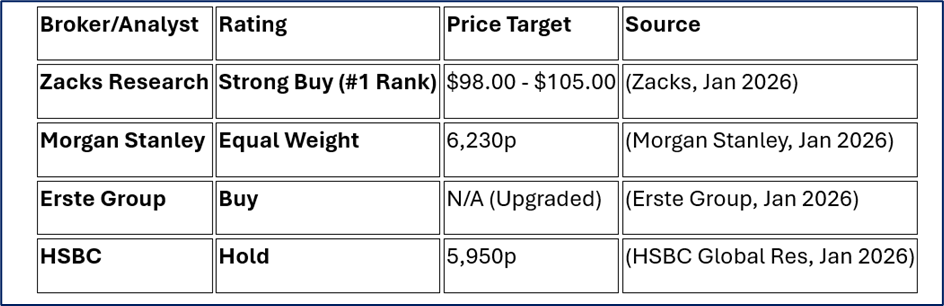
Source: Market Data
Key Risks: Geopolitical tensions in Guinea (Simandou), potential "Trump Tariffs" impacting global trade flow, and weather-driven interruptions in the Pilbara.
Investor FAQ: Everything You Need to Know Today
- Why did Rio Tinto stock surge this month? Primarily due to a 7% increase in iron ore shipments and the copper price rally (Rio Tinto Q4 Report).
- When is the next Rio Tinto dividend? The final 2025 dividend will be announced on February 19, 2026.
- Is a Glencore merger likely? While rumored, Morgan Stanley notes the "complexity and structure" make it a long-shot strategic possibility rather than an imminent deal.
Analytical Conclusion: Buy, Sell, or Hold?
Based on the 8% CuEq growth and the massive Simandou milestone, Rio Tinto remains a Core Hold for income seekers and a Strategic Buy on any 5-10% pullbacks for growth investors. The stock is currently a "Moderate Buy" consensus.


 Jun 03, 2026




 Please wait processing your request...