
 AU
AU
 CA
CA
 US
US
 NZ
NZ
 IND
IND

 UK
UK

 Share
Share
 X (Formerly Twitter)
 Whatsapp
 Facebook
 LinkedIn
 Telegram
 Email This Article
 Copy Link
 Summarize with AI
 Chat GPT
 Perplexity

1. The Phenomenon: By the Numbers
The "Santa Rally" technically refers to the final 5 trading days of December and the first 2 of January. However, the market behaviour often shifts early in the month.
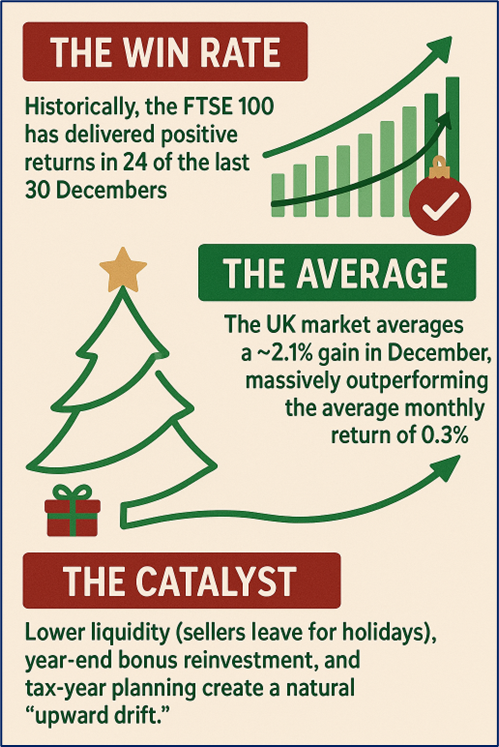
- The Win Rate: Historically, the FTSE 100 has delivered positive returns in 24 of the last 30 Decembers.
- The Average: The UK market averages a ~2.1% gain in December, massively outperforming the average monthly return of 0.3%.
- The Catalyst: Lower liquidity (sellers leave for holidays), year-end bonus reinvestment, and tax-year planning create a natural "upward drift."
Source: Kalkine Group
2. The Institutional "Cheat Code": Window Dressing
While retail investors look for holiday bargains, institutional fund managers are engaging in "Window Dressing."
The Mechanics:
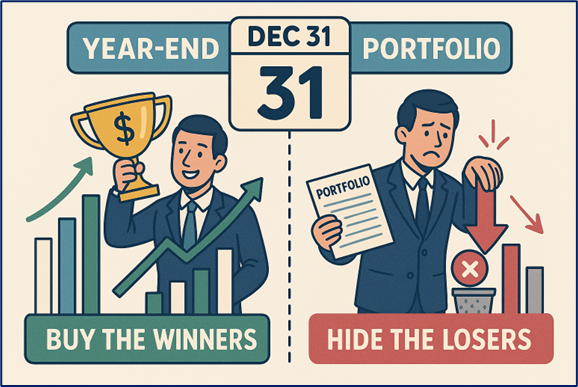
Fund managers want their year-end reports (sent to clients on Dec 31st) to look impressive. To do this, they:
- Buy the Winners: They rush to add the year's best-performing stocks to their portfolios, so it looks like they held them all along.
- Hide the Losers: They sell their worst performers, so they don't appear on the year-end balance sheet.
Source: Kalkine Group
Stocks to Watch (The 2025 Momentum Leaders):
Analysis suggests these stocks may see artificial buying pressure mid-December due to Window Dressing, based on high YTD performance.
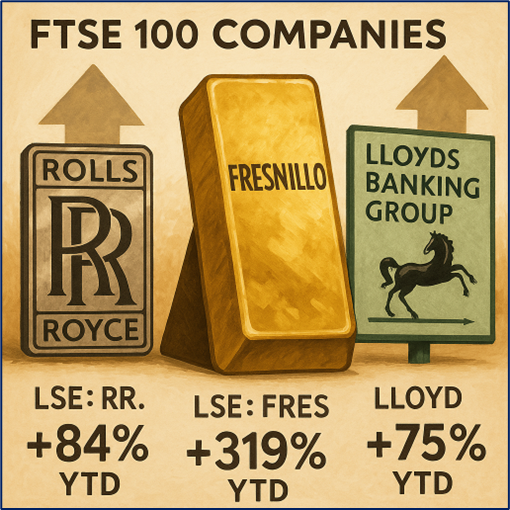
- Rolls-Royce (LSE: RR.): A key component of the defense and engineering recovery narrative. Its high YTD return (up ~84%) makes it a necessary addition for year-end optics.
- Fresnillo (LSE: FRES): With precious metals rallying in late 2025, this miner has become a defensive favourite (up ~319% YTD).
- Lloyds Banking Group (LSE: LLOY): Leading the financial sector rally (up ~75% YTD). Managers often park cash in large banks for the year-end snapshot.
Source: Kalkine Group
3. The Contra Trade: The "January Effect"
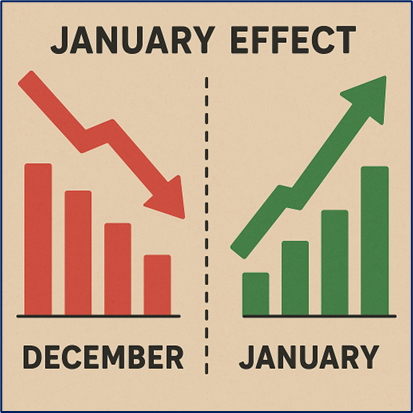
For every action, there is a reaction. The selling of "losers" in December creates a distinct opportunity known as the January Effect.
The Mechanics:
Investors sell losing positions in December to "crystallize" tax losses (offsetting gains elsewhere). This selling pressure drives these stocks below their perceived fair value. Once the selling stops on Jan 1st, these stocks often "snap back" aggressively.
Source: Kalkine Group
The "Wash Rule" Nuance:
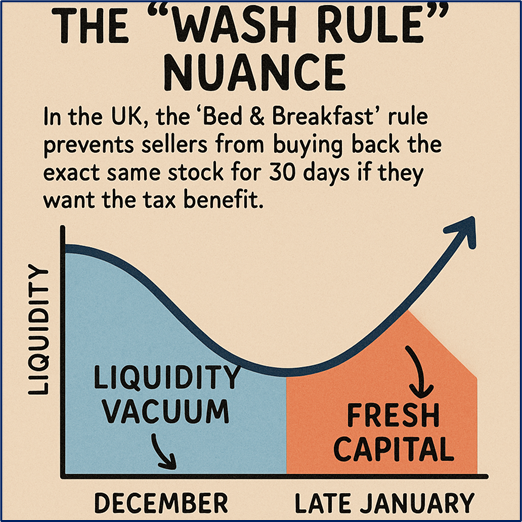
In the UK, the "Bed & Breakfast" rule prevents sellers from buying back the exact same stock for 30 days if they want the tax benefit. This creates a liquidity vacuum in December, followed by a rush of fresh capital in late January.
Source: Kalkine Group
Stocks to Watch (The 2025 Laggards):
These stocks have faced heavy selling pressure and may be technically oversold, making them potential January rebound candidates.
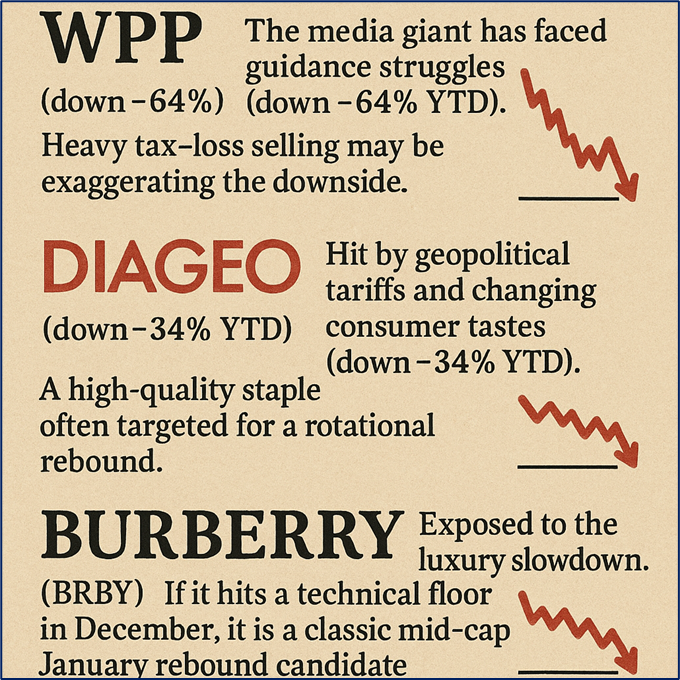
- WPP (LSE: WPP): The media giant has faced guidance struggles (down ~64% YTD). Heavy tax-loss selling may be exaggerating the downside.
- Diageo (LSE: DGE): Hit by geopolitical tariffs and changing consumer tastes (down ~34% YTD). A high-quality staple often targeted for a rotational rebound.
- Burberry (LSE: BRBY): Exposed to the luxury slowdown. If it hits a technical floor in December, it is a classic mid-cap January rebound candidate.
Source: Kalkine Group
4, Sector Watch: Who Wins Christmas?
Based on current data and seasonal trends, three sectors are seeing heightened activity.
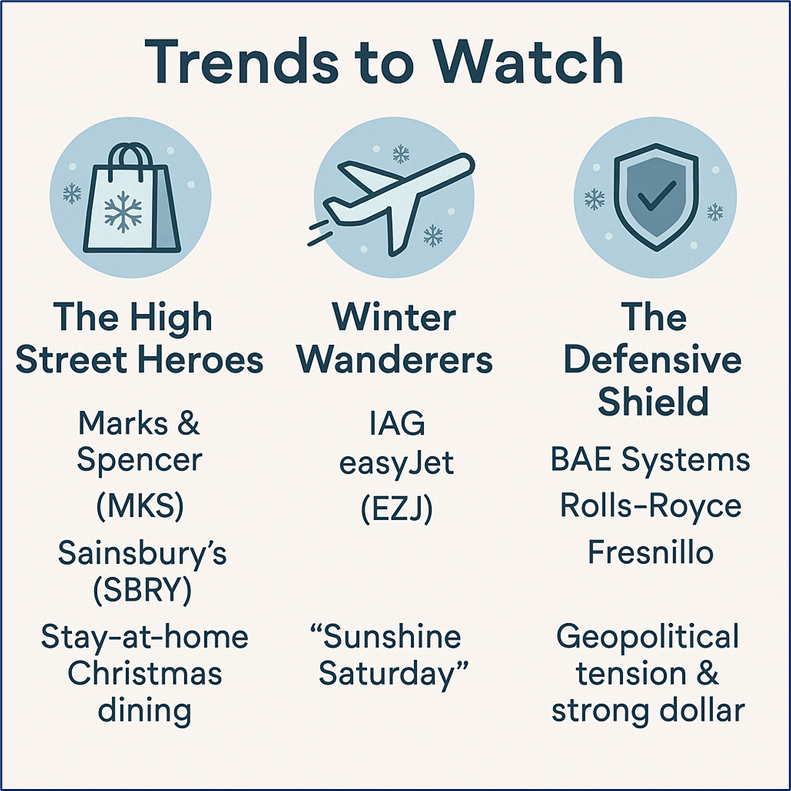
- The High Street Heroes (Retail)
- Context: Retailers live or die by Q4. The winners in 2025 are those with premium food offerings and robust logistics.
- Focus: Marks & Spencer (MKS) and Sainsbury's (SBRY).
- Trend: Data suggests a "Stay-at-Home" Christmas dining trend, favoring supermarkets over restaurants.
- Winter Wanderers (Travel)
- Context: With oil prices stabilizing, airline margins are improving.
- Focus: International Consolidated Airlines (IAG) and easyJet (EZJ).
- Trend: "Sunshine Saturday" (the first Saturday of Jan) usually sees record bookings, but stock prices often front-run this news in late December.
- The Defensive Shield (Aerospace & Mining)
- Context: Geopolitical tension and a strong dollar keep defense and mining stocks in demand.
- Focus: BAE Systems and Rolls-Royce (Defense); Fresnillo (Precious Metals).
Source: Kalkine Group
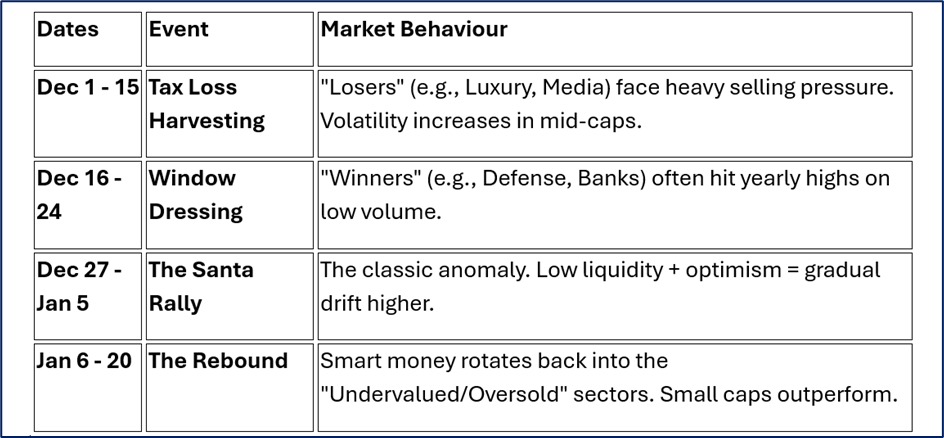
5, The Strategic Calendar
Timing is everything. Here is how the month typically flows:
Source: Kalkine Group
6. Latest Updates, Triggers & Risks
- FTSE Momentum: The FTSE 100 is up ~17% YTD (as of Dec 5), reinforcing institutional pressure to buy 2025's winners.
- The Fed Pivot: Markets are hypersensitive to the US Federal Reserve. If they signal rate cuts for early 2026, global equities will typically surge.
- Inflation Check: UK Inflation remains sticky at 3.6%. Any surprise hike here would immediately dampen consumer sentiment and hit retail stocks.
The Risks: The Grinch Factors
- The "Reverse" Rally: If the FTSE 100 drops below the key psychological and technical level of 9,500, institutional selling could trigger a broader pre-Christmas sell-off.
- Geopolitics: Any sudden escalation in global conflicts typically hits the FTSE’s energy and banking heavyweights first, neutralizing festive optimism.
- Liquidity Trap: Ultra-low trading volumes in the final week can exaggerate both rises and falls, increasing risk.
Conclusion: Analyze, Don't Fomo
The market in December is less about fundamentals and more about flows. The historical odds favor a positive outcome, but only those who understand the Window Dressing and January Effect cycles are positioned to take advantage of the dual selling and buying pressures.
The Analytical Takeaway: Focus on quality companies that are either momentum leaders (Window Dressing candidates) or fundamentally sound companies that have been unfairly beaten down by tax-loss harvesting (January Effect candidates).


 Jun 24, 2026




 Please wait processing your request...