
 AU
AU
 CA
CA
 US
US
 NZ
NZ
 IND
IND

 UK
UK

 Share
Share
 X (Formerly Twitter)
 Whatsapp
 Facebook
 LinkedIn
 Telegram
 Email This Article
 Copy Link
 Summarize with AI
 Chat GPT
 Perplexity
The U.S. labor market effectively "limped" across the 2025 finish line on Friday, with the Bureau of Labor Statistics reporting a modest gain of 50,000 nonfarm payrolls for December. While the figure represents a "bend-but-don't-break" resilience, it cements 2025 as the weakest year for American job growth since the 2020 pandemic era.
The report, a complex tapestry of cooling demand and surprising silver linings, saw the unemployment rate defy gravity, ticking down to 4.4% from a downwardly revised 4.5% in November. However, for Wall Street, the "headline" was overshadowed by significant downward revisions to previous months, painting a picture of a labor market that is cooling faster than many had predicted just a quarter ago.
The Verdict from the Street: Fund Managers Speak
The reaction from the world’s leading investment houses has been a mix of relief and renewed caution.
- T. Rowe Price: Blerina Uruçi, Chief US Economist, noted that while the 50,000 figure was slightly below the 55,000 consensus, "job growth remains steady enough to stave off immediate recession fears, though the 'margin of safety' has narrowed significantly."
- Interactive Brokers: Senior Economist José Torres highlighted the "increased confidence" that the Federal Reserve will now be forced into a more aggressive easing cycle in 2026. "Rate-sensitive areas are finally getting the oxygen they need," Torres remarked.
- J.P. Morgan Asset Management: Strategists point out that the rise in unemployment throughout 2025 has been driven less by mass layoffs and more by a surge in labor supply and slower hiring—a "softer" kind of weakness that historically allows for a soft landing if the Fed acts in time.
Sector Breakdown: The Winners and the Weary
The December data revealed a stark divergence between the "defensive" stalwarts and the "discretionary" laggards.
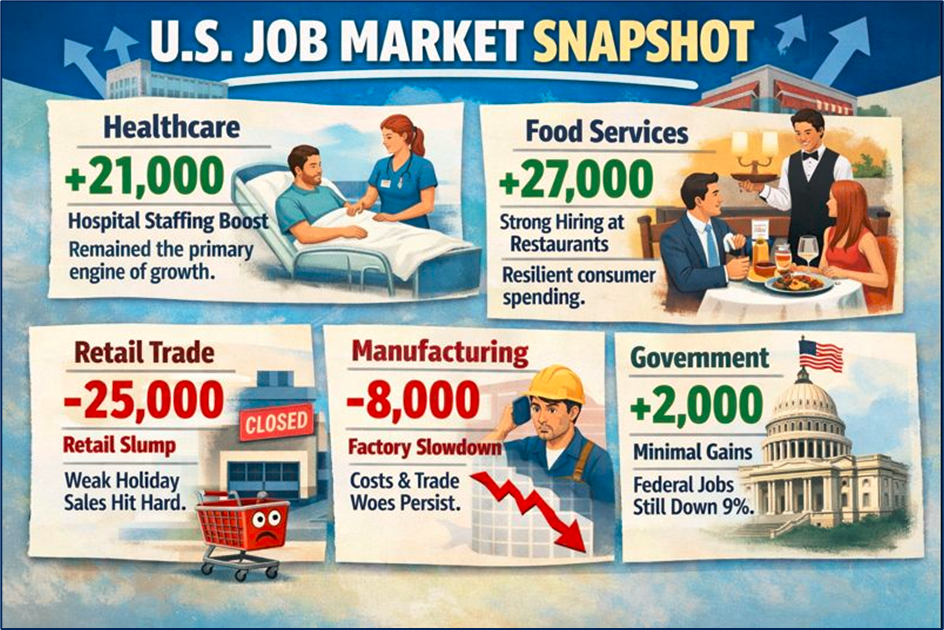
Source: Kalkine Group
Stocks to Strategize: The "Pivot" Playbook
With the labor market cooling, the investment thesis is shifting toward sectors that benefit from falling yields and defensive earnings.
- The Infrastructure & Utilities Play
Vistra Corp (VST) surged 17% in pre-market trading following a landmark 20-year deal with Meta Platforms (META) to supply zero-carbon nuclear power. As the labor market cools, "Big Tech’s" insatiable hunger for AI-driven energy remains a secular growth theme regardless of the payroll print.
- The Rate-Sensitive Recovery
Small caps, tracked by the Russell 2000, are increasingly becoming a favorite "catch-up" trade. Lower hiring costs and the prospect of 2026 rate cuts provide a tailwind for smaller companies that were previously throttled by high debt-servicing costs.
- Defensive Growth
Healthcare (XLV) has emerged as a fourth-quarter leader, rallying nearly 9.3% into the year-end. Stocks like UnitedHealth (UNH) and Eli Lilly (LLY) are being viewed as "safe harbors" as the broader economy slows.
Indices Forecast: Navigating the 2026 Outlook
The December jobs print has stabilized expectations for the S&P 500, which currently hovers near all-time highs.
- S&P 500: Forecasted to remain in a "sideways-to-up" trajectory, supported by an expected 13% EPS growth in 2026. The index is finding strong support at the 6,900–6,950 level.
- Nasdaq 100: Likely to outperform in a "bad news is good news" environment, where soft jobs data keeps the 10-year Treasury yield anchored below 4.20%, boosting tech valuations.
- DXY (US Dollar Index): Expected to face downward pressure as the "US exceptionalism" narrative fades, potentially benefiting emerging market equities in the first half of 2026.
Latest Upgrades and Downgrades
- UPGRADE: Vistra Corp (VST) — Upgraded by several bulge-bracket firms following the Meta nuclear deal; seen as a premier "AI-energy" hybrid.
- UPGRADE: Regional Banks (KRE) — Receiving speculative upgrades as the yield curve "steepens," potentially improving net interest margins.
- DOWNGRADE: Consumer Staples (XLP) — Downgraded to "Underweight" by several houses as "discerning customers" and high input costs squeeze margins.
- DOWNGRADE: General Merchandise Retailers — Major downgrades following the -25,000 job print in the retail sector, signaling a tough Q1 for brick-and-mortar.
Conclusion: The "Wait-and-See" Winter
The December jobs report is a Rorschach test for investors. To the bull, the 4.4% unemployment rate and +50,000 jobs signal a "controlled glide" toward a soft landing. To the bear, the downward revisions and the collapse in retail hiring suggest that the "lagged effects" of 2025's volatility are finally biting.
As we enter 2026, the mandate for the Federal Reserve is clear: support the labor market before the "cooling" turns into a "chill." For retail investors, the strategy is one of barbelled positioning—retaining exposure to high-growth AI infrastructure while padding portfolios with defensive healthcare and rate-sensitive small caps.


 Jun 03, 2026




 Please wait processing your request...