
 AU
AU
 CA
CA
 US
US
 NZ
NZ
 IND
IND

 UK
UK

 Share
Share
 X (Formerly Twitter)
 Whatsapp
 Facebook
 LinkedIn
 Telegram
 Email This Article
 Copy Link
 Summarize with AI
 Chat GPT
 Perplexity
Standard Chartered (LSE: STAN) kicked off 2026 with a definitive bang. On January 2, 2026, the stock climbed ~1.2%, hitting a fresh 52-week high of 1,855.50p. While the broader FTSE 100 celebrated a historic milestone by crossing the 10,000-point mark, Standard Chartered emerged as a primary engine of that rally.
But this isn't just a "rising tide lifts all boats" story. From record-breaking wealth management fees to a massive $8 billion shareholder return plan, "StanChart" is undergoing a fundamental re-rating. Here is the deep dive into why the market is suddenly obsessed with this emerging markets specialist.
The "January 2" Spark: Key Drivers
Source: Kalkine Group
The 1.2% jump was fueled by three specific catalysts:
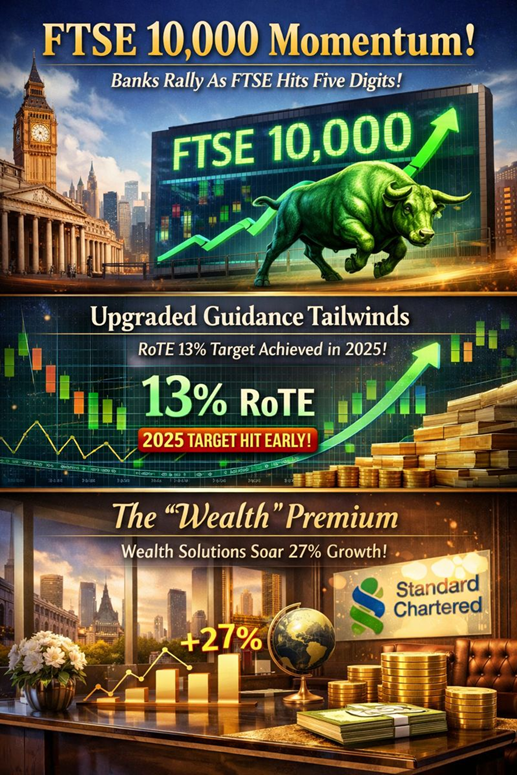
- FTSE 10,000 Momentum: As the UK’s blue-chip index hit five digits for the first time, institutional rotation favored high-yielding, undervalued banks.
- Upgraded Guidance tailwinds: Investors are still reacting to the bank’s Q3 2025 revelation that it will hit its 13% Return on Tangible Equity (RoTE) target an entire year early (now expected in 2025 instead of 2026).
- The "Wealth" Premium: Standard Chartered’s Wealth Solutions division posted a staggering 27% growth in its most recent quarterly update, signaling that its pivot to "affluent" banking is paying off.
Latest Business Model: The "Capital-Light" Pivot
Standard Chartered has shed its image as a "clunky" legacy lender. Its 2026 business model is built on three lean pillars:
- Wealth & Retail Banking (WRB): Moving away from mass-market retail to focus on "Affluent" clients. The goal? To have 75% of WRB income coming from wealthy individuals by 2026.
- Corporate & Investment Banking (CIB): Serving as the "bridge" for trade. It now facilitates over $1.5 trillion in trade flows annually, focusing on the high-growth corridor between Asia, Africa, and the Middle East.
- SC Ventures: This is the bank’s fintech laboratory. Successes like Mox (Hong Kong) and Trust (Singapore) are expected to turn profitable in 2026, transforming "digital loss-makers" into "digital assets."
Financial & Operational Performance (Latest Update)
The bank’s financial health is currently at its most robust in a decade:
- Income Growth: Tracking toward the upper end of its 5–7% CAGR target (2023–2026).
- Shareholder Returns: The bank is mid-way through a massive $8 billion capital return program (2024–2026), including aggressive share buybacks that are shrinking the share count and boosting Earnings Per Share (EPS).
- Efficiency: Under the "Fit for Growth" program, the bank is on track to deliver $1.5 billion in cost savings by the end of 2026, keeping total expenses below $12.3 billion.
SWOT Analysis (2026 Outlook)
Source: Kalkine Group
Strengths
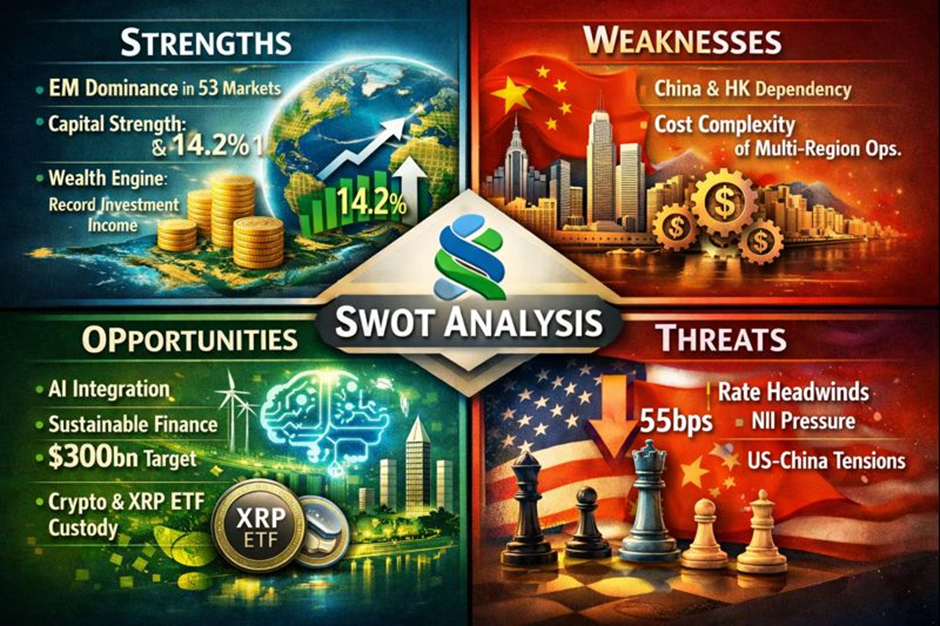
- EM Dominance: Unrivaled footprint in 53 of the world’s fastest-growing markets.
- Capital Strength: A CET1 ratio of 14.2%, well above regulatory requirements.
- Wealth Engine: Record-breaking income from investment products and managed fees.
Weaknesses
- Geographic Concentration: Over-reliance on Hong Kong and China for a significant portion of profits.
- Cost Complexity: Operating in dozens of different regulatory environments is inherently expensive compared to domestic-only rivals.
Opportunities
- AI Integration: Standard Chartered is betting big on AI to drive "hyper-personalized" wealth advice for its affluent clients.
- Sustainable Finance: Aiming for $300 billion in sustainable finance mobilization by 2030, a high-margin growth area.
- Crypto Infrastructure: Emerging as a leader in institutional crypto custody and XRP ETF facilitation (forecasted $4–8bn inflows in 2026).
Threats
- Rate Headwinds: As global central banks pivot toward cuts in 2026, Net Interest Income (NII) may face a 55bps headwind.
- Geopolitical Friction: Trade tensions between the US and China remain a constant "wildcard" for a bank that sits right in the middle.
The Risk Landscape
Despite the 52-week high, the path isn't without hurdles. The primary risk is "Margin Compression." As interest rates fall, the "easy money" made from the gap between deposit and loan rates shrinks. Standard Chartered must grow its "fee-based" income (wealth management, transaction services) fast enough to offset this decline. Additionally, any sharp economic slowdown in China could trigger higher credit impairments in the commercial real estate sector.
Conclusion
Standard Chartered’s 1.2% rise on the first trading days of 2026 isn't just a fluke—it’s a validation of a multi-year turnaround. By shifting toward a "capital-light," wealth-heavy model and aggressively returning cash to shareholders, the bank has transitioned from a value trap to a growth story. For retail investors, the story is no longer about "recovery," but about "execution."


 Jun 03, 2026




 Please wait processing your request...