
 AU
AU
 CA
CA
 US
US
 NZ
NZ
 IND
IND

 UK
UK

 Share
Share
 X (Formerly Twitter)
 Whatsapp
 Facebook
 LinkedIn
 Telegram
 Email This Article
 Copy Link
 Summarize with AI
 Chat GPT
 Perplexity
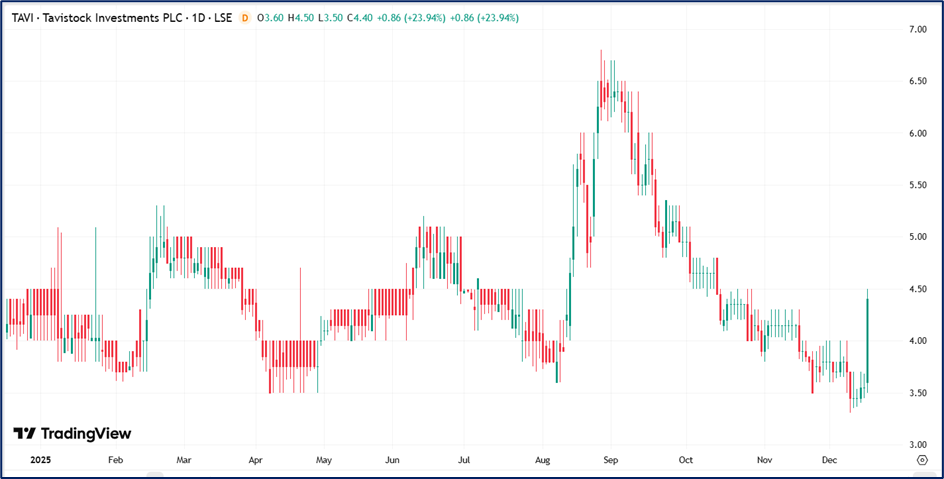
Tavistock Investments PLC (LSE: TAVI) is a UK-based financial services company that has experienced significant stock price volatility, including reported surges like the potential 20% jump cited in your request. Such dramatic movements are typically driven by major strategic developments and the market's reaction to them.
Based on recent developments, here is a breakdown of the company's situation, focusing on the drivers of recent performance and the company's new strategic direction.
Key Reasons & Drivers for Share Price Movement
The significant upward moves in Tavistock's share price appear to be primarily driven by a series of strategic refocussing and capital-generating transactions, rather than steady operating performance alone.
- Strategic Disposals (Cash Injection): The company generated substantial capital by selling non-core or high-risk business units.
- Sale of Network of Self-Employed IFAs (2024): A major sale to Saltus Partnership Holdings LLP generated an initial cash consideration and potential deferred payments (up to £37.8 million in total), giving the Group significant working and development capital.
- Prior Disposal of UCITS Funds (2021): Another key sale earlier provided over £30 million, initiating the strategic change.
- Strategic Acquisitions & Refocus: The capital from disposals has been redeployed into businesses aligned with a new, simplified, and technology-enabled strategy, focusing on high-growth areas.
- Acquisition of Lifetime Financial Management (2025): The purchase of a majority stake in Lifetime, known for its "hybrid model" and use of AI, is central to the strategy of addressing the underserved retail financial advice market.
- Acquisition of Alpha Beta Partners (2024): This move bolstered its asset management capabilities, particularly in providing outsourced investment solutions.
- Favorable Legal Outcome (Latest Update): A recent court ruling (December 2025) in an ongoing litigation case with Titan Wealth Services Limited in favour of Tavistock, including an award of costs, was a positive market sentiment driver, reducing uncertainty and potentially strengthening its claim.
- Proposed Higher Dividends: Despite sometimes volatile financial results, the company has proposed and paid increased dividends, such as the 29% increase in the interim dividend, which is generally a positive signal to investors.
Latest Business Updates
The company has been undergoing a "year of strategic transformation" (CEO statement, 2025 final results).
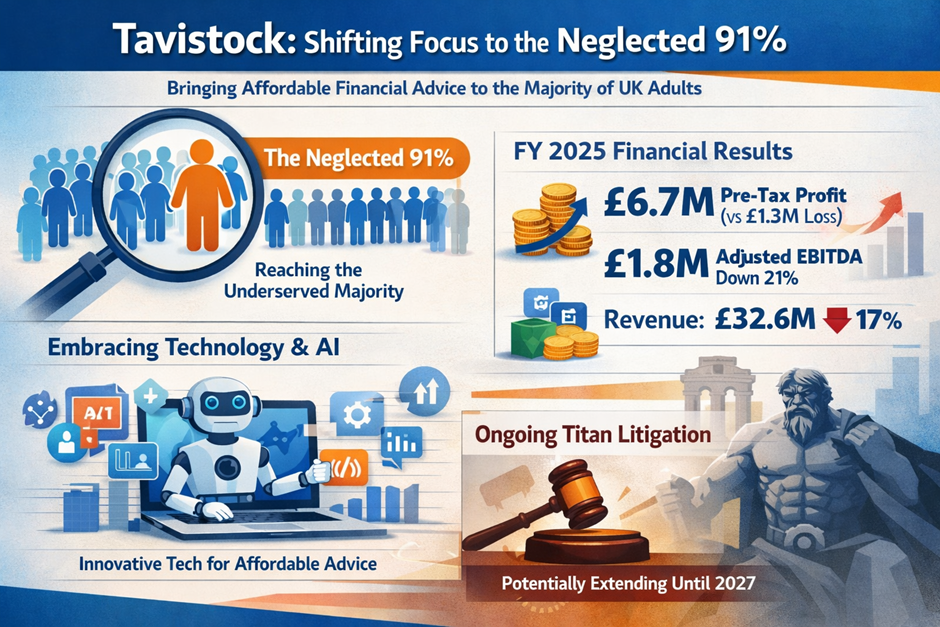
- Shifting Focus (The 'Neglected 91%'): Tavistock is pivoting to address the substantial gap in the UK retail financial advice sector, aiming to serve the vast majority of UK adults ("the neglected 91%") who are currently not catered to by traditional financial services.
- Embracing Technology: The new strategy heavily incorporates Artificial Intelligence (AI) and technology platforms to support qualified professionals, aiming to deliver professional, affordable, and cost-effective financial advice.
- Mixed Financial Results (FY 2025): The final results for the year ended March 31, 2025, showed a mix:
- Pre-tax Profit: Swung to a pre-tax profit of £6.7 million (from a loss of £1.3 million the previous year), significantly helped by a £20.0 million gain on sale.
- Adjusted EBITDA: Fell by 21% to £1.8 million, indicating a decline in underlying operational earnings during the transitional period.
- Revenue: Fell 17% to £32.6 million.
- Ongoing Titan Litigation: While achieving a favorable outcome recently, the broader, costly, and time-consuming litigation with Titan remains an ongoing issue, potentially extending until 2027.
Source: Kalkine Group
Business Model: The Post-Transformation Structure
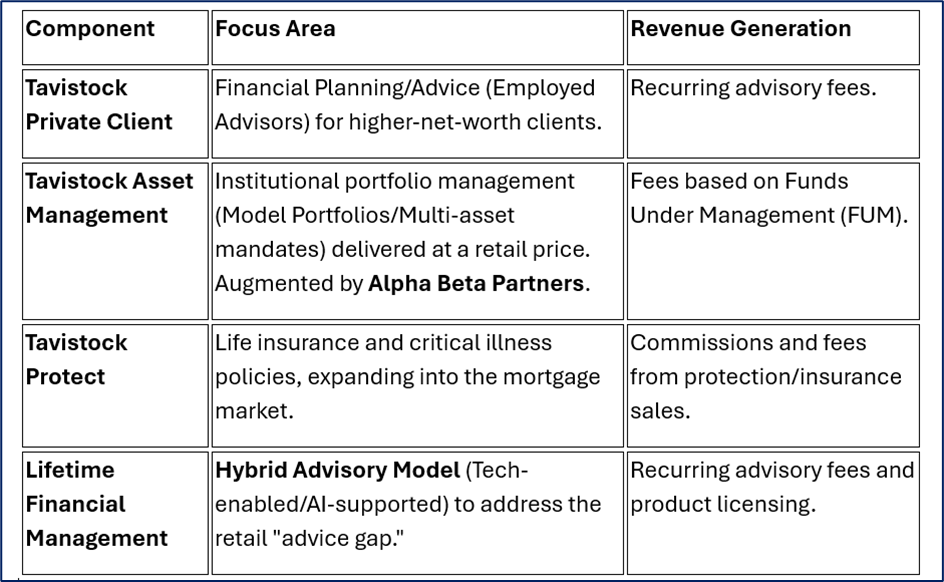
Tavistock's new business model is a focused, vertically-integrated wealth and asset management structure, leveraging capital from its disposals.
Source: Company Data
The core strategy is to accelerate the growth of its Asset Management business through acquisitions and organic growth in Funds Under Management (FUM), while its streamlined Advisory business generates high levels of recurring income.
Investor Risks
- Financial Volatility: While large disposals create cash and headline profit, the decline in underlying adjusted EBITDA (FY25) indicates that the core operational performance of the remaining business is still finding its feet after the transition.
- Integration Risk: The success of the strategy hinges on the successful and rapid integration of acquisitions like Lifetime and Alpha Beta Partners, and the commercial success of the revised, technology-driven service proposition.
- Litigation Uncertainty: Despite the recent win, the Titan litigation is ongoing, lengthy, and costly, representing a significant distraction and potential financial liability until it is fully resolved.
- Market Competition: The financial services market is intensely competitive, and delivering professional, affordable advice to the "neglected 91%" is a challenging operational and cost hurdle to overcome at scale.
Conclusion: The Transformational Bet
The surge in Tavistock's share price is largely a vote of confidence in the management's decisive strategic transformation. The company has successfully sold off lower-margin, higher-risk units for significant cash, and is now acquiring and building a new model focused on two key pillars: a scalable, low-cost asset management business and a tech-enabled financial advisory model to capture the vast, underserved retail market.
Investors are betting that the newfound capital and strategic clarity will soon translate into robust and sustainable operational earnings, outweighing the current financial transition and ongoing legal risks.
Source: Trading View, 16 December 2025, 10:45 AM GMT


 Jun 03, 2026




 Please wait processing your request...