
 AU
AU
 CA
CA
 US
US
 NZ
NZ
 IND
IND

 UK
UK

 Share
Share
 X (Formerly Twitter)
 Whatsapp
 Facebook
 LinkedIn
 Telegram
 Email This Article
 Copy Link
 Summarize with AI
 Chat GPT
 Perplexity
The £2,000 Question: To Invest or to Wait?
Investing £2,000 in Rolls-Royce (LSE: RR) today is a fundamentally different proposition than it was just two years ago. The company has transitioned from a pandemic-era "recovery play" into a high-performance industrial compounder.
The current investment thesis hinges on whether the market has fully priced in the aggressive "Rolls-Royce 3.0" transformation led by CEO Tufan Erginbilgic. While the stock has seen a meteoric rise—up over 1,000% from its 2021 lows—current drivers suggest the business model is now optimized for sustained cash generation rather than just survival.
Strategic Drivers and the Business Model Pivot

Source: Kalkine Group
The latest business model has shifted away from simply selling hardware toward high-margin, recurring revenue through Long-Term Service Agreements (LTSAs). This "Power-by-the-Hour" model ensures that as long as planes fly, Rolls-Royce earns.
- Civil Aerospace Renaissance: Large engine flying hours (EFH) have surged to 109% of 2019 levels as of early 2026, driving massive aftermarket inflows.
- The AI Power Play: A critical and often underappreciated driver is the Power Systems division. Rolls-Royce has become a primary provider of standby power for global data centres. With the AI boom requiring massive infrastructure, order intake for power generation jumped 85% year-over-year.
- Defense & Geopolitics: The defense segment, making up roughly 25% of revenue, is benefiting from a "war footing" global economy. Recent geopolitical shifts, including heightened NATO spending and US military activity in South America, have triggered a rotation into defense stocks where Rolls-Royce is a structural winner.
Latest Financial and Operational Updates
Rolls-Royce enters 2026 with a significantly repaired balance sheet, moving from a net debt position to holding over £1.1 billion in net cash.
- Profit Upgrades: Management recently lifted full-year 2025 operating profit guidance to £3.1 billion–£3.2 billion, with free cash flow expected to hit a record £3.0 billion.
- Shareholder Returns: For the first time in five years, dividends have been reinstated. Furthermore, the company successfully completed a £1 billion buyback in late 2025 and immediately launched a new £200 million interim buyback in January 2026 to support the share price.
- Operational Efficiency: Operating margins in Civil Aerospace have hit nearly 25%, a staggering jump from the mid-teens seen during the recovery phase, reflecting aggressive cost-cutting and pricing power.
Current Technical Analysis: Bullish Momentum vs. Overbought Signals
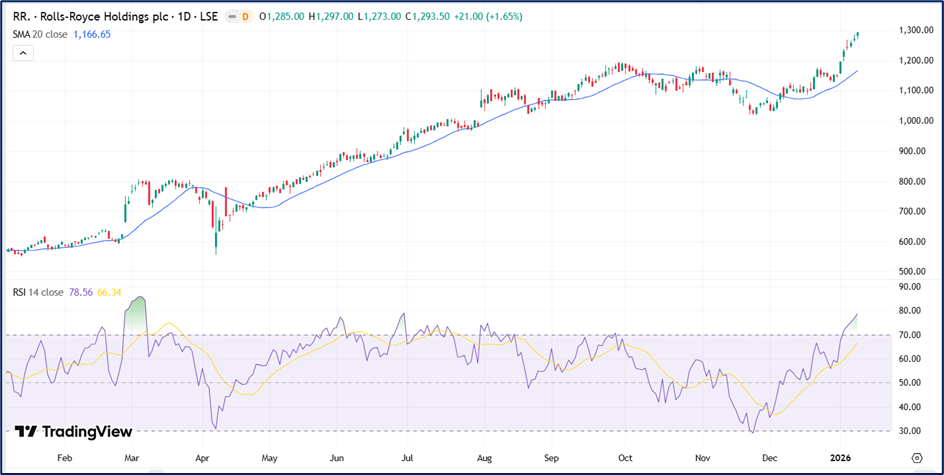
Source: Trading View
From a technical perspective, Rolls-Royce is currently a "momentum" stock trading at all-time highs near the 1,200p–1,300p range.
- Moving Averages: The stock remains well above its 50-day (1,114p) and 200-day (989p) moving averages, confirming a long-term uptrend.
- The RSI Alert: The Relative Strength Index (RSI) is currently hovering around 78.5, which technically places the stock in "overbought" territory. This suggests that while the trend is upward, a short-term "cooling off" period or minor retracement to the 1,100p support level could occur before the next leg up.
- MACD Divergence: The MACD is currently at 19.18, sitting comfortably above the signal line (12.39), reinforcing that the bulls are still in control of the narrative.
Latest Analyst Upgrades and Sentiment
The consensus among major institutions remains a "Moderate Buy" to "Strong Buy," though price targets are beginning to catch up to the rapid price action.
- UBS Upgrade: Analysts at UBS recently hiked their price target to 1,625p, citing the unexpected acceleration in the Power Systems segment.
- JPMorgan: Maintains an "Overweight" rating with a target of 1,245p, viewing the company as a top-tier momentum play.
- Berenberg: Recently upgraded the stock from a "Sell" to "Hold/Buy" range, admitting the margin expansion has far exceeded initial bearish forecasts.
Key Risks to Consider
No investment is without friction, and Rolls-Royce faces specific "execution risks" despite its success.
- Valuation Premium: With a forward P/E ratio exceeding 40x, the stock is no longer "cheap." It is trading at a premium compared to peers like BAE Systems or Raytheon, meaning any earnings miss could lead to a sharp sell-off.
- Supply Chain Fragility: Global aerospace supply chains remain brittle. Shortages in specialized alloys or skilled labor could cap engine delivery targets.
- SMR Uncertainty: While the Small Modular Reactor (SMR) program is a massive long-term "moonshot," it will not be cash-flow positive until at least 2030, making it a speculative driver for now.
Conclusion
Investing £2,000 in Rolls-Royce at current levels is a bet on the "extended cycle." The company is no longer a turnaround story—it is an execution story. For investors seeking a blend of aerospace recovery, defense stability, and a "backdoor" play on AI infrastructure through data center power, the fundamentals remain exceptionally strong. However, technical indicators suggest caution for those looking for a quick flip, as the stock is currently "hot." A disciplined approach might involve scaling in or waiting for a minor technical pullback to the 50-day moving average.


 Jun 03, 2026




 Please wait processing your request...