
 AU
AU
 CA
CA
 US
US
 NZ
NZ
 IND
IND

 UK
UK

 Share
Share
 X (Formerly Twitter)
 Whatsapp
 Facebook
 LinkedIn
 Telegram
 Email This Article
 Copy Link
 Summarize with AI
 Chat GPT
 Perplexity
Views Expressed Disclaimer:
You are reading a free article with opinions that may differ from the recommendation given by Kalkine in its paid research reports. Become a Kalkine member today to get access to our research reports, in-depth technical and fundamental research.
The Sage Group, a UK-based enterprise software provider specialising in accounting, payroll, and ERP solutions for small and medium-sized businesses (SMEs), recently experienced a share price decline of more than 4%. Moves of this magnitude in technology stocks are often linked to valuation dynamics and market sentiment rather than sudden fundamental deterioration.
Below is a comprehensive analysis of the potential drivers behind the decline and what investors should watch going forward.
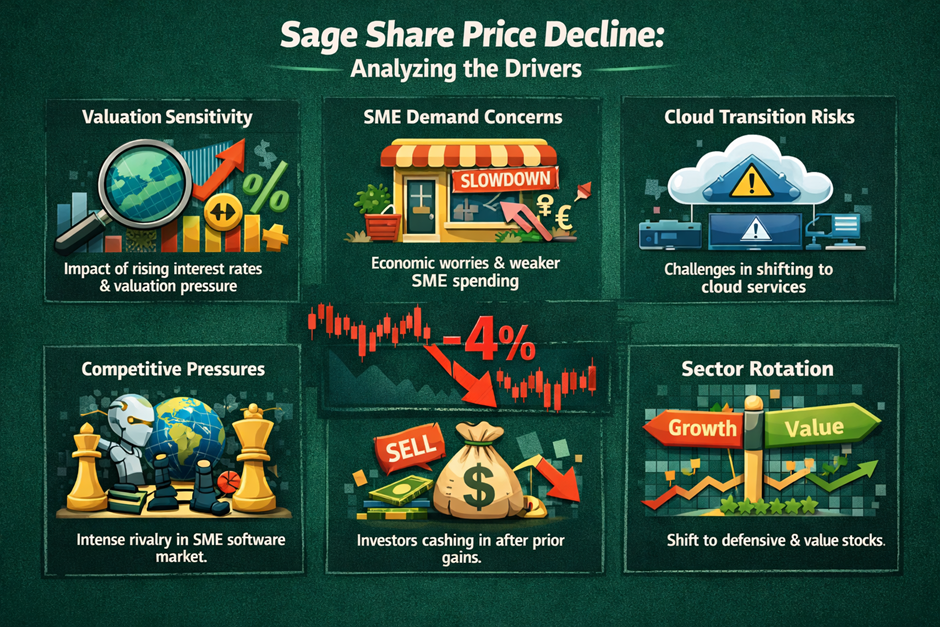
Source: Kalkine Group
Valuation Sensitivity in Software Stocks
Sage typically trades at a premium valuation compared with many traditional companies. This higher multiple is supported by several attractive characteristics:
- Recurring subscription-based revenue model
- Ongoing cloud migration progress
- Strong operating margins
- High levels of cash conversion
However, premium valuations also create downside sensitivity. When bond yields rise or interest rate expectations shift higher, growth-oriented technology companies often face valuation compression. Even modest changes in discount rates can materially affect discounted cash flow (DCF) assumptions, leading to share price volatility.
Technology stocks frequently move inversely to interest rate expectations, which means macroeconomic data releases or central bank commentary alone can trigger notable price adjustments.
Concerns Around SME Demand
Sage’s customer base is heavily concentrated in SMEs, which are generally more economically sensitive than large enterprises. If investors perceive weakening economic momentum in the UK or Europe, concerns may arise around:
- Slower customer acquisition
- Higher churn rates
- Reduced IT and software spending
- Delays in upgrades or new product adoption
Because SMEs tend to react quickly to economic uncertainty, any recession signals or negative business sentiment indicators can disproportionately impact companies like Sage.
Cloud Transition Execution Risk
The company has been shifting its customer base from legacy desktop products toward cloud-based subscription platforms. While this transition improves long-term revenue visibility and recurring income quality, it introduces execution risks, including:
- Migration complexity
- Short-term revenue mix adjustments
- Increased investment in sales and marketing
- Margin pressure during transition phases
If analysts interpret cloud adoption momentum as slowing or customer acquisition costs as rising, investor confidence can weaken even if the long-term strategy remains intact.
Competitive Landscape Pressures
The accounting and ERP software industry is highly competitive, with both global software giants and agile fintech innovators targeting the SME segment. Investor concerns may emerge around:
- Pricing competition
- Product differentiation challenges
- Artificial intelligence-driven disruption
- Market share dynamics
Rapid innovation cycles in enterprise software mean competitive risks are continuously reassessed by markets, sometimes leading to short-term valuation adjustments.
Profit-Taking After Prior Gains
If Sage shares had previously experienced a strong rally, a 4% decline may simply represent normal profit-taking behaviour. Momentum-driven technology stocks often see sharper pullbacks when sentiment shifts, particularly during broader market volatility.
Such moves are not uncommon and do not necessarily signal deteriorating fundamentals.
Sector Rotation Dynamics
Equity markets frequently experience rotations between growth and value sectors. If investors moved capital toward defensive or cyclical industries—such as energy, financials, or utilities—mid-cap technology names like Sage may have faced selling pressure.
Sector rotation can amplify short-term volatility even when company-specific news is limited.
Conclusion: Interpreting Sage’s Share Price Decline
The recent decline in Sage’s share price likely reflects a combination of:
- Valuation compression linked to interest rate expectations
- Macroeconomic concerns impacting SME spending outlook
- Sensitivity to growth sentiment in technology stocks
Importantly, these factors are largely market-driven rather than evidence of structural business deterioration.
Broader Market Context
The same macro forces influencing Sage can also affect companies across financial services, investment vehicles, and technology sectors simultaneously. Market declines exceeding 4% are relatively common during periods characterised by:
- Inflation data surprises
- Central bank policy uncertainty
- Geopolitical developments
- Liquidity-driven portfolio repositioning
Investors should focus on whether the share price stabilises in subsequent sessions or continues trending lower, as sustained weakness may indicate deeper concerns while short-term volatility often reflects sentiment adjustments.
Investor Takeaway
For long-term investors, the key considerations remain:
- Cloud revenue growth trajectory
- Margin expansion potential
- SME demand resilience
- Competitive positioning
- Cash flow generation
Short-term price movements can appear dramatic, but they often represent shifts in expectations rather than changes in underlying business quality.


 Jun 09, 2026




 Please wait processing your request...