
 AU
AU
 CA
CA
 US
US
 NZ
NZ
 IND
IND

 UK
UK

 Share
Share
 X (Formerly Twitter)
 Whatsapp
 Facebook
 LinkedIn
 Telegram
 Email This Article
 Copy Link
 Summarize with AI
 Chat GPT
 Perplexity
Key Reasons and Drivers for the 7 January 2026 Surge
The significant 6% move in Grainger’s stock price on January 7, 2026, was driven by a combination of high-profile institutional interest and favorable regulatory shifts:
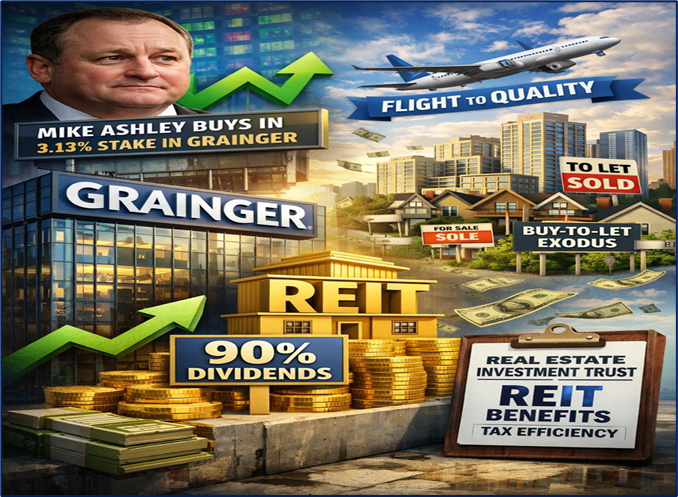
- Mike Ashley’s Strategic Entry: A regulatory filing revealed that Michael James Wallace Ashley (founder of Frasers Group) acquired a 3.13% stake in Grainger. Market participants often view such "activist" or high-net-worth entries as a signal of deep value, triggering a "follow the smart money" rally.
- The "Flight to Quality": As the Renters' Rights Act 2025 implementation begins to bite, smaller "Buy-to-Let" landlords are exiting the market in record numbers. Grainger, as the UK's largest listed professional landlord, is the primary beneficiary of this supply vacuum.
- REIT Conversion Realization: Following its conversion to a Real Estate Investment Trust (REIT) in late 2025, the market has finally priced in the long-term tax efficiencies and the requirement to distribute 90% of rental profits as dividends.
Source: Kalkine Group
Latest Business Model: The Pure-Play BTR Powerhouse
Grainger has completed its decade-long transformation into a "pure-play" Build to Rent (BTR) operator. Its current model focuses on:
- Vertical Integration: Grainger originates, develops, and manages its own properties, keeping the entire value chain in-house to protect margins.
- Cluster Strategy: Investing heavily in "clusters" within high-growth cities (Manchester, Birmingham, Leeds, London) to achieve operational scale.
- Digital Integration: The use of the CONNECT platform for seamless tenant management, which has helped expand EBITDA margins toward 56%.
- Mid-Market Focus: Targeting "workforce housing" where rents are approximately 28% of gross household income, ensuring high occupancy even during economic downturns.
Latest Financial and Operational Updates
Recent disclosures highlight a business operating at peak efficiency:
- Net Rental Income: Rose by 12% to £123.6 million in the most recent reporting cycle.
- Occupancy Excellence: Maintained a staggering 98.1% occupancy rate, effectively operating at full capacity.
- Earnings Trajectory: Management reiterated targets of £60m EPRA earnings by FY26 and £72m by FY29.
- Dividend Track Record: Announced its 20th consecutive year of dividend growth, with a total payout of 8.31p per share.
- Pipeline Delivery: A £343 million committed pipeline is currently under construction, with the majority of capital already deployed.
Technical Analysis
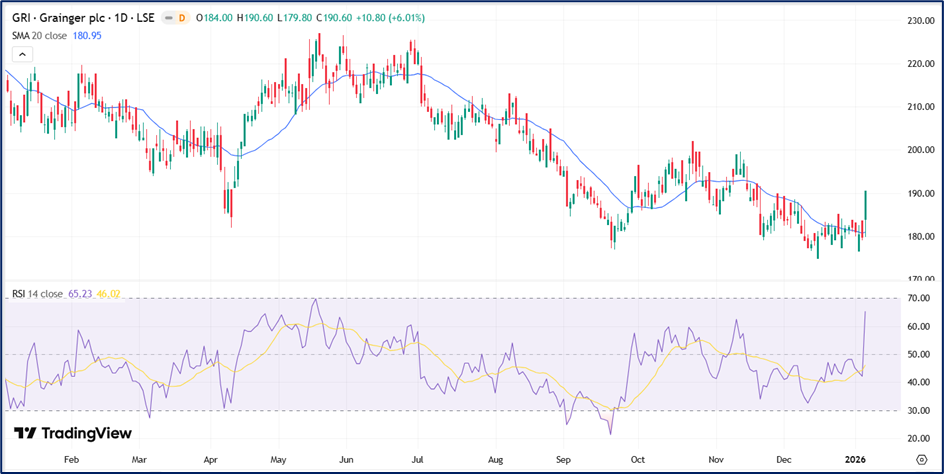
Technically, Grainger (LSE: GRI) has executed a classic bullish breakout. Before the January 7 surge, the stock had been consolidating in a tight range around 175p–180p. The 6% jump pushed the price to 190.60p, slicing through both the 50-day and 100-day moving averages on significantly elevated volume.
- RSI Momentum: The Relative Strength Index (RSI) climbed from 45 to 68, indicating strong buying pressure but remaining just below the "overbought" 70 threshold.
- Resistance/Support: The stock has flipped the previous resistance at 182p into a new support floor. The next major technical hurdle is the 198p level, which represents a key Fibonacci retracement point.
- MACD: A bullish crossover on the MACD (Moving Average Convergence Divergence) histogram confirms the trend shift from neutral to positive.
Source: Trading View
Risks and Market Headwinds
Despite the rally, several "red flags" remain on the horizon:
- Regulatory Creep: While the Renters' Rights Act benefits large players, any future move toward formal rent caps by the government would immediately compress valuation yields.
- Refinancing Cliff: While debt costs are fixed in the mid-3% range until 2029, any sustained "higher-for-longer" interest rate environment will make future pipeline funding more expensive.
- Construction Inflation: High labor and material costs continue to pose a risk to the £1.3bn total pipeline delivery dates.
- Affordability Ceilings: With UK wage growth cooling, Grainger’s ability to push rents by the historic 3–4% may be tested by the limits of tenant disposable income.
Conclusion
Grainger’s 6% surge on 7 January 2026 marks a turning point where institutional scale meets high-profile investor confidence. By positioning itself as the "professional alternative" to the crumbling private landlord sector, Grainger has built a defensive moat around its cash flows. While macro-economic pressures and construction costs remain permanent features of the landscape, the company’s transition to a REIT and its robust operational metrics suggest it is entering a new phase of institutional maturity.


 Jun 03, 2026




 Please wait processing your request...