
 AU
AU
 CA
CA
 US
US
 NZ
NZ
 IND
IND

 UK
UK

 Share
Share
 X (Formerly Twitter)
 Whatsapp
 Facebook
 LinkedIn
 Telegram
 Email This Article
 Copy Link
 Summarize with AI
 Chat GPT
 Perplexity
Key Takeaways — February 2026
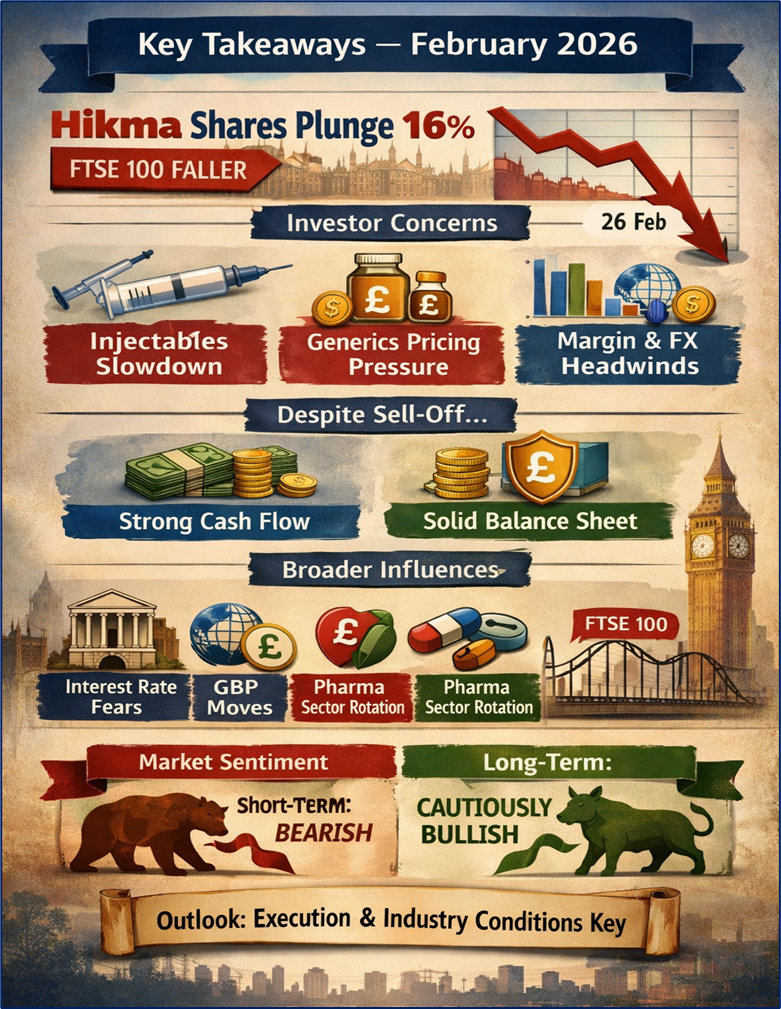
- Hikma Pharmaceuticals (LON:HIK) shares plunged about 16% on 26 February 2026, becoming one of the biggest FTSE 100 fallers today after a negative market reaction to its latest outlook and operational updates.
- Investor concerns are focused on injectables growth moderation, ongoing generics pricing pressure, and potential margin compression, alongside currency headwinds (company update, February 2026).
- Despite the sharp sell-off, dividend sustainability remains supported by strong cash flow generation and balance sheet strength.
- Broader influences including UK interest rate expectations, GBP currency moves, global pharmaceutical sector rotation, and FTSE 100 volatility amplified the decline.
- Short-term sentiment appears bearish, while long-term fundamentals remain neutral to cautiously bullish depending on execution and industry conditions.
Source: Kalkine Group
Why Is Hikma Pharmaceuticals Stock Down 16% Today on 26 February 2026?
Hikma Pharmaceuticals share price has dropped sharply on 26 February 2026, attracting widespread attention across the FTSE 100, UK stock market investors, and global healthcare equity markets. The sudden decline reflects a combination of company-specific developments, macroeconomic factors, and broader pharmaceutical sector sentiment shifts. Searches for “Why is Hikma stock falling,” “Hikma share price forecast 2026,” and “Is Hikma a buy after the crash” have surged as investors reassess the investment case.
The most significant trigger appears to be investor disappointment surrounding forward guidance expectations, particularly concerns about the pace of growth in the injectables business and continued competitive pricing pressure in generics markets. Hikma has historically relied heavily on these segments for earnings growth, so any perceived slowdown tends to drive strong market reactions. Currency movements, especially fluctuations impacting emerging market revenues, also contributed to sentiment weakness (company update, February 2026).
The sell-off also occurred within a broader environment of FTSE 100 volatility, shifting interest rate expectations in the UK and US, healthcare sector rotation, and global risk sentiment changes, which amplified the downside move. Stocks with previously strong performance often see sharper corrections when expectations are reset.
What Company-Specific Factors Triggered the Market Reaction?
Several operational concerns influenced investor sentiment:
- Expectations of slower near-term growth in the injectables segment
- Ongoing pricing erosion in the US generics market
- Margin sensitivity due to manufacturing and input costs
- Foreign exchange headwinds impacting reported earnings
- Investor uncertainty regarding earnings visibility for FY2026
- Profit-taking following prior share price strength
At the same time, some underlying fundamentals remain intact:
- Stable performance in branded pharmaceuticals
- Continued investment in product pipeline
- Healthy cash generation and balance sheet positioning
How Are Global Market Dynamics and the UK Economy Influencing Hikma?
Global Pharmaceutical Industry Environment
The pharmaceutical sector is currently shaped by several structural forces:
- Increasing competition in generic medicines globally
- Regulatory scrutiny around drug pricing
- Normalisation of supply chains after pandemic disruptions
- Long-term demographic tailwinds from ageing populations
- Rising demand for hospital injectables and specialty medicines
These factors create both opportunities and risks for companies like Hikma.
UK Economy and Currency Context
Macroeconomic conditions also play an important role:
- Interest rate uncertainty affecting equity valuations
- GBP exchange rate volatility influencing multinational earnings
- Investor rotation toward cyclical sectors during economic optimism
- Inflation trends impacting cost structures
FTSE 100 and FTSE 250 Market Trends
- Defensive healthcare stocks have underperformed cyclical sectors recently
- Market participants are repositioning portfolios amid rate expectations
- Mid-cap pharmaceutical peers have also experienced volatility
How Does Hikma Compare With Its Industry Peers?
Relative to global pharmaceutical peers, Hikma demonstrates a mixed profile.
Competitive advantages include:
- Strong global injectables platform
- Diversified geographic exposure across multiple markets
- Consistent free cash flow generation
- Defensive demand characteristics typical of healthcare
Key challenges include:
- Exposure to generics pricing pressure
- Currency risk from emerging markets
- Margin sensitivity linked to production costs
Valuation multiples remain moderate compared with global peers, reflecting both growth potential and operational uncertainty.
What Is the Dividend Outlook for Hikma Pharmaceuticals?
Dividend sustainability remains an important consideration for investors.
Supporting factors:
- Reliable operating cash flow
- Reasonable payout ratio
- Strong financial position
Outlook across time horizons:
- Short term: Dividend likely maintained with cautious growth
- Medium term: Growth dependent on margin recovery
- Long term: Supported by structural healthcare demand and pipeline development
Healthcare companies often prioritise dividend stability, which may provide downside support for the share price.
What Is the Stock and Sector Outlook Over Different Time Horizons?
Short-Term Outlook (3–6 Months)
- Elevated volatility expected
- Earnings uncertainty persists
- Technical sentiment weakened after sharp decline
Overall bias: Bearish to neutral
Medium-Term Outlook (6–18 Months)
- Dependent on operational execution and margin trends
- Currency environment remains influential
- Investor confidence could stabilise with improved guidance
Overall bias: Neutral
Long-Term Outlook (3–5 Years)
- Structural healthcare demand remains strong
- Demographic trends support pharmaceutical growth
- Pipeline expansion and geographic diversification provide opportunity
Overall bias: Neutral to bullish
What Strategies Could Investors Consider?
Short-term considerations:
- Monitor earnings revisions and management guidance
- Observe technical price behaviour and trading volume
- Track macroeconomic indicators such as interest rates and currency trends
Medium-term considerations:
- Evaluate valuation relative to historical averages
- Monitor margin improvement and product launches
- Consider phased investment approaches
Long-term considerations:
- Focus on structural healthcare demand trends
- Dividend reinvestment strategies
- Competitive positioning within injectables and specialty pharmaceuticals
Is Hikma Stock Bullish, Bearish, or Neutral Right Now?
Short-term perspective suggests bearish momentum due to uncertainty and negative sentiment.
Long-term perspective appears more balanced:
- Fundamentals remain intact
- Healthcare demand is defensive
- Execution improvements could drive recovery
Retail investor interpretation often depends on whether the decline reflects temporary sentiment or structural deterioration.
What Future Catalysts Could Move the Share Price?
Potential upside drivers:
- Strong earnings updates
- Successful product launches
- Margin expansion evidence
- Currency tailwinds
- Strategic acquisitions or partnerships
Potential downside risks:
- Continued generics pricing pressure
- Regulatory or compliance challenges
- Persistent cost inflation
- Emerging market instability
What Do Analysts Currently Forecast?
Broker sentiment remains mixed as of February 2026:
- Some analysts highlight long-term injectables growth potential
- Others emphasise near-term margin risks
- Consensus outlook suggests cautious optimism over the longer term
Scenario Analysis — Bull vs Bear Case
What Are the Key Investment Risks?
- Pricing pressure in generics markets
- Regulatory compliance challenges
- Currency fluctuations
- Manufacturing disruptions
- Margin compression risk
- Competitive pharmaceutical landscape
FAQ — Investor Questions
Why did Hikma stock fall today?
The decline reflects concerns over growth outlook, margins, and broader sector sentiment.
Is Hikma a good dividend investment?
Dividend stability appears relatively strong due to cash generation, though growth may be moderate.
Can the share price recover?
Recovery depends on operational execution, margins, and investor confidence.
Is this a buying opportunity?
Potentially for long-term investors, but risks remain and volatility may continue.
Final Investment Conclusion — What Should Investors Consider?
The sharp fall in Hikma Pharmaceuticals shares on 26 February 2026 appears to represent a reassessment of growth expectations rather than a fundamental breakdown of the business model. The company retains strong healthcare exposure, defensive demand characteristics, and long-term growth drivers, but near-term uncertainties justify investor caution.
Investment positioning may depend heavily on time horizon:
- Short term: Elevated risk and volatility
- Medium term: Balanced risk-reward profile
- Long term: Potential value if execution improves
Overall assessment:
Short term stance: Bearish
Medium term stance: Neutral
Long term stance: Neutral to cautiously bullish


 Jun 03, 2026




 Please wait processing your request...