
 AU
AU
 CA
CA
 US
US
 NZ
NZ
 IND
IND

 UK
UK

 Share
Share
 X (Formerly Twitter)
 Whatsapp
 Facebook
 LinkedIn
 Telegram
 Email This Article
 Copy Link
 Summarize with AI
 Chat GPT
 Perplexity
Several major FTSE 100 constituents are trading lower today, with weakness spread across consumer goods, healthcare, chemicals, aviation, and defence sectors. The declines appear to be driven by a combination of macroeconomic uncertainty, currency movements, sector rotation, and company-specific concerns rather than a single market event.
Below is a detailed breakdown of what is pressuring each stock and what investors should watch next.
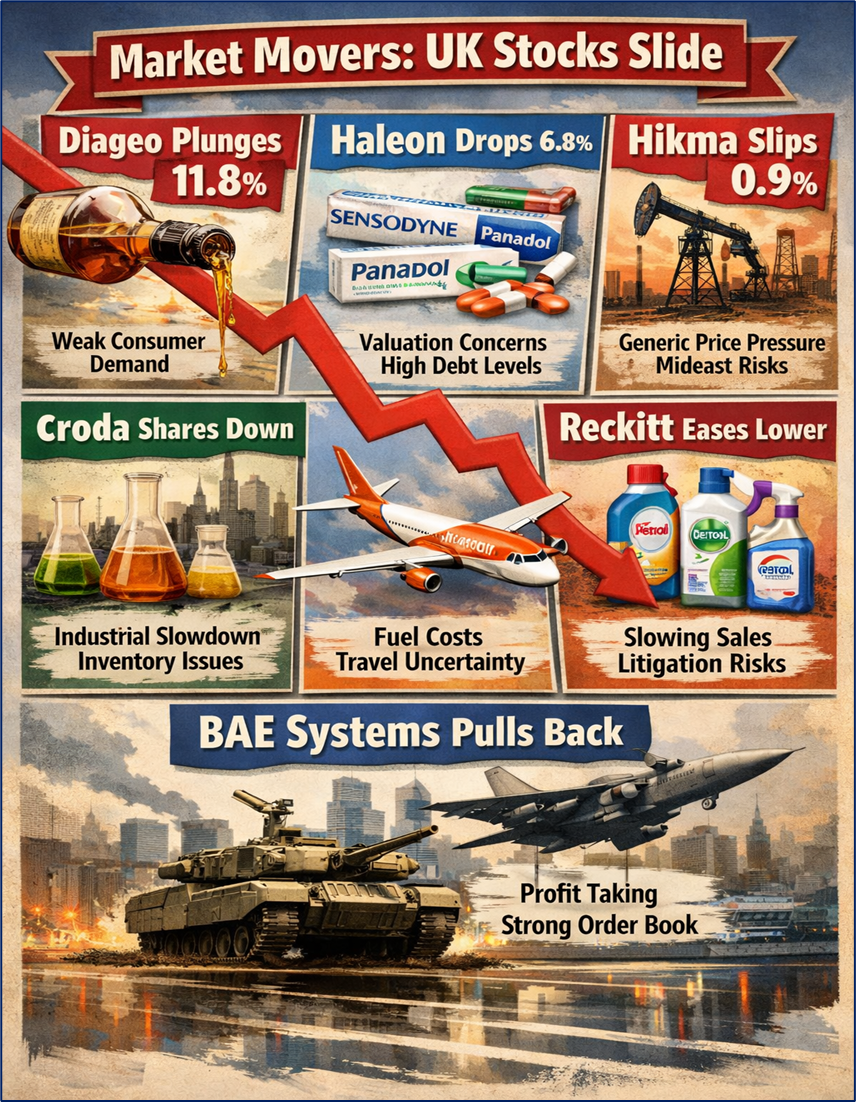
Source: Kalkine Group
- Diageo (LON:DGE) Share Price Falls Sharply
Diageo is among the biggest fallers, dropping around 11.8%, as investors reassess growth expectations for premium spirits.
One major concern is the weakening consumer environment, particularly in North America and certain emerging markets. Premium alcohol brands tend to be more sensitive to discretionary spending cycles, and persistent inflation combined with elevated interest rates is reducing consumer purchasing power. Slower premiumisation trends can quickly impact revenue growth forecasts for companies positioned at the high end of the market.
The company also continues to face challenges in Latin America and the Caribbean, where previous inventory build-ups and distributor destocking created volatility in reported sales. Any renewed concerns about channel inventory levels can significantly affect investor sentiment.
Currency movements are another factor. As a global business with substantial US dollar exposure, exchange rate fluctuations — especially a stronger pound — can reduce reported earnings.
Investors will closely monitor organic sales growth recovery, margin trends, and inventory normalisation across key regions to assess whether the recent weakness represents a temporary slowdown or a longer-term structural issue.
- Haleon (LON:HLN) Shares Under Pressure
Haleon shares are down more than 6.8%, reflecting valuation sensitivity and broader weakness in defensive healthcare names.
The company has traded at a premium multiple since its separation from GSK due to its strong brand portfolio and stable cash flows. However, during periods of risk-off sentiment or rising bond yields, investors often rotate away from higher-valuation defensive stocks.
Debt levels remain another consideration. As a company with significant leverage following its spin-off, Haleon’s valuation can be sensitive to interest rate expectations and refinancing costs.
Despite short-term volatility, the company retains strong structural advantages through global brands such as Sensodyne and Panadol, which support long-term demand resilience.
- Hikma Pharmaceuticals (LON:HIK) Slips Amid Industry Pressures
Hikma shares are down around 0.9%, largely reflecting ongoing concerns in the generic pharmaceuticals industry.
The US generics market remains highly competitive, with persistent pricing erosion across many product categories. Even well-positioned companies face margin pressure when industry pricing dynamics deteriorate.
Pharmaceutical stocks are also highly sensitive to regulatory developments, including approvals, inspections, and compliance outcomes. Additionally, Hikma’s exposure to Middle Eastern markets introduces geopolitical risk factors that can affect investor risk appetite.
Long-term growth will depend on stability in US generics pricing and expansion within higher-margin branded products.
- Croda International (LON:CRDA) Weakens on Demand Concerns
Croda shares are trading lower amid concerns about global industrial demand and inventory normalisation.
The company supplies specialty ingredients across multiple sectors including consumer care, pharmaceuticals, and industrial markets. Weak manufacturing activity globally can reduce short-term demand, particularly in cyclical segments.
Another factor is valuation. Croda historically trades at a premium relative to traditional chemical companies due to its higher margins and innovation capabilities. In uncertain macro conditions, premium-rated stocks often experience sharper corrections.
Investors are watching for signs of recovery in industrial demand and improvement in margins across its life sciences segment.
- easyJet (LON:EZJ) Drops on Cost and Demand Uncertainty
easyJet shares are down roughly 2.2%, reflecting continued sensitivity to fuel prices and forward booking trends.
Airlines are highly exposed to energy costs, and any increase in oil prices can quickly impact profitability expectations despite hedging programs.
There are also concerns around future travel demand if economic growth slows. Although leisure travel has recovered strongly since the pandemic period, consumer confidence remains a key variable for airline earnings forecasts.
Competitive pressures across European low-cost carriers also continue to influence ticket pricing and yields.
Reckitt shares are modestly weaker, reflecting normalisation in consumer goods demand after pandemic-era strength.
Household and hygiene product growth has slowed as consumers shift spending priorities amid cost-of-living pressures. Private label competition has also intensified, particularly in price-sensitive markets.
Ongoing litigation exposure in certain product categories may also contribute to cautious investor sentiment.
Despite these challenges, Reckitt’s strong global brands continue to provide long-term stability.
- BAE Systems (LON:BA) Pulls Back After Strong Rally
BAE Systems shares are slightly lower, likely reflecting profit-taking following a strong multi-year rally in defence stocks.
Defence companies have benefited significantly from rising global military spending and geopolitical tensions. However, periodic pullbacks are common after sustained gains as investors rebalance portfolios.
The company’s long-term outlook remains supported by a strong order backlog, multi-year contracts, and continued NATO defence investment commitments.
Broader Market Context
Today’s declines across multiple FTSE 100 names highlight several overarching themes affecting global equities:
- Persistent macroeconomic uncertainty
• Interest rate sensitivity across sectors
• Currency fluctuations impacting multinational earnings
• Sector rotation between defensive and cyclical stocks
• Profit-taking after recent rallies
• Technical selling triggered by support level breaks
Investment Outlook
While short-term volatility is evident, the long-term fundamentals for many of these blue-chip companies remain largely intact. Investors should evaluate whether current price weakness reflects temporary sentiment shifts or genuine structural risks.
Key indicators to monitor in coming months include:
- Consumer demand trends in major economies
• Interest rate trajectory and bond yields
• Currency movements, particularly GBP versus USD
• Corporate margin performance
• Sector-specific growth catalysts
For long-term investors, market pullbacks can sometimes present opportunities — but careful assessment of company-specific fundamentals remains essential.


 Jun 29, 2026




 Please wait processing your request...