
 AU
AU
 CA
CA
 US
US
 NZ
NZ
 IND
IND

 UK
UK

 Share
Share
 X (Formerly Twitter)
 Whatsapp
 Facebook
 LinkedIn
 Telegram
 Email This Article
 Copy Link
 Summarize with AI
 Chat GPT
 Perplexity
Is Airtel Africa a Rare Blend of High Growth, Cash Flow Strength, and Improving Dividends?
Key Takeaways – February 2026 Investor Snapshot
- Airtel Africa shares rise ~1.5% on 6 February 2026, outperforming the FTSE 100 amid selective risk-on sentiment
- FX tailwinds, robust mobile data demand, and rising free cash flow support earnings momentum
- Dividend visibility strengthens as leverage declines and capital intensity stabilises
- Airtel Africa remains one of the FTSE 100’s purest plays on Africa’s digitalisation, mobile money, and population growth
Why Is Airtel Africa Stock Rising in February 2026?
Airtel Africa shares are trading higher in early February 2026 as investors rotate toward high-quality growth companies with visible cash flows. With global inflation easing, expectations of a less restrictive UK monetary stance, and stabilising emerging-market currencies, Airtel Africa is attracting renewed interest as a telecom-plus-fintech hybrid.
The stock also benefits from its positioning as:
- A USD-linked revenue generator
- A structural growth story, not a cyclical rebound
- A diversification tool for UK investors seeking exposure beyond domestic demand
As markets reassess risks around global growth, geopolitics, and AI disruption, predictable digital consumption and financial inclusion trends are commanding a valuation premium.
How Do Global Market Conditions Support Airtel Africa in 2026?
Global markets in February 2026 are balancing slower developed-market growth against resilient emerging-market demand. Expectations for gradual rate cuts later in 2026 have improved sentiment without reigniting inflation concerns.
For Airtel Africa, this macro backdrop matters in three critical ways:
- US dollar stability improves earnings and dividend translation
- Selective EM capital flows favour companies with scale and strong cash generation
- Telecoms and fintech are increasingly viewed as defensive growth sectors
What Does the UK and FTSE 100 Environment Mean for Airtel Africa Shares?
The UK economy remains subdued but stable, a backdrop that continues to reward international earners and dividend-visible businesses within the FTSE 100.
Within the FTSE ecosystem:
- The FTSE 100 favours global revenues and structural growth
- The FTSE 250 remains more exposed to UK domestic cycles
- Airtel Africa stands out as a non-UK, emerging-market growth proxy with improving capital returns
How Does GBP and FX Movement Impact Airtel Africa in February 2026?
Sterling softness versus the US dollar remains a key earnings tailwind. Airtel Africa’s USD-denominated revenues and dividends translate more favourably for UK investors, while improving currency stability across core African markets has reduced earnings volatility and boosted valuation confidence.
What Is Airtel Africa’s Growth Model in 2026?
Operating across 14 African countries, Airtel Africa combines telecom infrastructure with fintech scale:
- Mobile voice and data serving a rapidly expanding subscriber base
- Airtel Money, one of Africa’s fastest-growing mobile money platforms
- Scalable digital infrastructure aligned with long-term data consumption trends
Strategic priorities include:
- Disciplined network investment with improving returns
- Cost efficiency and operational leverage
- Balance-sheet repair and sustainable shareholder distributions
Is Airtel Africa’s Dividend Outlook Improving?
Yes—materially. Dividend confidence has strengthened due to:
- Rising free cash flow
- Lower net debt and declining leverage
- Reduced FX-driven earnings volatility
While the yield is still modest compared with traditional UK defensives, dividend growth potential is increasingly compelling for long-term income investors.
How Does Airtel Africa Compare With Global and Regional Telecom Peers?
Peer comparison highlights:
- Faster revenue growth than mature European telecoms
- Stronger fintech optionality than most African peers
- Margins improving versus historical averages
- A premium valuation justified by growth, scale, and balance-sheet repair
Airtel Africa Outlook: Short, Medium, and Long Term
Short Term (3–6 months)
- Bias: Neutral to mildly bullish
- Supported by momentum, FX stability, and earnings visibility
- Sensitive to global risk sentiment
Medium Term (6–24 months)
- Bias: Bullish
- Accelerating mobile data usage and fintech adoption
- Deleveraging enhances equity value
Long Term
- Bias: Strongly bullish
- Africa’s demographics, digitalisation, and financial inclusion remain powerful structural tailwinds
What Strategies Can Investors Consider in 2026?
- Short-term traders: Focus on momentum, FX moves, and earnings updates
- Medium-term investors: Accumulate on macro-driven volatility
- Long-term investors: Position Airtel Africa as a core emerging-market growth holding within a diversified UK portfolio
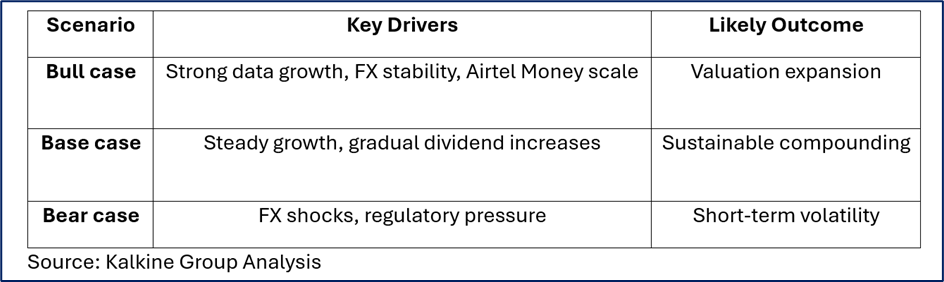
Bull, Base, and Bear Scenarios for Airtel Africa
What Are Analysts Saying About Airtel Africa in February 2026?
Broker consensus remains constructive, with most ratings clustered around Buy / Overweight. Analysts cite:
- Long-term structural growth
- Improving capital returns
- Execution risks balanced by scale advantages
Key Risks Investors Should Monitor
- Currency volatility across African markets
- Regulatory and political uncertainty
- Competitive pricing pressure
- Execution risk in scaling mobile money
Final Verdict: Is Airtel Africa a Compelling Investment in 2026?
Airtel Africa continues to stand out in the FTSE 100 as a rare combination of structural growth, cash generation, and emerging-market exposure. While short-term volatility is unavoidable, the long-term thesis—anchored in demographics, digital adoption, and financial inclusion—remains firmly intact.
For investors seeking diversification beyond the UK economy, exposure to Africa’s digital future, and improving dividend visibility, Airtel Africa remains a stock that deserves serious attention in February 2026 and beyond.


 Jun 29, 2026




 Please wait processing your request...