
 AU
AU
 CA
CA
 US
US
 NZ
NZ
 IND
IND

 UK
UK

 Share
Share
 X (Formerly Twitter)
 Whatsapp
 Facebook
 LinkedIn
 Telegram
 Email This Article
 Copy Link
 Summarize with AI
 Chat GPT
 Perplexity
Ceres Power Holdings PLC isn’t a traditional manufacturer—and that’s exactly why long-term investors are paying attention. Instead of building factories or selling hardware, Ceres licenses its world-class solid oxide fuel cell (SOFC) and electrolysis intellectual property to global partners. This capital-light, royalty-driven model has the potential to deliver highly scalable returns over the next decade as the global energy transition accelerates.
Key Takeaways Today – 4 February 2026
- Stock Rebound Momentum: Shares trade around ~318p, rebounding sharply after volatility and outperforming the FTSE 250 year-to-date.
- Analyst Sentiment Improving: Most brokers rate the stock Buy or Strong Buy, citing licensing expansion and long-term hydrogen adoption.
- Fuel Cell Growth Narrative: Ceres’ SOFC and electrolysis licensing model aligns with energy-transition priorities across the UK, EU, US, and Asia.
- High Volatility Persists: A wide 52-week range (44p–430p) reflects sensitivity to macro conditions and sentiment shifts.
- Near-Term Technical Signals Mixed: Some models flag downside risk over the next 3–6 months if key supports fail.
- Macro Environment Matters: GBP trends, UK inflation data, energy policy changes, and FTSE performance all influence investor appetite.
Is Ceres Power Stock Trending Up or Down Right Now?
Over recent weeks, Ceres Power has staged a notable rebound from its 2025 lows, trading well above historical troughs and outperforming broader UK indices. This renewed momentum coincides with rising interest in hydrogen, distributed power generation, and energy-security technologies worldwide.
By combining FTSE index trends, GBP macro movements, and clean-energy sector data, this outlook evaluates short-, medium-, and long-term scenarios for both retail and institutional investors.
How Is Ceres Power Performing in the UK and Global Market Context?
What’s Happening with the FTSE 250 and UK Economy?
- The FTSE 250 continues to highlight resilience among UK mid-caps, particularly in technology-led and energy-transition themes.
- Clean-tech and alternative-energy stocks are attracting rotational flows as investors balance growth with long-term structural demand.
How Do GBP and Inflation Trends Affect Ceres Power?
- GBP strength or volatility directly impacts valuation for UK-listed companies with international licensing revenue.
- UK inflation data and Bank of England policy decisions remain key drivers of sentiment toward growth and technology equities.
Is Ceres Outperforming UK Benchmarks?
- On a YTD and 1-year basis, Ceres Power has outpaced major FTSE benchmarks, signaling renewed confidence in its technology roadmap.
Share Price and Trading Signals (As of 4 Feb 2026)
- Current Range: Approximately 295p–300p, reflecting recovery from mid-2025 lows.
- Volume: Trading activity is above long-term averages, suggesting strong retail and institutional participation.
- Volatility Profile: The 44p–430p 52-week range underlines the stock’s high-beta nature.
Such volatility is typical for mid-cap clean-energy technology stocks tied to macro cycles and policy expectations.
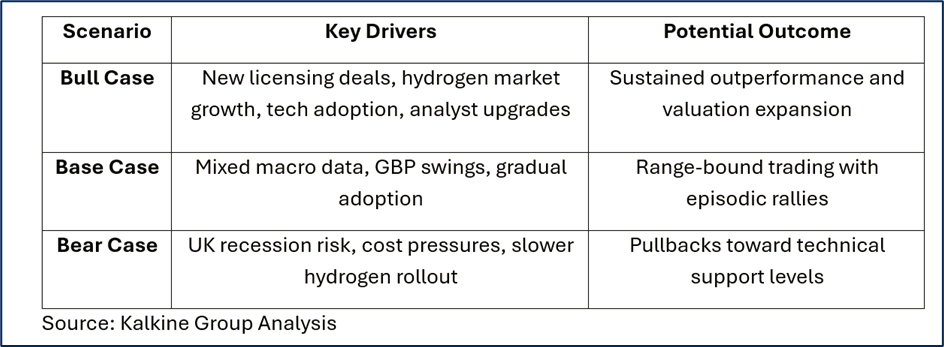
Ceres Power 2026 Bull, Base, and Bear Scenarios
Source: Kalkine Group Analysis
What Are Analysts Forecasting in February 2026?
- Consensus View: Predominantly Buy / Strong Buy ratings.
- 12-Month Target Range: Roughly £1.55 (low) to £5.70 (high) per broker estimates.
- Upgrade Drivers: Expansion of manufacturing license agreements and increasing interest from Asia-Pacific markets.
Important: Analyst targets are forward-looking opinions, not guarantees.
Core Company and Sector Drivers
Ceres Power Business Model
- Focuses on solid oxide fuel cell and electrolysis IP development.
- Licenses technology to global industrial partners, enabling scalable manufacturing without heavy capex.
Sector-Level Tailwinds
- Global push toward decarbonization and green hydrogen.
- Rising demand for distributed power, data-centre energy solutions, and low-carbon industrial processes.
- Government and corporate investment in clean infrastructure continues to expand addressable markets.
Key Risks Investors Should Watch
- Macroeconomic Risk: UK growth slowdowns, inflation surprises, and currency volatility.
- Earnings Profile: Continued investment means profitability remains uneven.
- Policy Sensitivity: Changes to clean-energy subsidies or hydrogen incentives could affect momentum.
- Share Price Volatility: Large swings require disciplined risk management.
Short-, Medium-, and Long-Term Investment Strategies
Short Term (0–6 Months)
- Watch technical support and resistance levels closely.
- Monitor RNS announcements, licensing news, and sector catalysts.
- Consider stop-loss strategies due to elevated volatility.
Medium Term (6–18 Months)
- Track UK inflation trends and central-bank policy shifts.
- Assess real-world adoption of fuel cells in data centers, EV infrastructure, and distributed generation.
Long Term (18 Months+)
- Structural megatrends—hydrogen, decarbonization, and energy security—remain intact.
- The licensing model offers asymmetric upside if global infrastructure investment accelerates.
Search-Optimized Investor FAQs
Is Ceres Power stock rising in February 2026?
The stock has rebounded strongly from 2025 lows, with elevated trading interest.
Is Ceres Power considered a bullish investment?
Long-term fundamentals are positive, but short-term volatility remains high.
What are the biggest risks?
Macro headwinds, delayed adoption, and earnings volatility.
How does it compare with FTSE peers?
Ceres has outperformed many FTSE mid-cap peers on a year-to-date basis.
Final Investment Outlook (Informational Analysis Only)
In early February 2026, Ceres Power stands out as a high-growth, high-volatility energy-technology stock within the FTSE 250. Its differentiated licensing model and exposure to global hydrogen and fuel-cell adoption offer compelling long-term upside. However, macroeconomic uncertainty, profitability challenges, and sharp price swings mean it’s best suited to investors with a higher risk tolerance and a diversified strategy.
Bullish drivers: Energy-transition tailwinds, scalable IP licensing, strong analyst sentiment.
Bearish pressures: Macro risk, earnings variability, technical downside risk.
Think of Ceres Power as a long-duration clean-energy option—powerful if the hydrogen thesis plays out, but not for the faint-hearted.


 Jun 03, 2026




 Please wait processing your request...