
 AU
AU
 CA
CA
 US
US
 NZ
NZ
 IND
IND

 UK
UK

 Share
Share
 X (Formerly Twitter)
 Whatsapp
 Facebook
 LinkedIn
 Telegram
 Email This Article
 Copy Link
 Summarize with AI
 Chat GPT
 Perplexity
Spire Healthcare shares vaulted more than 18% on 26 January, instantly becoming one of the strongest performers in the FTSE 250 and reigniting global investor attention on the UK private healthcare sector. The sharp re-rating was driven by a convergence of operational momentum, balance-sheet progress, and improving structural tailwinds rather than a single headline catalyst. Markets responded to clear evidence that Spire’s post-pandemic reset has moved decisively into a sustainable growth phase, supported by resilient demand, improving margins, and rising confidence in forward cash generation.
The surge also reflected a broader repricing of healthcare service providers as investors rotated toward defensive earnings with visible cash flows amid global macro uncertainty. Spire, long viewed as a recovery story weighed down by legacy cost inflation and NHS exposure, delivered confirmation that its turnaround is gaining traction.
Key Reasons Behind the Share Price Surge

Source: Kalkine Group
- Stronger-than-expected trading momentum
Recent company trading updates confirmed that private patient admissions and self-pay volumes continued to exceed internal expectations, supported by elevated NHS waiting lists and growing employer-funded demand (Spire Healthcare Trading Update). - Margin recovery becoming structural
Operational efficiencies implemented over the last 18 months — including workforce optimisation, pricing discipline, and theatre utilisation improvements — are now flowing consistently into operating margins rather than appearing as one-off benefits (Spire Healthcare FY Update). - Debt reduction and balance-sheet confidence
Management reiterated progress on deleveraging, with net debt trending lower and leverage metrics moving comfortably inside covenant headroom, easing long-standing investor concerns around financial flexibility (Spire Healthcare Annual Results). - Dividend visibility restored
The confirmation of a maintained dividend policy, supported by recurring free cash flow rather than exceptional items, reinforced confidence in capital discipline and earnings quality (Spire Healthcare Dividend Statement). - Re-rating catalyst after prolonged underperformance
After lagging UK healthcare peers for several years, Spire entered 2026 trading at sentiment lows. The update acted as a technical and fundamental inflection point, triggering rapid institutional repositioning.
Spire Healthcare’s Current Business Model
Spire operates a hybrid private healthcare model across the UK, blending private patient services with contracted NHS work. The group owns and operates a national network of hospitals, clinics, and diagnostic centres, providing surgical, medical, and outpatient care.
- Private Patient Services
Self-pay and insured patients account for the majority of earnings, delivering higher margins and shorter payment cycles. - NHS Contracted Work
Spire partners with the NHS to reduce elective surgery backlogs, offering stable volume but lower margin contribution. - Diagnostics and Day-Case Growth
Capital-light diagnostic services and day-case procedures are expanding faster than traditional inpatient care, improving returns on capital.
This diversified model allows Spire to flex capacity between public and private demand, smoothing revenue volatility while capturing structural shifts toward private healthcare access.
Latest Financial and Operational Updates (Company Sources)
- Revenue trajectory improving
Management confirmed continued year-on-year revenue growth driven primarily by higher private patient volumes and improved case mix (Spire Healthcare Trading Update). - Cost inflation moderating
Staff cost pressures, previously the group’s largest headwind, have stabilised as agency usage declines and permanent staffing levels normalise (Spire Healthcare Operational Update). - Capex discipline maintained
Capital expenditure remains focused on high-return diagnostic assets and digital infrastructure rather than large-scale hospital expansion (Spire Healthcare Annual Results). - Dividend maintained
The board reaffirmed its dividend payout, signalling confidence in sustainable free cash flow generation rather than recovery-phase optimism (Spire Healthcare Dividend Announcement).
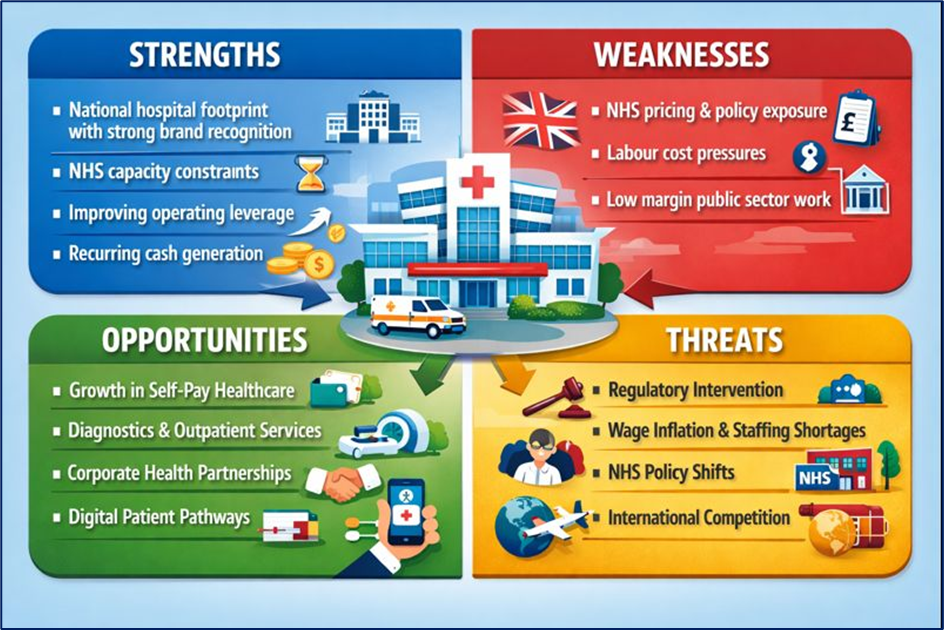
Updated SWOT Analysis
Source: Kalkine Group
Strengths
• National hospital footprint with strong brand recognition
• Structural demand tailwinds from NHS capacity constraints
• Improving operating leverage as utilisation rises
• Recurring cash generation supporting dividends and debt reduction
Weaknesses
• Exposure to NHS pricing and policy decisions
• Labour-intensive cost base sensitive to wage inflation
• Lower margins on public sector work relative to private care
Opportunities
• Long-term growth in self-pay healthcare in the UK
• Expansion of diagnostics and outpatient services
• Corporate and employer healthcare partnerships
• Digital patient pathways improving throughput and margins
Threats
• Regulatory intervention in private healthcare pricing
• Renewed wage inflation or staffing shortages
• NHS policy shifts reducing outsourced elective work
• Competitive pressure from international healthcare operators
Outlook: A Business Entering Its Next Phase
Spire Healthcare enters 2026 with materially improved visibility. Management has transitioned from recovery messaging to operational execution, focusing on throughput optimisation, pricing discipline, and capital efficiency. The company’s ability to convert elevated demand into sustainable earnings rather than temporary volume spikes is now increasingly evident.
Structural healthcare pressures in the UK show no signs of easing, with private providers expected to play a permanent role in alleviating system capacity constraints. Spire’s established infrastructure positions it as a natural beneficiary of this long-term shift, while its improving balance sheet provides optionality for targeted investment.
Key Risks to the Narrative
- Any reversal in NHS outsourcing volumes could impact utilisation rates
• Renewed wage inflation would pressure margins
• Political scrutiny of private healthcare participation could introduce regulatory risk
• Execution risk remains if volume growth outpaces staffing capacity
Compelling Conclusion
Spire Healthcare’s 18% surge was not a speculative spike but a decisive market verdict on improving fundamentals. After years of recovery-stage uncertainty, the business is demonstrating consistency, discipline, and strategic clarity. Investors responded to proof — not promises — that Spire has crossed the threshold from stabilisation to sustainable performance.
In a market searching for earnings resilience, predictable cash flows, and structural growth, Spire’s re-emergence as a credible UK healthcare operator has become impossible to ignore.


 Jun 03, 2026




 Please wait processing your request...