
 AU
AU
 CA
CA
 US
US
 NZ
NZ
 IND
IND

 UK
UK

 Share
Share
 X (Formerly Twitter)
 Whatsapp
 Facebook
 LinkedIn
 Telegram
 Email This Article
 Copy Link
 Summarize with AI
 Chat GPT
 Perplexity
The first trading day of 2026 has etched itself into financial history. As the FTSE 100 smashed past the 10,000-point milestone for the first time, BAE Systems (LSE: BA) emerged as a primary engine of this historic rally, with its stock climbing ~2.3% on January 2nd.
For retail investors and institutional desks alike, the question isn't just "why the jump?" but "is this the start of a new era for defense equities?"
The New Year Catalyst: Why BAE Popped +2.3%

Source: Kalkine Group
The 2.3% surge wasn't a fluke of the "January Effect." It was driven by a convergence of three powerful macro and micro factors:
- The "NATO Paradigm Shift": Market sentiment on Jan 2nd was heavily influenced by the realization that European defense spending is no longer discretionary—it is mandatory. Analysts cited a "paradigm shift" where NATO members are aggressively front-loading budgets to meet 2%+ GDP targets.
- Sector Rotational Inflows: As the FTSE 100 hit 10,000, global "value hunters" rotated out of overstretched US tech and into high-visibility UK industrials. BAE, with its £75B+ order backlog, was the go-to beneficiary.
- Energy & Commodity Tailwinds: A surge in mining and energy prices on Jan 2nd lifted the entire FTSE index, creating a "rising tide" effect for heavy industrials like BAE.
2026 Business Model: Beyond Heavy Metal
BAE Systems is no longer just a shipbuilder or a jet manufacturer. Its 2026 business model has evolved into a hybrid defense-tech ecosystem.
- Digital Intelligence & Cyber (The High-Margin Engine)
The acquisition of Ball Aerospace (now BAE Systems Space & Mission Systems) has been fully integrated. BAE now dominates Space Control—protecting satellites from the "weekly" GPS jamming and laser threats currently reported in the UK.
- Electronic Warfare (EW) and AI
The company has transitioned to a software-first approach. Its 2026 "Prophesea" and "SeaReady" products use AI to predict maintenance needs for complex naval assets, shifting the model from one-off sales to recurring service-based revenue.
- The "Tempest" & GCAP Partnership
The Global Combat Air Programme (GCAP) has moved from blueprint to prototype. This collaborative model (UK, Japan, Italy) reduces BAE's individual R&D risk while securing its role as a global lead in 6th-generation aerial dominance.
Financial & Operational Update (Latest Stats)
- Record Order Backlog: Sitting at approximately £75.4 Billion as of the latest mid-2025/early 2026 reporting cycles.
- Revenue Growth: Projected to hit £30 Billion in 2026, a steady climb from £28B in 2025.
- EBITDA Margins: Maintaining a healthy 14.5%–15.0%, showcasing strong pricing power despite inflationary pressures on raw materials.
- Shareholder Returns: Continued execution of its multi-billion pound share buyback program, which supported the price floor during the mid-2025 volatility.
SWOT Analysis
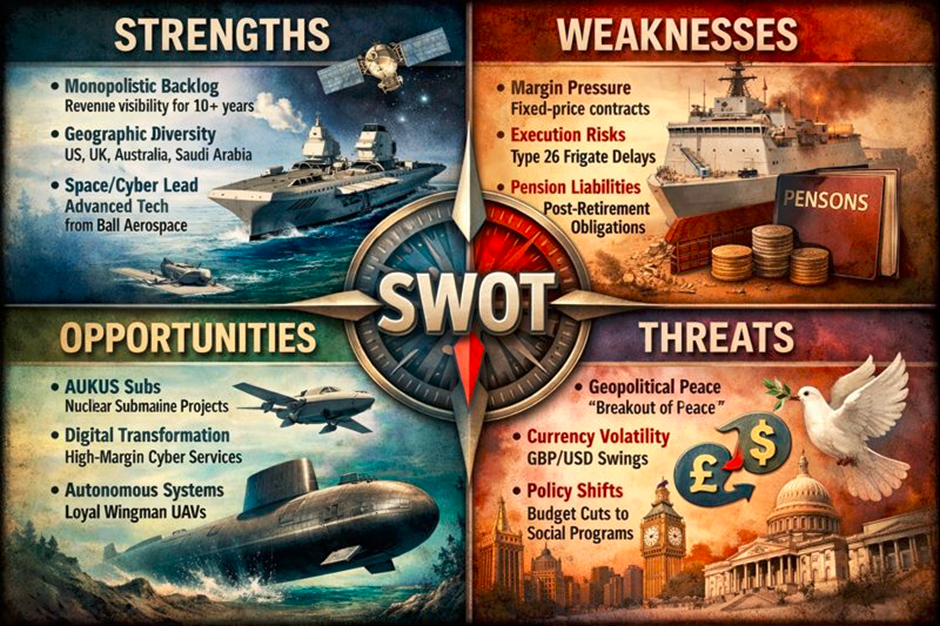
Source: Kalkine Group
Critical Risks: What Could Stall the Engine?
- The "Peace" Factor: If diplomatic breakthroughs occur in major global conflict zones, the "war premium" currently baked into the stock price could evaporate rapidly.
- Regulatory Hurdles: The new UK Cyber Security and Resilience Bill (2026) imposes stricter obligations on defense contractors. Non-compliance or data breaches are now high-stakes risks.
- Labor Scarcity: Finding enough specialized engineers to build the Type 26 Frigates and the Tempest jet remains a bottleneck for operational scaling.
Conclusion
The 2.3% gain on January 2nd reflects a market that has priced BAE Systems as a "defensive growth" play. With the FTSE 100 in unchartered territory above 10,000, BAE offers a rare combination of earnings visibility and technological expansion. While the valuation is no longer "cheap" compared to historical averages, the fundamental shift in global security architecture suggests that the "Defense Supercycle" still has fuel in the tank for 2026.


 Jun 03, 2026




 Please wait processing your request...