
 CA
 NZ
 US
 AU
 IND

 UK

 Share
 X (Formerly Twitter)
 Whatsapp
 Facebook
 LinkedIn
 Telegram
 Email This Article
 Copy Link
 Summarize with AI
 Chat GPT
 Perplexity

Summary
Foxtons Group (LSE:FOXT) is a London-focused estate agency spanning lettings, sales and mortgage broking rather than a landlord or REIT. FY2025 revenue rose around 5% to roughly £172.5 million, helped by lettings resilience and the Cauldwell acquisition, though adjusted operating profit was broadly flat. A subsequent 2026 trading update pointed to stronger momentum. This article checks verified facts, flags unconfirmed figures, and sets out risks and dividend caveats without recommending the shares.
Key takeaways
- Foxtons Group (FOXT) is a London-focused estate agency with three divisions — lettings, sales and financial services — not a REIT or landlord.
- FY2025 revenue rose to roughly £172.5 million, up around 5% year-on-year, with lettings and the Cauldwell acquisition cited as key drivers.
- FY2025 adjusted operating profit was described as broadly flat year-on-year, despite the revenue growth, reflecting a still-uneven sales market.
- A subsequent 2026 trading update reportedly showed a stronger start to the year, with revenue and adjusted operating profit both growing faster than in FY2025.
- Current share price, market capitalisation, exact dividend per share and net cash position were not independently verified here and should be checked against live sources first.
Introduction
Foxtons Group has long been one of the most recognisable names on London high streets, its lime-green branding a fixture of the capital's lettings and sales markets for decades. After a difficult stretch through the higher interest-rate years, the group's own trading updates now point to a business rebuilding momentum, leaning on recurring lettings income, bolt-on acquisitions and a mortgage broking arm to offset a still-choppy sales market.
This article sets out what is known about Foxtons' latest financial performance, dividend position and balance sheet, based on company statements and press coverage available as of 13 July 2026. Where figures such as the current share price, market capitalisation or exact dividend yield could not be independently confirmed, that is flagged clearly rather than estimated.
Key facts 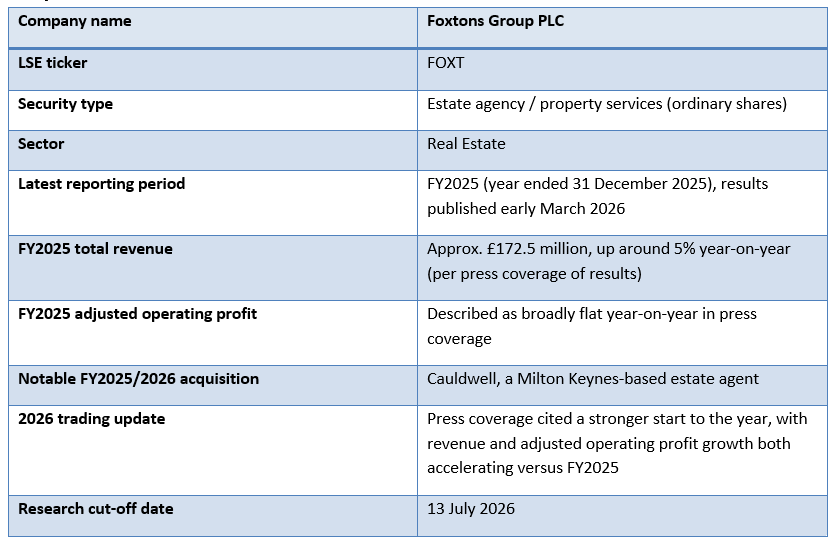
Company overview: how does the Foxtons agency model work?
Foxtons Group PLC is not a real estate investment trust and does not own the properties it markets. It operates through three divisions: lettings, which manages rented properties and earns a share of rent as fee income; sales, which earns commission on transactions; and financial services, a mortgage broking business serving buyers and landlords.
Why is FOXT attracting attention?
Interest in FOXT has picked up as investors look for London-exposed plays on a housing market many expect to stabilise as rate pressure eases. Foxtons' FY2025 results, published in early March 2026, described total revenue rising to around £172.5 million, up roughly 5% year-on-year, with lettings growth and the acquisition of Milton Keynes-based agent Cauldwell cited as contributing factors.
Latest financial performance: what do the FY2025 numbers show?
According to press reports of the FY2025 results, group revenue rose to approximately £172.5 million, up around 5% on the prior year, driven mainly by lettings growth and the Cauldwell acquisition, a Milton Keynes-based agency bolted onto the existing network.
Despite the revenue growth, coverage described adjusted operating profit as broadly flat year-on-year, implying higher revenue came with higher costs or a less favourable mix. The exact adjusted margin, and the precise revenue split between lettings, sales and financial services, were not independently confirmed here and should be checked against Foxtons' own results presentation.
It is worth separating fact from interpretation: that revenue rose roughly 5% and profit was flat are reported facts from press coverage; any view on what that implies for margin trajectory into 2026 is analysis, not a confirmed company statement.
Operating performance: how are sales, lettings and productivity trending?
Commentary on the FY2025 results characterised the year as one in which lettings growth offset a still-volatile sales market. This pattern, a steadier lettings book cushioning swings in sales commission, is consistent with the structural role lettings has played since Foxtons diversified away from a pure sales-agency model after 2008.
The Cauldwell acquisition continues Foxtons' stated strategy of buying smaller lettings books to expand its managed-tenancy base outside central London, a lower-capital way of growing recurring revenue than organic branch expansion. Branch-level productivity metrics were not independently verified here, so any such figures from third-party summaries should be treated with caution.
The 2026 trading update, described in press coverage as showing double-digit revenue growth and a much larger percentage rise in adjusted operating profit, suggests operating leverage may be starting to work in the group's favour as sales activity picks up. Because the exact period and full detail were not independently confirmed, this should be read as a directional signal rather than a precise figure.
Balance sheet and cash: how solid is Foxtons' financial footing?
Foxtons has historically operated with a net cash balance sheet rather than material debt, a position that has previously supported bolt-on acquisitions such as Cauldwell and shareholder returns including buybacks. The precise net cash figure at the FY2025 year-end, and any update on buyback activity, were not independently confirmed here.
Given Foxtons appears to fund acquisitions from its own resources rather than external financing, the balance sheet looks a relative strength of the case, but readers should verify the latest net cash position and any buyback programme directly from investor relations materials.
Dividend analysis: what income does FOXT currently offer?
The starting screening data used for this piece indicated a yield of roughly 2.72%, but this could not be corroborated against a live share price and confirmed dividend-per-share figure, and should be treated as unverified pending direct confirmation from Foxtons' investor relations pages or a live data provider.
Qualitatively, Foxtons' dividend policy has historically been linked to profitability and cash generation across the housing cycle, so payouts have moved up and down with trading conditions rather than following a fixed progression. With FY2025 adjusted operating profit reported broadly flat despite higher revenue, there is no basis here to assume automatic dividend growth; no dividend is guaranteed.
A dividend cover ratio would require both a confirmed profit figure and a confirmed dividend per share; neither was verified in this pass, so cover has not been calculated. Investors wanting precise current figures should consult Foxtons' latest RNS announcements or a live data provider.
UK housing and rental backdrop: is the market really finding momentum?
The broader narrative around FOXT rests heavily on the London and UK housing market. Press summaries of FY2025 results described the sales market as volatile through the year, even as lettings performed more consistently, suggesting any transaction-market recovery has so far been gradual rather than a sharp upturn.
The acceleration flagged in Foxtons' 2026 trading update, if borne out in fuller results, would tend to support improving conditions into 2026, potentially reflecting lower mortgage rates or easier lending feeding through to transactions and the financial-services arm. Macro data on UK mortgage approvals, house prices and rental growth were not independently checked here, so this remains a plausible but unconfirmed interpretation.
Valuation context: how does FOXT compare with peers?
A meaningful valuation comparison, price-to-earnings, enterprise value to operating profit, or yield relative to peer agency and property-services groups, requires a confirmed current share price, market capitalisation and forward earnings estimate, none of which could be independently verified here. This article therefore does not offer a specific valuation multiple or fair-value view for FOXT.
Main risks
The most direct risk is continued volatility in the London and UK sales market, explicitly flagged in press coverage of FY2025 results even as lettings performed better. A renewed slowdown in transactions, from higher-for-longer mortgage rates or weaker sentiment, would weigh on sales commissions and financial-services income.
Integration risk from the Cauldwell acquisition, and any further bolt-on deals, is also relevant, since acquired lettings books need retaining and cross-selling to justify their price. Regulatory and cost pressures affecting lettings and mortgage broking, including tenant-protection legislation, are worth monitoring. Given several figures in this article could not be independently verified, readers also face an information-quality risk if relying on screened data rather than primary disclosures.
What investors may watch next
Near-term catalysts likely include Foxtons' next scheduled trading update or interim results, which should clarify whether the momentum referenced in the 2026 update has continued, and provide a clearer divisional breakdown than was available for this piece. Further bolt-on acquisitions, buyback updates, and commentary on UK mortgage rates and transaction volumes are also worth tracking.
Balanced conclusion
Foxtons Group presents a recognisable, London-centric property-services business built on three complementary revenue streams, with lettings providing a steadier base, sales offering cyclical upside, and financial services adding a mortgage-linked layer. FY2025 revenue growth and a reportedly stronger start to 2026 support a cautious comeback narrative, though flat adjusted operating profit in FY2025 is a reminder that revenue growth has not yet translated cleanly into profit growth.


 Nov 13, 2026





 Please wait processing your request...