Kalkine’s Global Tariff Report provides fully independent analysis and data-driven analysis of major global sectors affected by tariff changes, evaluating the implications these shifts may have on equity valuations across those industries. The report concentrates on trade-sensitive sectors that typically experience heightened investor scrutiny during periods of tariff uncertainty. It also identifies defensive and countercyclical segments that demonstrate relative resilience or may even outperform, amid disruptions to global trade flows.
As illustrated in the table below, several key sectors in different countries are directly impacted by the recent tariff announcement from President Trump.
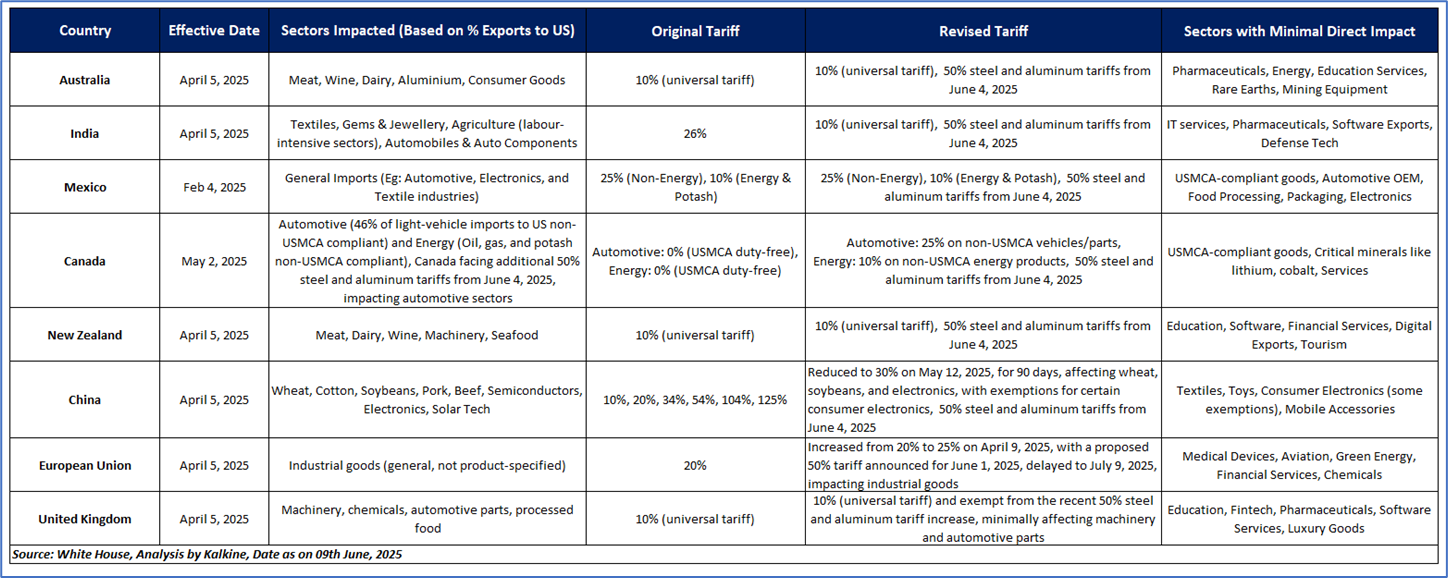

Key Developments (June 2, 2025)
- Steel Tariff Hike: President Donald Trump announced a doubling of tariffs on steel imports from 25% to 50%, citing a need to "further secure the steel industry" in the US.
- US-China Tensions: Trump accused China of violating its trade deal with the US, though no specific breaches were detailed. USTR Jamieson Greer stated that China is "slow rolling their compliance."
United States: Legal Challenges and Strategic Shifts
- A US Court of International Trade blocked several Trump-era tariffs, labeling their implementation method "unlawful."
- The US Court of Appeals granted a temporary administrative stay, allowing tariffs to remain in effect while legal reviews proceed.
- The Trump administration must file its response by June 9; an appeal to the Supreme Court is possible.
European Union: Responses and Negotiations
- Proposed Tariffs on US Goods: In response to US tariffs, the European Union has proposed a 25% tariff on USD ~23.8 bn worth of US goods, targeting agricultural products and items from specific US states. Implementation has been delayed for 90 days to allow for further negotiations.
- Trade Talks and Deadlines: President Trump had threatened to impose a 50% tariff on all EU imports starting June 1, 2025. However, after discussions with European Commission President Ursula von der Leyen, he agreed to delay the tariffs until July 9, 2025, to allow for continued negotiations.
- EU's Strategic Position: The EU is pushing for a mutually beneficial deal that could include both sides moving to zero tariffs on industrial goods, and the EU buying more soybeans, arms, and liquefied natural gas as it phases out all Russian gas imports by the end of 2027.




In April 2025, the United States saw a significant improvement in its trade imbalance, with the trade deficit narrowing to USD 62 billion from USD 140 billion in March, driven by a rise in total exports to USD 289 billion and a sharp decline in imports to USD 351 billion, reflecting the impact of tariffs and reduced consumer demand. Goods exports increased to USD 188.47 billion, while service exports reached USD 162.53 billion, maintaining a strong services surplus, though the 30% tariff on Chinese goods and retaliatory measures continue to threaten goods-exporting sectors, necessitating cautious economic strategies amidst a still-elevated external debt of USD 27.6 trillion and potential macroeconomic risks.


The U.S. economy is currently grappling with significant challenges, including high inflation, supply chain disruptions, and the effects of aggressive monetary policy from the Federal Reserve. Key sectors such as manufacturing, agriculture, and technology are feeling strain, particularly due to their dependence on global supply chains and export markets, with trade policies like tariffs on steel, aluminum, and electronics driving up costs for businesses and consumers alike. Despite these pressures, there’s cautious optimism in some quarters about market stabilization within the next year, though this is tempered by ongoing issues like labor shortages, energy price volatility, and political divisions. The Federal Reserve’s interest rate hikes aimed at curbing inflation—still above target levels—have slowed economic growth, raising recession risks, while strategic efforts such as trade agreements and supply chain diversification remain critical to fostering stability and mitigating prolonged uncertainty across these vital sectors.


Amid elevated Market Volatility and Tariff pressures, Airbnb Inc. (NASDAQ: ABNB) stands out as our defensive pick within the Travel & Hospitality Industry, supported by rigorous fundamental and technical research
Kalkine’s Global Tariff Report covers the Investment Highlights, Key Financial Metrics, Risks, Technical Analysis along with the Valuation, Target Price, and Recommendation on the Airbnb, Inc. (NASDAQ: ABNB).
Section 1: Company Overview and Fundamental Insights
1.1 Company Overview:
Airbnb, Inc. (NASDAQ: ABNB) operates a global platform for stays and experiences. The Company’s marketplace model connects hosts and guests online or through mobile devices to book spaces and experiences around the world. The Company has built its platform to onboard new hosts, especially those who previously had not considered hosting. It partners with hosts throughout the process of setting up their listing and provides them with a suite of tools to manage their listings, including scheduling, merchandising, integrated payments, community support, host protection, pricing guidance, and feedback from reviews.

1.2 The Key Positives, Negatives, Investment Highlights and Risks


1.3 Top 10 Shareholders:
The top 10 shareholders together form ~34.44% of the total shareholding. The Vanguard Group, Inc. and BlackRock Institutional Trust Company, N.A. hold a maximum stake in the company at ~8.64% and ~4.67%, respectively.

1.4 Key Metrics:
Airbnb, Inc. (Nasdaq: ABNB) has demonstrated robust financial growth from 2020 to 2024, with revenue from business activities increasing from USD 3,378.2 million to USD 11,102 million, reflecting a 4-year CAGR of 34.64%, while gross profit surged from USD 1,624.3 million to USD 7,942 million, achieving an impressive 4-year CAGR of 92.49%, driven by a consistent rise in gross margin from 48.08% in 2020 to 71.54% in 2024, as reported on June 9, 2025. Comparing Q1 FY24 to Q1 FY25, the gross profit margin slightly improved from 70.87% to 71.54%, while profitability metrics showed significant enhancement, with the EBITDA margin increasing from 15.75% to 23.58%, the operating margin rising from 15.31% to 23.00%, and the income before tax margin advancing from 21.20% to 30.00%, indicating improved operational efficiency and cost management amidst revenue growth, positioning Airbnb favorably for sustained profitability in the hospitality and travel industry.

Section 2: Business Updates and Financial Highlights
2.1 Recent Updates: The below picture gives an overview of the company’s recent activities, such as an announcement regarding dividend distribution.

2.2 Insights on Q1 2025 Financial Performance:

Section 3: Key Risks, Company Outlook:

Section 4: Stock Recommendation Summary:
4.1 Price Performance and Technical Summary:
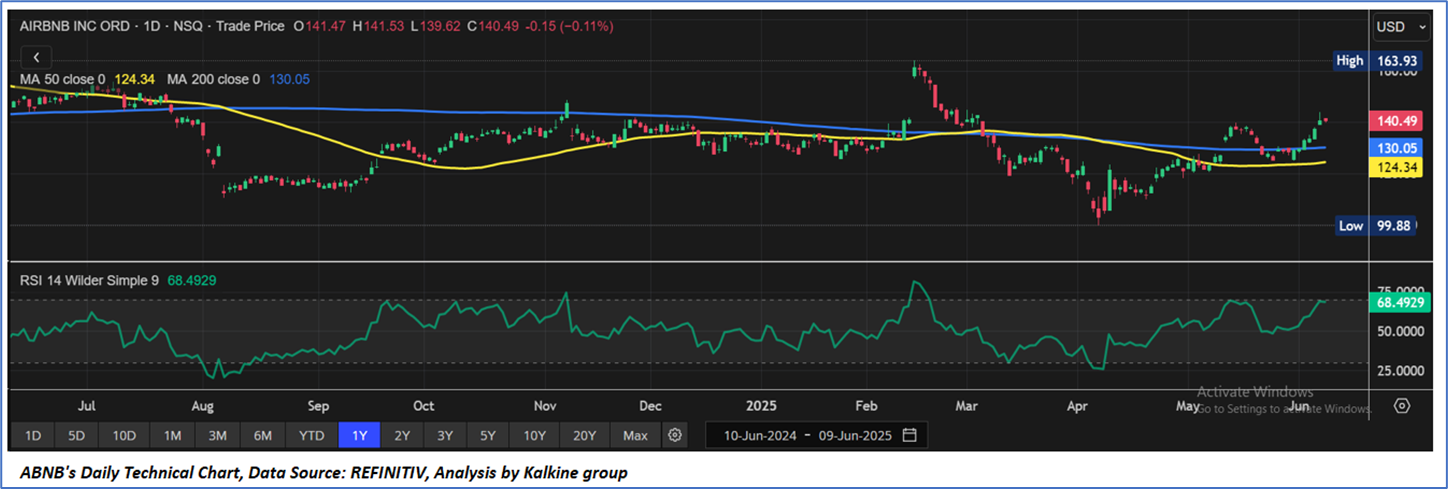
- ABNB has generated a return of approx. 6.33% in past three months. Similarly, a return of approx. 2.36% in past six months.
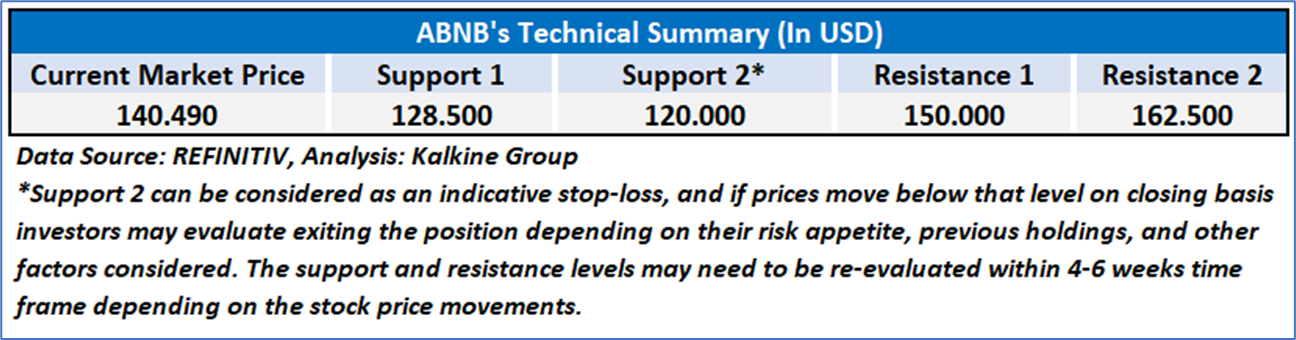
- The stock is around the higher end of its 52-week range of USD 163.93 and 52-week low price of USD 99.88. Post the announcement of Q1FY25 results the stock has given a return of almost 13.81%, with the current price broken above an important resistance of USD 120- USD 130.
- The price is currently trading above both its long-term (200-day) SMA and its short-term (50-day) SMA, with the current RSI of 68.49.
4.2 Fundamental Valuation
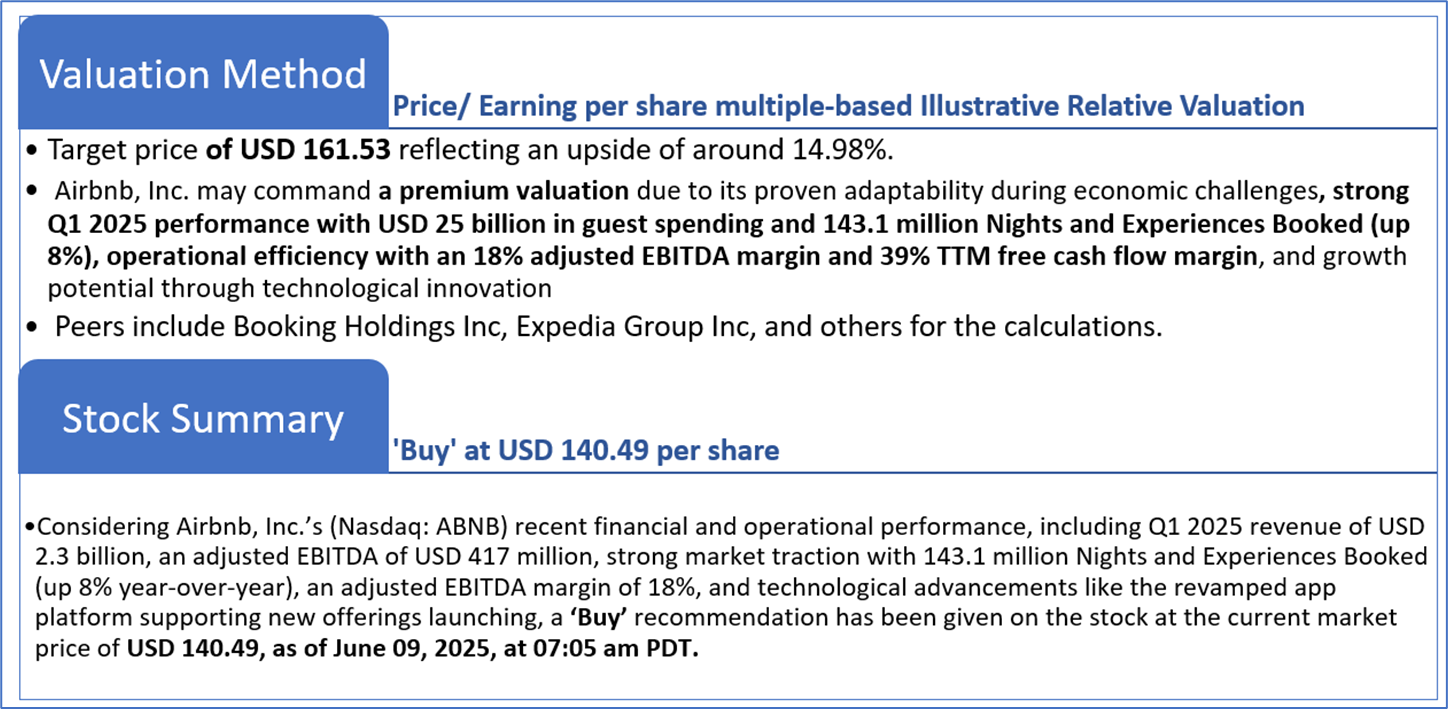
Valuation Methodology: Price/ Earnings Per Share Multiple Based Relative Valuation (Illustrative)

Note 1: Past performance is not a reliable indicator of future performance.
Note 2: The reference date for all price data, currency, technical indicators, support, and resistance levels as on June 09, 2025. The reference data in this report has been partly sourced from REFINITIV.
Note 3: Investment decisions should be made depending on an individual's appetite for upside potential, risks, holding duration, and any previous holdings. An 'Exit' from the stock can be considered if the Target Price mentioned as per the Valuation and or the technical levels provided has been achieved and is subject to the factors discussed above.
Note 4: Dividend Yield may vary as per the stock price movement.
Note 5: Kalkine reports are prepared based on the stock prices captured either from REFINITIV or Trading View. Typically, REFINITIV or Trading View may reflect stock prices with a delay which could be a lag of 25-30 minutes. There can be no assurance that future results or events will be consistent with the information provided in the report. The information is subject to change without any prior notice.
Technical Indicators Defined: -
Support: A level at which the stock prices tend to find support if they are falling, and a downtrend may take a pause backed by demand or buying interest.
Resistance: A level at which the stock prices tend to find resistance when they are rising, and the uptrend may take a pause due to profit booking or selling interest.
Stop-loss: In general, it is a level to protect further losses in case of any unfavorable movement in the stock prices.
Disclaimer-
This report has been issued by Kalkine Limited (Company number 07903332), a private limited company, incorporated in England and Wales ("Kalkine”). Kalkine.co.uk and associated pages are published by Kalkine. Kalkine is authorised and regulated by the Financial Conduct Authority under reference number 579414.
The information in this report and on the Kalkine website has been prepared from a wide variety of sources, which Kalkine, to the best of its knowledge and belief, considers accurate. Kalkine has made every effort to ensure the reliability of information contained in its reports, newsletters and websites. All information represents our views at the date of publication and may change without notice. The information in this report does not constitute an offer to sell securities or other financial products or a solicitation of an offer to buy securities or other financial products. Our reports contain non personalized recommendations to invest in securities and other financial products.
Kalkine does not offer financial advice based upon your personal financial situation or goals, and we shall not be held liable for any investment or trading losses you may incur by using the opinions expressed in our reports, publications, market updates, news alerts and corporate profiles. Kalkine does not intend to exclude any liability which it is not permitted to exclude under applicable law or regulation. Kalkine’s non-personalised advice does not in any way endorse or recommend individuals, investment products or services for your personal financial situation. You should discuss your portfolios and the risk tolerance level appropriate for your personal financial situation, with a professional authorised financial planner and adviser. You should be aware that the value of any investment and the income from it can go down as well as up and you may not get back the amount invested.
Please also read our Terms & Conditions for further information. Employees and/or associates of Kalkine and its related entities may hold interests in the securities or other financial products covered in this report or on the Kalkine website. Any such employees and associates are required to comply with certain safeguards, procedures and disclosures as required by law.
Kalkine Media Limited, an affiliate of Kalkine, may have received, or be entitled to receive, financial consideration in connection with providing information about certain entity(s) covered on its website including entities covered in this report.
Past performance is not a reliable indicator of future performance.

 AU
AU
 CA
CA
 US
US
 NZ
NZ
 IND
IND

 UK
UK

 Please wait processing your request...