
 AU
AU
 CA
CA
 US
US
 NZ
NZ
 IND
IND

 UK
UK

 Share
Share
 X (Formerly Twitter)
 Whatsapp
 Facebook
 LinkedIn
 Telegram
 Email This Article
 Copy Link
 Summarize with AI
 Chat GPT
 Perplexity
Image Source : Krish Capital Pty Ltd
Index Update: The FTSE 100 index, a key benchmark index for the London stock exchange, went down around 0.42% on 13 January 2025. Energy, Utilities & Basic Materials sector has witnessed a substantial growth. Moreover, Industrials, HealthCare and Technology sector has faced a significant decline.
Macro Update: London's financial sector saw a sharp drop in job vacancies, with a 20% decline in Q4 2024 compared to the previous quarter and a 28% decrease for the year overall, reaching its lowest levels since June 2020, according to Morgan McKinley's Employment Monitor. The sector grapples with challenges including economic volatility, geopolitical uncertainties, strategic overhauls, and rapid technological disruptions. At the same time, British 30-year government bond yields surged to a 27-year high, fueled by concerns over increased debt issuance amid a slowing economy and inflationary pressures in the U.S. Finance Minister Rachel Reeves, under scrutiny for visiting China during this market turmoil, defended her fiscal policies while seeking to revive economic and financial discussions that had been frozen for nearly six years.
Top Market Movers: Among top gainers on FTSE 100 index, Rentokil Initial PLC (LSE: RTO) witnessed a rise of 2.33% followed by Entain PLC (LSE: ENT) which gained around 2.12%.
Commodity Update: The U.S. dollar surged at the start of the week, bolstered by a strong jobs report highlighting the nation's economic resilience. U.S. job growth accelerated in December, with the unemployment rate dropping to 4.1%, prompting traders to scale back expectations for Federal Reserve rate cuts in 2025. The dollar's strength left its peers languishing near multi-year lows. In commodities, gold inched up 0.01% to $2,715.70, while silver dropped 0.24% to $31.23. Copper gained 0.50%, reaching $9,126.50. Meanwhile, Brent crude oil climbed 1.81%, settling at $81.22 per barrel, driven by concerns over supply disruptions following the U.S.'s stringent sanctions on Russian oil exports.
Our Stance: The recent surge in U.S. Treasury yields, spurred by stronger-than-expected job growth in December and a declining unemployment rate, has heightened expectations of prolonged high interest rates by the Federal Reserve. This has reignited inflation concerns, dampened hopes for a yield reprieve, and increased market volatility. Meanwhile, China is stepping up measures to stabilize the yuan, including plans to park more dollars in Hong Kong and enhance capital flows, as the currency hits 16-month lows amidst a strong dollar and geopolitical uncertainties. Oil prices extended their rally, with Brent crude surpassing $80 per barrel due to stricter U.S. sanctions on Russian oil, while Chinese and Hong Kong stocks faced declines over concerns about the U.S.-China yield gap and fewer anticipated U.S. interest rate cuts. These developments highlight a complex global economic landscape with inflationary pressures, geopolitical tensions, and market volatility at play.
FTSE 100
The FTSE 100 closed at 8,248.49 on Friday, down by 0.86%, forming a bearish candlestick pattern, though it found solid support at 8,002.00. The index remains above its 21-period Simple Moving Average (SMA), indicating potential for short-term upward momentum. The 50-period SMA provides additional downside support, minimizing the risk of a sharp decline. With the Relative Strength Index (RSI) at 52.39, bullish sentiment persists. On the weekly chart, the FTSE 100 rose 0.30%, staying above the 50-period SMA at 8,130.76. Key support lies at 7,932, with resistance at 8,400. A breakout above 8,400 could signal stronger bullish momentum, while a drop below 8,020 may indicate further downside. Monitoring these levels is essential for predicting future price movements.
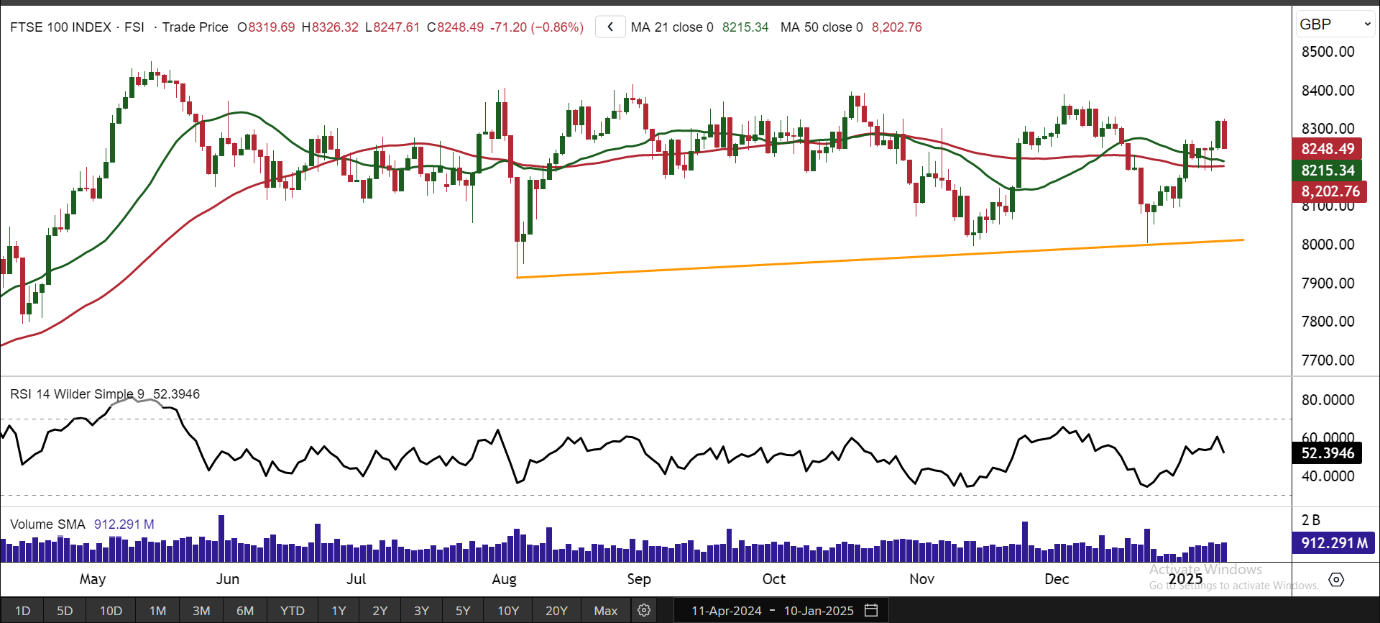
Data Source - EODHD/Others


 Jun 05, 2026




 Please wait processing your request...