
 AU
AU
 CA
CA
 US
US
 NZ
NZ
 IND
IND

 UK
UK

 Share
Share
 X (Formerly Twitter)
 Whatsapp
 Facebook
 LinkedIn
 Telegram
 Email This Article
 Copy Link
 Summarize with AI
 Chat GPT
 Perplexity
Key Takeaways — March 2026
- Rolls-Royce Holdings Plc (LON: RR) declined 5.36% on 5 March 2026, becoming one of the notable FTSE 100 laggards.
- Profit-taking after a strong rally, global market volatility, and defence sector rotation contributed to the drop.
- Aerospace engine demand and long-term service contracts remain strong growth drivers.
- Dividend restoration expectations remain a key catalyst for investors.
- Analyst sentiment remains broadly constructive on long-term fundamentals despite short-term volatility.
Why Is Rolls-Royce (LON: RR) Stock Down 5.36% Today in March 2026?
Rolls-Royce stock, Rolls-Royce share price today, and FTSE 100 aerospace stocks became major talking points across UK financial markets on 5 March 2026, as Rolls-Royce Holdings Plc (LON: RR) fell 5.36% in a single trading session. The decline triggered investor curiosity across UK stock market news, FTSE 100 analysis, Rolls-Royce investment outlook, aerospace defence stocks UK, and global aviation industry recovery trends.
The sudden drop in RR stock price March 2026 comes after a remarkable rally over the past two years driven by strong civil aerospace recovery, rising defence spending, improved cash flow generation, and operational restructuring. With Rolls-Royce becoming one of the best-performing FTSE 100 stocks, many investors appear to be locking in profits amid broader global market volatility and sector rotation.
Despite today’s decline, the Rolls-Royce long-term growth narrative — driven by aerospace engine services, defence contracts, and power systems — remains intact, keeping the stock firmly on the radar of long-term investors, institutional funds, and retail traders tracking UK aerospace stocks and FTSE dividend opportunities in March 2026.
Could Profit-Taking After a Massive Rally Be the Main Reason for the RR Stock Drop?
One of the most logical explanations behind the Rolls-Royce share price fall today is profit-taking after an extraordinary share price recovery since 2023.
Key drivers include:
- Significant gains over the past two years attracting short-term traders booking profits
- High expectations already priced into the stock
- Portfolio rebalancing by institutional investors
- Broader volatility in global aerospace and defence stocks
When stocks outperform the broader FTSE 100 index, temporary pullbacks are common as investors reassess valuations.
Is Global Market Volatility Impacting FTSE 100 Aerospace Stocks?
Global macroeconomic trends are also influencing Rolls-Royce stock performance in March 2026.
Current global dynamics include:
- Rising geopolitical tensions impacting global markets
- Central bank policy uncertainty
- Fluctuations in aviation demand forecasts
- Commodity and energy price volatility
Aerospace stocks like Rolls-Royce are cyclical and sensitive to global economic sentiment, which can trigger short-term corrections.
Is the UK Economy and GBP Movement Affecting Rolls-Royce Shares?
The UK macroeconomic environment also plays a role in FTSE 100 stock volatility.
Key factors influencing investor sentiment include:
- Slower UK GDP growth expectations
- Inflation pressures impacting manufacturing costs
- Movements in the British Pound (GBP)
- Interest rate policy from the Bank of England
Since Rolls-Royce generates a large portion of revenue internationally, currency fluctuations can impact earnings expectations and investor sentiment.
How Does Rolls-Royce’s Business Model Drive Long-Term Growth?
Rolls-Royce operates a unique “Power-by-the-Hour” service model, which generates recurring revenue.
Core business segments include:
Civil Aerospace
- Aircraft engines for wide-body jets
- Long-term maintenance service contracts
Defence
- Engines for military aircraft and naval vessels
Power Systems
- Industrial engines and energy solutions
This diversified model allows Rolls-Royce to generate stable long-term cash flow even during aviation cycles.
(Source: Rolls-Royce Annual Report)
What Do the Latest Financial and Operational Updates Show?
Recent company updates highlight improving fundamentals.
Key operational highlights:
- Rising flying hours in civil aviation boosting service revenue
- Improved operating margins from restructuring programs
- Strong order book in defence segment
- Focus on small modular nuclear reactor (SMR) technology
Management has also indicated continued progress toward balance sheet strengthening and cash flow improvement.
(Source: Rolls-Royce Investor Updates)
How Does Rolls-Royce Compare With Aerospace Industry Peers?
Peer benchmarking helps contextualise RR stock performance.
Major peers include:
- Airbus suppliers and engine manufacturers
- Safran
- General Electric Aerospace
Key comparative strengths:
- High-margin aftermarket service revenue
- Long-term aviation demand
- Defence spending tailwinds
However, compared with peers, Rolls-Royce still faces balance sheet and leverage challenges from past restructuring.
What Do Analysts Forecast for Rolls-Royce Stock?
Several leading analysts maintain constructive long-term outlooks.
Analyst forecasts include:
Goldman Sachs
- Positive long-term outlook on aerospace recovery
(Source: Goldman Sachs Research)
Morgan Stanley
- Strong service revenue growth expectations
(Source: Morgan Stanley)
UBS
- Improved cash flow trajectory
(Source: UBS Research)
Barclays
- Defence segment providing stability
(Source: Barclays Equity Research)
Analysts generally expect continued earnings growth as aviation demand normalises globally.
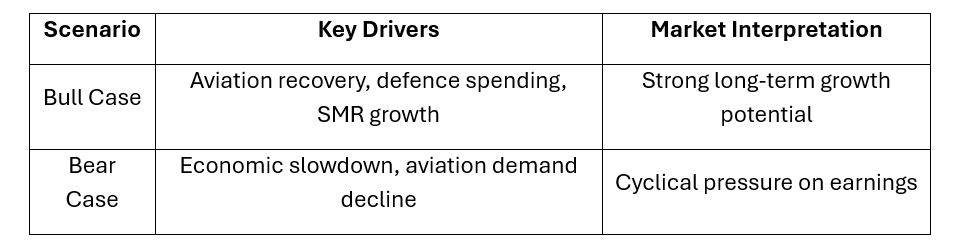
Scenario Analysis — Bull vs Bear Case
What Are the Dividend Prospects for Rolls-Royce Investors?
Rolls-Royce suspended dividends during the pandemic but investors are closely watching potential reinstatement.
Future dividend drivers:
- Sustainable free cash flow generation
- Balance sheet strengthening
- Stable civil aviation demand
Dividend restoration could become a major catalyst for income investors.
What Are the Key Risks Investors Should Watch?
Important risks include:
- Global aviation downturn
- Supply chain disruptions
- Currency volatility
- Execution risks in restructuring programs
- Competition from global aerospace giants
How Does Rolls-Royce Perform on ESG Metrics?
Environmental
- Focus on sustainable aviation fuel compatibility
- Investment in low-carbon propulsion technologies
Social
- Aerospace innovation and skilled employment
Governance
- Corporate restructuring and improved transparency
ESG initiatives are becoming increasingly important for institutional investors evaluating aerospace companies.
What Could Investors Do in the Short, Medium, and Long Term?
Short Term (3-6 months)
Investors may focus on:
- Market volatility opportunities
- Aviation demand trends
- macroeconomic indicators
Medium Term
Key catalysts include:
- Defence contracts
- cash flow improvements
- margin expansion
Long Term
Structural growth drivers include:
- global air travel expansion
- energy transition technologies
- nuclear power initiatives
Is Rolls-Royce Stock Bullish, Bearish, or Neutral?
Short-term outlook: Neutral to slightly bearish
Reasons:
- Profit-taking pressure
- market volatility
Long-term outlook: Constructive bullish bias
Reasons:
- strong aerospace fundamentals
- long-term service contracts
- defence spending growth
FAQ — Rolls-Royce Stock
Why did Rolls-Royce stock fall today?
Profit-taking, market volatility, and sector rotation contributed to the decline.
Is Rolls-Royce still a growth stock?
Yes, due to aerospace recovery and defence demand.
Will Rolls-Royce restore dividends?
Dividend reinstatement is widely expected once financial stability improves.
Is Rolls-Royce a cyclical stock?
Yes, aerospace demand cycles influence revenue growth.
Final Investment Conclusion
Rolls-Royce remains one of the most fascinating turnaround stories in the FTSE 100 aerospace sector. The 5.36% drop on 5 March 2026 appears more like a short-term market reaction rather than a fundamental deterioration in business performance.
While volatility may persist in the near term due to global macroeconomic uncertainty and investor profit-taking, the long-term growth narrative driven by aviation recovery, defence contracts, and emerging energy technologies remains compelling.
For investors tracking UK aerospace stocks, FTSE 100 growth opportunities, and long-term industrial innovation, Rolls-Royce continues to be a company worth monitoring closely.


 Jun 05, 2026




 Please wait processing your request...