
 AU
AU
 CA
CA
 US
US
 NZ
NZ
 IND
IND

 UK
UK

 Share
Share
 X (Formerly Twitter)
 Whatsapp
 Facebook
 LinkedIn
 Telegram
 Email This Article
 Copy Link
 Summarize with AI
 Chat GPT
 Perplexity
Key Takeaways – March 2026
- LON:MSLH Marshalls shares fell about 4.5% on 6 March 2026, underperforming the FTSE 250 construction materials sector.
- Weak UK construction demand, housing slowdown and infrastructure uncertainty are pressuring building materials stocks.
- Investors are reacting to margin pressure, higher borrowing costs and cautious industry outlook.
- Long-term investors remain focused on Marshalls’ landscaping, roofing and drainage portfolio and dividend potential.
- Analyst sentiment remains mixed but cautiously optimistic as the UK construction cycle gradually stabilises.
Why Are Investors Searching “Why Is Marshalls Share Price Down Today in March 2026”?
The LON:MSLH Marshalls share price decline of roughly 4.5% on 6 March 2026 has attracted strong attention from investors tracking FTSE 250 construction materials stocks, UK housing market trends, infrastructure spending outlook and dividend growth shares.
Search interest around Marshalls stock analysis March 2026, FTSE 250 share price fall today, UK building materials sector outlook and LON:MSLH dividend forecast has surged as investors assess whether the current weakness represents a short-term pullback or a longer-term structural slowdown.
The decline in Marshalls shares today comes amid broader pressure on UK construction stocks, building materials companies, landscaping product suppliers and infrastructure material manufacturers as the UK economy navigates high interest rates, weaker residential construction demand and cautious infrastructure spending expectations in 2026.
Could Global Market Dynamics and the UK Economy Be Pressuring FTSE 250 Construction Stocks?
Several macroeconomic trends are currently influencing FTSE 250 industrial and construction stocks, including Marshalls.
Global macro drivers
- Higher global interest rates slowing construction investment
- Soft property development activity across Europe
- Infrastructure spending delays in several major economies
UK economic environment
- UK housing demand remains uneven due to mortgage costs
- Commercial construction projects showing cautious investment
- UK government infrastructure spending facing fiscal pressure
The FTSE 100 and FTSE 250 indices have both experienced volatility in early March 2026, particularly among cyclical sectors such as construction materials, housebuilding and industrial suppliers.
Meanwhile, GBP currency volatility and elevated input costs continue to affect companies with energy-intensive manufacturing operations, including building materials producers.
What Does Marshalls Actually Do and Why Is Its Business Model Sensitive to Construction Cycles?
Marshalls is one of the UK’s leading landscaping, paving, roofing and drainage solutions manufacturers, supplying products used across:
- Residential landscaping and driveways
- Commercial urban infrastructure
- Roofing systems
- Water management and drainage products
The company’s diversified product portfolio includes natural stone paving, concrete landscaping products, roofing tiles and engineered drainage solutions.
Recent strategic initiatives include:
- Expansion into roofing systems following the Marley acquisition
- Increased focus on sustainable building materials
- Growth in infrastructure and public sector projects
According to company updates, Marshalls continues investing in low-carbon manufacturing processes and recycled materials to strengthen its ESG positioning.
However, the company remains highly sensitive to construction activity, housing demand and infrastructure investment cycles.
Could Industry Weakness in UK Construction Be Driving the Marshalls Share Price Drop?
The UK construction materials sector has faced a challenging environment over the past year.
Key industry trends affecting Marshalls include:
- Slower new housing starts across the UK
- Reduced private residential landscaping spending
- Contractors delaying major infrastructure projects
- Construction firms managing inventory carefully
Peers across the FTSE 250 building materials sector have also experienced similar volatility, indicating the move may be sector-driven rather than company-specific.
How Does Marshalls Compare With Its Industry Peers?
Peer benchmarking (UK building materials sector)
Key competitors include:
- CRH
- Breedon Group
- Ibstock
- Forterra
Relative positioning:
Strengths
- Strong brand in landscaping and paving
- Diversified product portfolio
- Exposure to infrastructure and drainage markets
Weaknesses
- Cyclical exposure to residential construction
- Margin sensitivity to energy costs
- Demand fluctuations linked to housing market activity
Compared with peers, Marshalls is often viewed as more exposed to residential landscaping demand, which tends to be more volatile during economic slowdowns.
What Is the Sector Outlook for UK Construction Materials Stocks?
Short-term outlook (3–6 months)
- Housing market recovery remains uncertain
- Construction orders likely to remain volatile
- Infrastructure spending may support some demand
Medium-term outlook
- Gradual stabilisation of mortgage rates
- Recovery in housing starts
- Increased focus on sustainable building materials
Long-term outlook
- Urban infrastructure investment
- Climate-resilient construction demand
- Growth in drainage and water management solutions
These trends could benefit companies like Marshalls with diversified product offerings.
Is LON:MSLH Marshalls Stock Bullish, Bearish or Neutral?
Short-term sentiment: Neutral to Bearish
Reasons include:
- Cyclical construction demand
- Investor caution toward UK housing-linked stocks
- Sector-wide pressure on building materials companies
Long-term sentiment: Moderately Bullish
Reasons include:
- Strong brand presence in landscaping products
- Infrastructure and drainage growth potential
- Sustainability-focused product development
What Are Analysts Saying About Marshalls Share Price Forecasts?
Latest broker sentiment remains mixed.
Analyst forecasts
- Barclays – Hold rating, moderate upside (source: Barclays research)
- Peel Hunt – Buy rating based on long-term infrastructure demand (source: Peel Hunt)
- Jefferies – Neutral rating citing housing uncertainty (source: Jefferies)
- Berenberg – Positive long-term outlook (source: Berenberg research)
Overall consensus suggests steady recovery potential once UK construction activity improves.
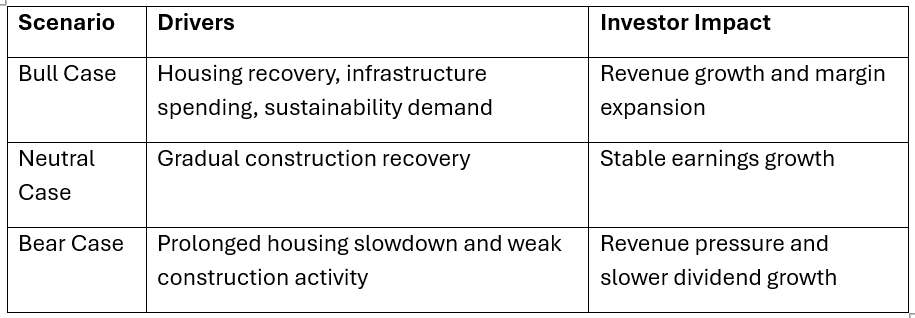
What Are the Key Bull and Bear Scenarios for Marshalls Stock?
Does Marshalls Still Offer an Attractive Dividend Outlook?
Marshalls has historically focused on consistent dividend payments and shareholder returns.
Dividend outlook factors:
- Cash flow generation from diversified product lines
- Capital expenditure requirements
- Construction cycle sensitivity
If construction demand stabilises, the dividend profile could remain attractive for income investors.
What Key Risks Should Investors Monitor?
Major risks include:
- UK housing market downturn
- Energy and raw material price volatility
- Infrastructure project delays
- Construction demand fluctuations
These factors can significantly affect building materials sector profitability.
How Strong Is Marshalls’ ESG Position?
Marshalls has positioned itself as a sustainability leader in the building materials sector.
Key ESG initiatives include:
- Carbon reduction targets
- Ethical stone sourcing
- Recycled material usage
- Water management solutions
These initiatives align with growing ESG investment trends.
What Strategies Could Investors Consider for Marshalls Stock?
Short-term investors
- Monitor housing market indicators
- Track UK construction PMI data
- Watch sector-wide movements
Medium-term investors
- Look for signs of construction demand recovery
- Monitor infrastructure spending announcements
Long-term investors
- Focus on sustainability and infrastructure trends
- Consider dividend growth potential
FAQ – Marshalls Stock
Why did Marshalls stock fall today?
The decline is largely attributed to sector weakness, housing demand uncertainty and broader FTSE 250 volatility.
Is Marshalls a cyclical stock?
Yes. Demand for its products depends heavily on construction activity and housing market conditions.
Does Marshalls pay dividends?
Yes, Marshalls has historically paid regular dividends, making it attractive to income investors.
Is Marshalls exposed to infrastructure spending?
Yes. Its drainage, paving and landscaping products are widely used in infrastructure projects.
Final Investment Conclusion: Is Marshalls Stock Worth Watching After This Drop?
The 4.5% decline in LON:MSLH Marshalls shares on 6 March 2026 reflects broader pressure across the UK construction materials sector rather than a fundamental company crisis.
In the near term, cyclical demand, UK housing market uncertainty and construction industry volatility could keep the stock range-bound.
However, over the longer horizon, infrastructure spending, sustainability trends and urban development demand could provide meaningful growth opportunities.
For investors, Marshalls may remain a cyclical but structurally relevant building materials company, making it a stock worth monitoring as the UK construction cycle evolves through 2026 and beyond.


 Jun 05, 2026




 Please wait processing your request...