
 AU
AU
 CA
CA
 US
US
 NZ
NZ
 IND
IND

 UK
UK

 Share
Share
 X (Formerly Twitter)
 Whatsapp
 Facebook
 LinkedIn
 Telegram
 Email This Article
 Copy Link
 Summarize with AI
 Chat GPT
 Perplexity
The London Stock Exchange has witnessed a dramatic shift over the last half-decade. While the broader FTSE 100 was once mocked for its "old economy" lethargy, a select group of titans has quietly delivered returns exceeding 100%—and in some cases, over 1,000%. As of January 2026, the index has finally breached the psychological 10,000-point barrier, fueled by a resurgence in aerospace, defense, and high-margin industrial services.
Companies like Rolls-Royce, BAE Systems, and 3i Group have not just participated in a market rally; they have fundamentally re-engineered their business models. The central question for 2026 is whether these "high-fliers" are now overextended or if they are entering a second phase of multi-bagger growth.
Key Drivers and Catalysts for Continued Growth

Source: Kalkine Group
The momentum behind the FTSE's top performers is rooted in three distinct global tailwinds that show no signs of abating in 2026.
- The Defense Super-Cycle: Geopolitical tensions, most recently highlighted by the 2026 Venezuela crisis and continued European rearmament, have shifted defense spending from a discretionary item to a mandatory national priority.
- Aerospace Efficiency Gains: The "Rolls-Royce 3.0" strategy is the blueprint for the sector, focusing on high-margin aftermarket services and shedding "onerous" loss-making contracts in favor of profitable uptime agreements.
- Private Equity Compounding: Firms like 3i Group have demonstrated that a single "crown jewel" asset—such as the discount retailer Action—can drive an entire portfolio’s valuation through aggressive European expansion.
Technical Analysis: The 10,000-Point Milestone
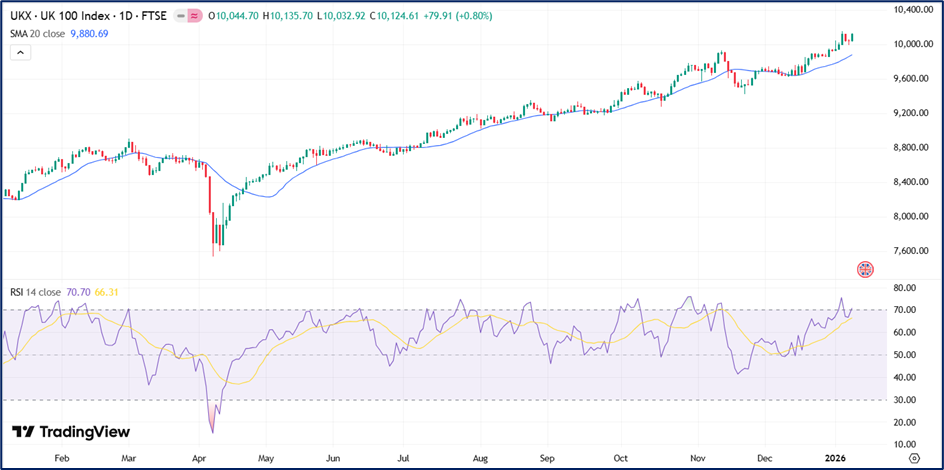
Source: Trading View
From a technical perspective, the FTSE 100 is navigating unchartered territory after closing above 10,000 in early January 2026.
- Momentum Indicators: Most top-tier performers are trading above their 200-day moving averages, though some, like Rolls-Royce, are showing Relative Strength Index (RSI) readings above 78, suggesting "overbought" conditions in the short term.
- Support Levels: The previous all-time highs near 8,500 now serve as a generational support floor. Analysts are looking for a period of consolidation where the "winners" build a base before the next leg up.
- Volume Profile: Trading volume during the January 2026 breakout was significantly higher than the 2025 average, indicating institutional "buying into the breakout" rather than a retail-driven spike.
Latest Business Models and Financial Updates
The business models of these winners have evolved from cyclical to structural growth stories.
- Rolls-Royce (Power Systems & Civil Aero): The model has shifted toward data center backup power. In 2026, their Power Generation segment reported an 85% jump in order intake, pivoting the company from just an engine maker to a critical infrastructure provider for the AI era.
- BAE Systems (Security & Tech): Their focus has moved beyond hardware into "Cyber & Intelligence." Recent financial updates show a record order backlog of over £80 billion, with free cash flow generation exceeding £2.5 billion annually.
- 3i Group (Private Equity): Their latest H1 2026 results showed a 13% total return on opening shareholders' funds. Their primary asset, Action, continues to see double-digit Like-for-Like (LFL) sales growth, funding a massive dividend and buyback program.
Analyst Upgrades and Sentiment Shifts
Market sentiment remains surprisingly bullish despite the high valuations.
- Recent Upgrades: UBS recently hiked price targets for major aerospace players, citing "underappreciated margin expansion" in the civil segments. Goldman Sachs has maintained a "Conviction Buy" on UK financials and miners, viewing them as hedges against sticky global inflation.
- Downgrades: Most downgrades have been "valuation-based" rather than "fundamental-based." Some analysts at JP Morgan have moved to "Neutral" on certain defense stocks, arguing that the 50% increase in US defense spending requested for 2027 is already "baked into the price."
Risks and Vulnerabilities
No investment is without friction, especially after a 100% run-up.
- The "Priced for Perfection" Trap: At record highs, any slight miss in quarterly earnings can lead to a 10-15% "flush-out" as momentum traders exit.
- Regulatory Scrutiny: As defense and infrastructure firms report record profits, the risk of "windfall taxes" or tighter government contract renegotiations increases.
- Macro Reversal: A sudden shift to a low-inflation, low-interest-rate environment would likely favor US tech over the FTSE’s "hard asset" and "cyclical" heavyweights.
Conclusion
The FTSE 100 stocks that generated 100% returns in the last five years have transitioned from being "undervalued" to "fairly valued" or "premium." While the easy money from mean reversion has been made, the structural tailwinds of 2026—global rearmament, the AI power crunch, and private equity consolidation—suggest that these companies are no longer the "boring" stocks of the past. They are the new growth engines of a 10,000-point index.


 Jun 03, 2026




 Please wait processing your request...