
 AU
AU
 CA
CA
 US
US
 NZ
NZ
 IND
IND

 UK
UK

 Share
Share
 X (Formerly Twitter)
 Whatsapp
 Facebook
 LinkedIn
 Telegram
 Email This Article
 Copy Link
 Summarize with AI
 Chat GPT
 Perplexity
Global Markets 2026 Outlook Snapshot
- AI is the new macro engine: Corporate AI capex is set to exceed $500B+ in 2026, driving more US GDP growth than households — a historic shift.
- Global fragmentation - new spending boom in defense, energy grids, robotics, and industrial reshoring.
- Inflation is becoming structural, not cyclical — powered by AI energy demand, commodity scarcity, and supply chain reconstruction.
- Asia is the global tech powerhouse (Taiwan, Korea, Japan, China) while Europe benefits from massive fiscal industrial support.
- UK sectors poised for structural tailwinds: Utilities, defense, energy services, data-centre real estate, industrial automation, and selective high-quality financials.
- Risks: Policy misalignment (too many Fed cuts priced in), valuation stretch, global government debt >$100T, bond-market volatility.
- Portfolio theme for 2026: AI infrastructure + quality credit + Asia tech + commodities + alternatives + selective EM.

1. The New Policy Nexus: Rate Cuts Meet Fiscal Firepower
A Post-Cyclical Cocktail Supercharging Asset Prices
2026 opens with an economic anomaly: large deficits + moderating inflation + rate cuts — outside recession.
- US: Tax rebates from the “One Big Beautiful Bill” add fuel to an already booming wealth effect from stocks & housing.
- Europe: Germany’s sweeping fiscal push (defence, industrial subsidies, infrastructure) aligns EU policy with global industrial nationalism.
- UK: Faces a fiscal squeeze (≈1% of GDP) but this stability opens space for the BoE to cut rates toward ~3%.

Source: Kalkine Group
This mix shifts markets away from “macro fear trades” toward AI-led earnings, data-center capex, and regional divergences.
II. AI Super-Cycle: The Biggest Productivity Shock Since the Internet
AI Capex Has Become the New Global Growth Engine
Mega-cap US tech firms are entering a hyper-investment cycle:
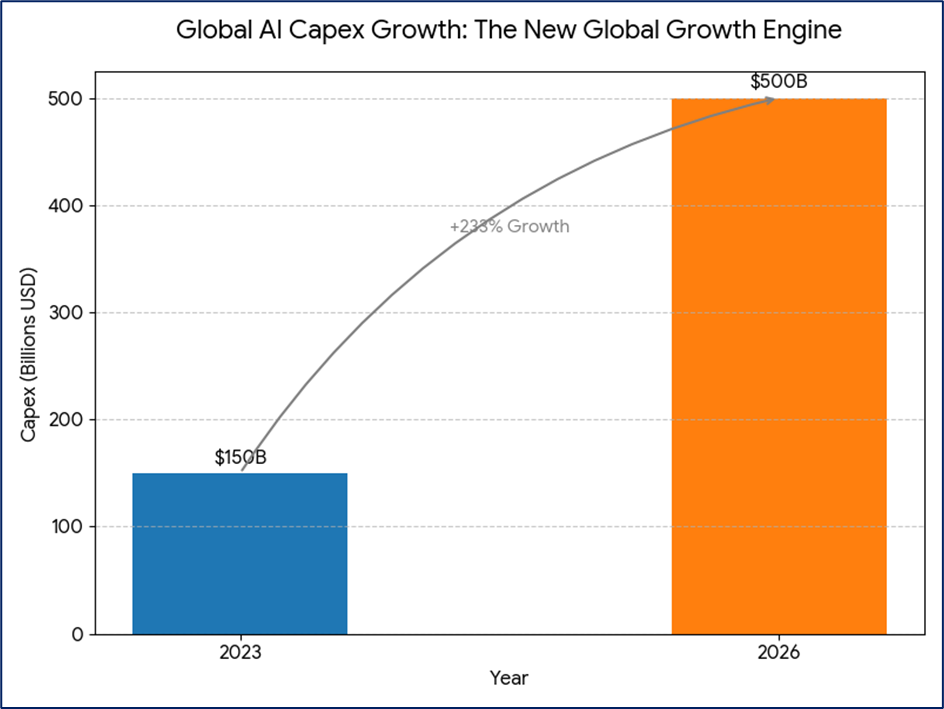
- 2023: ~$150B
- 2026: $500B+ global AI capex
- This is now a GDP driver on par with past consumer booms.
Data Source: Global Reports
Why This Time AI = Structural (Not a Bubble)
- Record profits across US mega-cap tech
- Rapid diffusion across services, manufacturing, finance, and healthcare
- OECD estimates 1–2.5% productivity gains over the decade
- Asia dominating the semiconductor backbone (Taiwan, Korea, Japan)
The Three Layers of AI Value Creation
- Enablers – chips, power grids, cooling systems, data centers
- Intelligence – proprietary models, cybersecurity, data management
- Applications – robotics, fintech, cloud, healthcare automation
The investment implications are now moving beyond Big Tech.
III. Physical AI: Energy, Metals & Infrastructure Become the New Growth Sectors
AI is hitting a physical bottleneck:
- Data centers need 10–30x more power
- Grid investment is lagging
- Copper, lithium, uranium and rare metals remain in structural deficit
Result:
Utilities, Industrials, Energy Services, and Grid Infrastructure become high-growth sectors, not defensive plodders.
Asia Takes the Lead
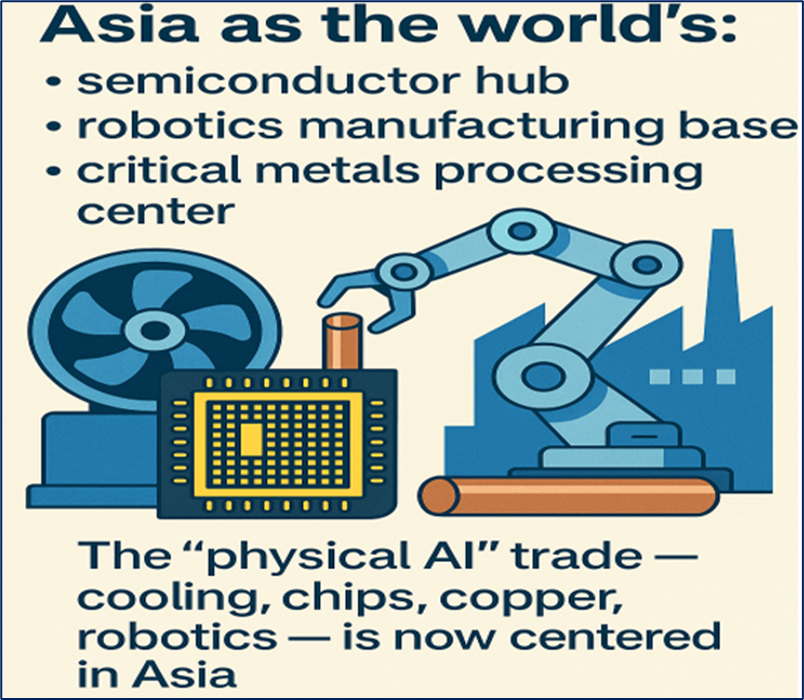
BNP Paribas and UBS point to Asia as the world’s:
- semiconductor hub
- robotics manufacturing base
- critical metals processing center
The “physical AI” trade — cooling, chips, copper, robotics — is now centered in Asia.
Source: Kalkine Group
IV. The Fragmentation Dividend: Geopolitics Is Now an Investment Theme
Strategic Rivalry = Big, Durable Spending Cycles
De-globalization is creating multi-year investment booms in:
- defense & military technology
- energy security
- industrial reshoring
- semiconductor independence
- critical minerals
These are not cyclical — they are government-backed and sticky.
The New Inflation Regime: Scarcity Everywhere
The world has entered:
- energy scarcity
- metal scarcity
- labour scarcity
- political scarcity (instability risk premium)
This makes the 2020–2023 inflation spike structural, not a one-off.
Result: commodities remain a core hedge; bonds lose diversification power.
V. Global Equity Architecture: Leadership, Dispersion & Rotations
US: Exceptionalism Still Intact
2026 S&P 500 targets converge at:
7,400 – 7,800, driven by AI-led earnings (13–15% required).
- Morgan Stanley: 7,800
- JPMorgan: 7,500 (up to 8,000 if Fed cuts more)
- Goldman Sachs: 7,400–7,600
- Bank of America: 7,100 (more energy + defence biased)
But the Rally MUST Broaden or It Breaks
Consensus: US mega-cap concentration risk is too high.
Rotation themes for 2026:
- Financials (valuation reset, balance-sheet resilience)
- Industrials & Utilities (AI power demand)
- Small & Mid-Caps (Goldman, BNP)
Asia = The 2026 High-Conviction Region
Drivers:
- Semiconductor dominance
- Governance reforms (Japan/Korea)
- China’s renewed tech stimulus
- EM benefiting from easing and strong real yields
Asia tech is the structural winner across all institutional reports.
VI. UK 2026: Sectors & Stocks Positioned for Structural Tailwinds
Despite sub-1% growth expectations, the UK market is value-rich and linked to global (not domestic) cycles.
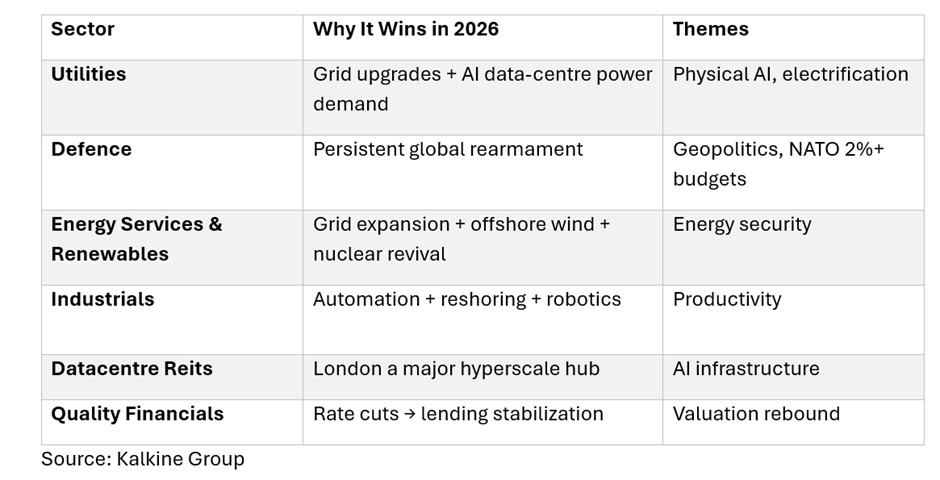
UK Sectors Poised to Benefit
Illustrative UK-Listed Names
- Utilities / Power Infrastructure: National Grid, SSE
- Defense & Security: BAE Systems, QinetiQ
- Energy & Renewables: BP (transition capex), Shell (LNG), Drax (bioenergy/BECCS)
- Industrial Automation: Melrose, IMI, Spirax-Sarco
- Data Infrastructure: Digital 9 Infrastructure (selectively), Greencoat UK Wind
- Banks / Insurers: HSBC, Barclays, Prudential
These align structurally with AI-energy demand, grid reinforcement, global defence capex, and capital-intensive resilience.
VII. Portfolio Resilience & Risk Management
Quality Is King
- Favourable IG credit
- Selective EM local currency (high real yields + USD moderation theme)
- Unfavourable HY due to refinancing risk
Alternatives (The 2026 Safety Net)
- Private credit (M&A recovery → demand)
- Infrastructure (power & digital grids)
- Hedge funds (volatility absorbers)
- Gold (political tail-risk hedge)
Strategic Hedges
- Commodities (inflation hedging)
- USD diversification (EUR/GBP portfolios)
- Tail-risk optionality around policy misalignment
Conclusion: 2026 = The Year of Complex Opportunity
2026 is defined by a triple paradox:
- AI accelerates productivity, but demands massive energy and physical infrastructure.
- Fiscal expansion fuels growth, but embeds inflation and deepens global government debt risks.
- Geopolitical fragmentation creates volatility, but unlocks multi-year spending cycles in defense, energy, robotics, semiconductors and reshoring.
The AI Super-Cycle is powerful enough to lift global equities again — but only if earnings deliver.
The winning strategy for 2026 is not passive exposure. It is:
- Own the AI infrastructure layer, not just the algorithms
- Rotate into Asia tech & UK industrials/defense
- Use quality credit + alternatives for downside protection
- Own commodities to hedge structural scarcity
- Lean into dispersion, not concentration
- The fragmentation paradox is clear: The world is breaking apart — but the investment opportunities are multiplying.


 Jun 24, 2026




 Please wait processing your request...