
 AU
AU
 CA
CA
 US
US
 NZ
NZ
 IND
IND

 UK
UK

 Share
Share
 X (Formerly Twitter)
 Whatsapp
 Facebook
 LinkedIn
 Telegram
 Email This Article
 Copy Link
 Summarize with AI
 Chat GPT
 Perplexity
The London Stock Exchange has seen a turbulent start to 2026, but First Tin PLC (LSE: 1SN) has emerged as a high-conviction outlier. While the broader FTSE indices grapple with global trade volatility, this small-cap tin developer has surged over 23% in the opening weeks of the year. The rally is not merely a "penny stock pump" but rather a fundamental re-rating driven by a rare alignment of massive insider buying, critical mineral scarcity, and the approach of commercial production milestones.
As tin remains a non-negotiable component in the global semiconductor and EV revolution, 1SN is positioning itself as one of the few conflict-free, OECD-based suppliers in a market dominated by unstable jurisdictions.
Key Drivers: The Catalyst Behind the 23% Surge
Source: Kalkine Group
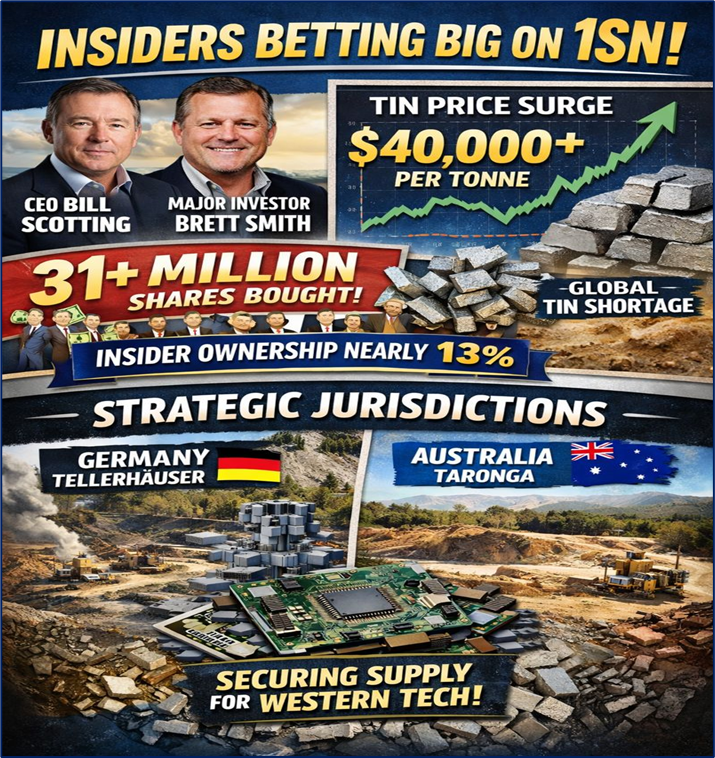
The primary engine behind the January rally is a massive show of insider confidence. In late December 2025 and early January 2026, CEO Bill Scotting and major shareholder Brett Smith executed significant share purchases, signaling to the market that the current valuation significantly discounts the company's "intrinsic" asset value. Beyond the boardroom, the global tin deficit has reached a fever pitch. With Indonesia tightening export licenses and Myanmar’s supply remaining erratic, 1SN’s low-political-risk projects in Germany and Australia are being viewed as "strategic insurance" for Western electronics manufacturers.
- Massive Insider Buying: Directors and major stakeholders recently acquired over 31 million shares, pushing total insider ownership to nearly 13%.
- Tin Price Momentum: Global tin prices have stabilized above $40,000 per tonne, providing a healthy margin over 1SN’s projected all-in sustaining costs (AISC) of ~$15,800.
- Strategic Jurisdiction: Operating in Germany (Tellerhäuser) and Australia (Taronga) allows the company to bypass the "conflict mineral" stigma and benefit from streamlined Western permitting.
Current Technical Analysis: The 13.50p Resistance
Source: Trading View
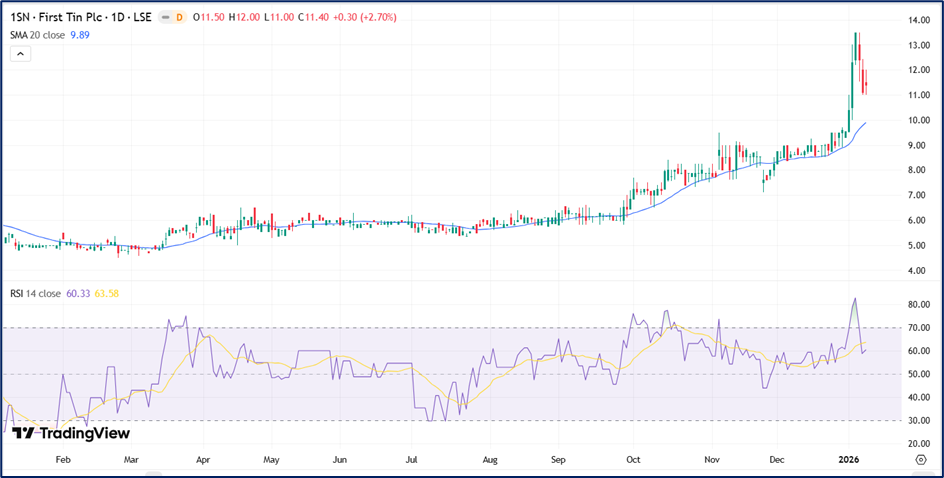
From a technical perspective, 1SN has broken out of a long-term consolidation wedge that defined much of 2025. The stock recently tagged a 52-week high of 13.50p, which now acts as the immediate psychological resistance level. The 50-day moving average (8.65p) has crossed sharply above the 200-day moving average (7.10p), forming a "Golden Cross" on the daily chart—a classic bullish indicator. However, the Relative Strength Index (RSI) is currently hovering near 61, suggesting the stock is in overbought territory and may require a brief period of "cooling off" or a minor pullback to the 11.50p support zone before another leg up.
- Key Support: 11.40p – 11.50p (Previous resistance turned support).
- Major Resistance: 13.50p (The current 52-week ceiling).
- Moving Averages: Bullish alignment with the price trading well above the 50-day and 200-day MA.
Latest Analyst Upgrades and Consensus
The analyst community has shifted from "Wait and See" to a "Strong Buy" consensus as of January 2026. Investment bank SP Angel and other boutique research houses have highlighted the company’s transition from an explorer to a developer. The consensus price target currently sits at 20.00p, representing a potential upside of nearly 75% from current levels. Analysts cite the de-risking of the Taronga project in Australia as the primary reason for the upgrades, noting that the Environmental Impact Statement (EIS) milestones have been met with higher-than-expected efficiency.
- Consensus Rating: Strong Buy (100% of covering analysts).
- Average Price Target: 20.00p.
- Catalyst Focus: Analysts are closely watching the "Permit to Mine" approvals expected mid-2026.
Latest Business Model & Operational Updates
First Tin’s business model is centered on a "Hub and Spoke" production strategy, aiming to become a top-five global tin producer outside of China and Indonesia. The company focuses on low-CAPEX, open-pit, or existing-infrastructure mines to ensure rapid time-to-market. The latest operational update confirmed that the Taronga Project is on track for first production in late 2027. In Germany, the Tellerhäuser project is being optimized not just for tin, but as a multi-mineral play, with plans to extract gallium and indium—critical materials for the 2026 AI hardware boom.
- Taronga (Australia): Completed the EIS and secured local council agreements for site infrastructure; low-risk open-pit mining plan.
- Tellerhäuser (Germany): Submission of the "Life of Mine" plan; strategic focus on "ESG-compliant" tin for European carmakers.
- Cash Position: Bolstered by a £10M+ raise in late 2025, leaving the firm with roughly £6.37M in cash to fund 2026 permitting and DFS work.
Financial Health & Key Risks
While the balance sheet is currently debt-free, the financial reality of 1SN is that of a pre-revenue mining firm. The company reported a comprehensive loss of £2.93M for FY2025, which, while an improvement over the previous year, highlights the ongoing burn rate. The primary risk remains financing for construction. Moving from the "permitting" stage to "digging" requires hundreds of millions in capital. If the equity markets sour, 1SN may face share dilution. Additionally, the German permitting process is notoriously slow, and any bureaucratic delay could push the 2027 production target into 2029 or beyond.
- Funding Risk: High CAPEX requirements for mine construction could lead to further equity dilution.
- Regulatory Hurdles: Potential delays in German environmental approvals.
- Commodity Volatility: A sudden drop in global tin prices would directly impact the Net Present Value (NPV) of their assets.
Conclusion
First Tin (1SN) is currently the poster child for the "Critical Minerals" trade on the London market. Its 23% January gain reflects a market finally pricing in the scarcity of non-Asian tin supply and the massive conviction shown by the company's leadership. While technical indicators suggest a short-term breather might be healthy, the fundamental path toward a 20p target appears anchored in tangible project milestones and a robust commodity macro environment. For the retail investor, 1SN represents a high-reward, high-volatility play on the very metals that make modern technology possible.


 Jun 03, 2026




 Please wait processing your request...